

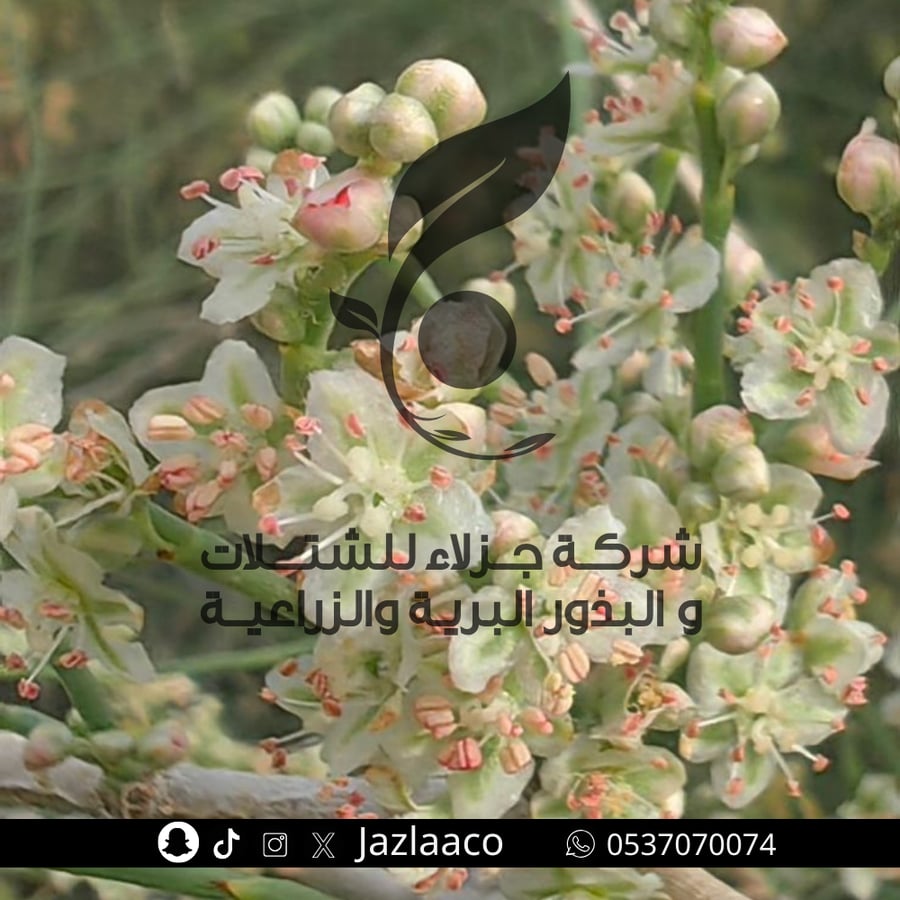

Arta - Abel - Calligonum comosum
9.50ر.س
Product description
Calligonum comosum is a perennial desert shrub from the Polygonaceae family. It is one of the most important sand shrubs in the Arabian Peninsula and is characterized by its high ability to withstand drought, heat, wind and living in sand dunes.
General Description
It grows as a dense, highly branched shrub, typically reaching a height of 1–3 meters, with branches extending even further. It is very well suited to sandy environments and shifting dunes, as its roots and branches help to stabilize the sand.
bark and stem
Older stems are woody, and the bark ranges in color from gray to grayish-brown, becoming rougher and more fissured with age. Younger branches are green and slender, performing a large part of photosynthesis, while the leaves are very reduced.
Papers
The leaves are very small and reduced, and they fall off early, so the green branches appear to be the main part of the plant responsible for photosynthesis. The reduction in leaves also helps to greatly decrease water loss.
flowers
Small, relatively fragrant flowers, ranging in color from white to pink or greenish, appear abundantly on the branches during the flowering season. These flowers are a distinctive feature of the plant's appearance in spring.
Fruits and seeds
It produces very distinctive fruits, which are winged or covered with hairs and feathery appendages that help them move with the wind and sand. The fruits turn brown or yellow when ripe and contain the seed inside.
Endurance and suitability
It is one of the plants most adapted to sandy environments; it tolerates drought, heat, wind, and even being partially buried in sand. It also possesses a strong root system that helps access moisture, stabilize dunes, and reduce sand encroachment.
Uses
It is of great importance in stabilizing sand dunes and combating desertification. It is also an important grazing plant in some areas, benefiting wild and grazing animals. Furthermore, it has multiple traditional uses in some parts of the Arabian Peninsula.
natural spread
Calligonum comosum is widespread in large areas of the Arabian Peninsula, as well as parts of North Africa and the Middle East, and is particularly associated with sand dunes, sandy plains and desert areas.
Preservation status
It is not known to be globally threatened with extinction, but habitat degradation, overgrazing and vehicle traffic within the dunes may affect its natural populations.
