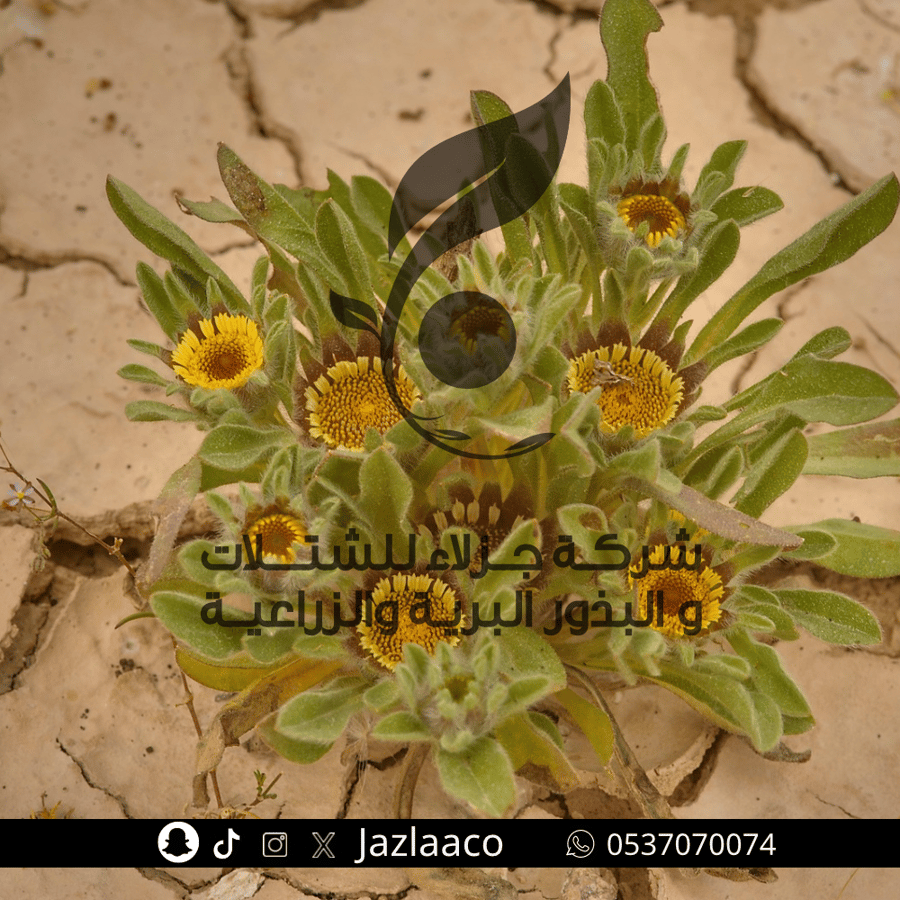

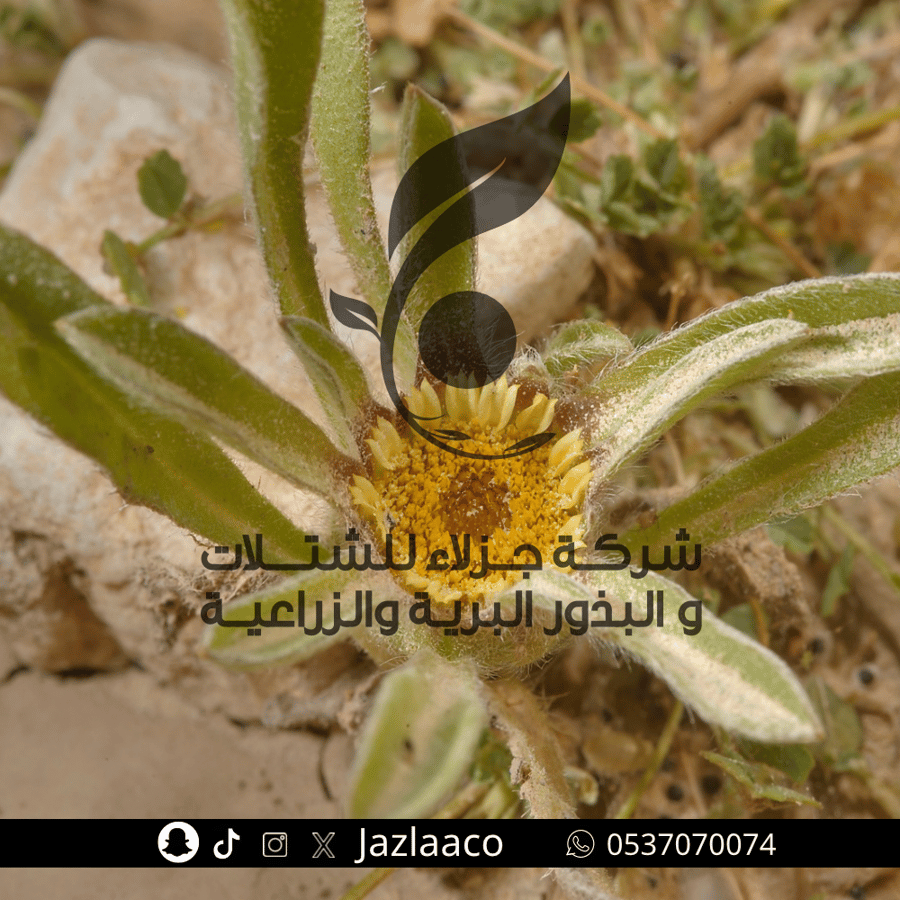
Pallenis hierochuntica
9.50ر.س
Product description
Pallenis hierochuntica is an annual herbaceous plant from the Asteraceae family. It is a seasonal desert plant that appears after rainfall and is characterized by its bright yellow flowers and its ability to complete its life cycle in a short period.
General Description
It grows as a small, upright or spreading herbaceous plant, usually reaching a height of about 10–30 cm. The stems branch out from the base, and the plant may be covered with fine hairs that give it a relatively rough texture.
Papers
The leaves are simple and alternate, green to gray-green, ovate or lanceolate, and may be covered with fine hairs. The lower leaves are larger, becoming smaller towards the tips of the branches.
flowers
It produces bright yellow flower heads that appear singly at the ends of the stems. The heads consist of yellow ray florets surrounding the central disc and are most prominent during the flowering season.
Fruits and seeds
It produces small, dry spores, surrounded by structures that aid in their dispersal. After the flower head dries, the seeds are released and can remain in the soil until rainfall provides suitable conditions for germination in the following season.
Endurance and suitability
It is adapted to drought and heat, and has a rapid life cycle that allows it to take advantage of seasonal rains. It grows in sandy and gravelly soils, and in plains and open desert areas.
Uses
It has ecological importance as a seasonal wild plant, providing a source of nectar and pollen for some insects and pollinators, and it also contributes to the diversity of desert vegetation.
natural spread
Pallenis hierochuntica is widespread in North Africa, the Middle East and the Arabian Peninsula, and is associated with desert, semi-desert, plains and sandy and gravelly environments.
Preservation status
Pallenis hierochuntica is not known to be globally threatened with extinction, and its density varies greatly from season to season depending on the amount of rainfall and climatic conditions.