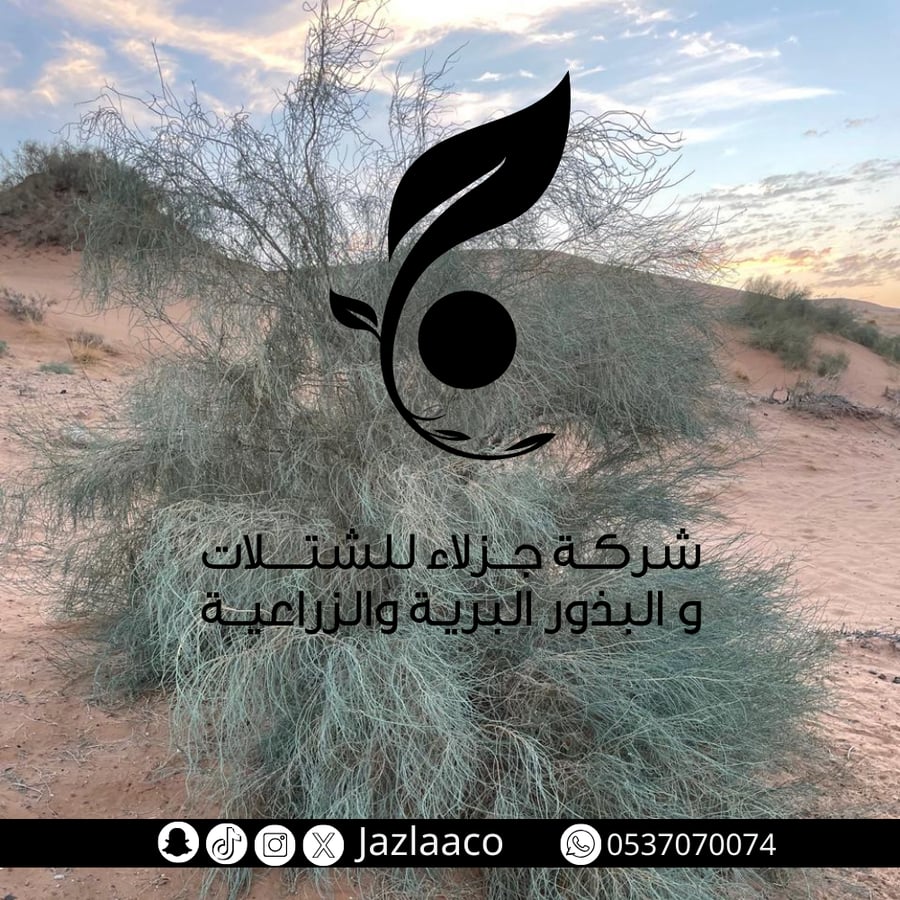

Ghada - Haloxylon ammodendron
9.50ر.س
Product description
Haloxylon ammodendron is a perennial desert tree or shrub of the Amaranthaceae family. It is a plant highly adapted to drought, heat, wind, and shifting sands, and is considered an important plant in sandy desert environments.
General Description
The ghaf tree grows as a small tree or a large, highly branched shrub, typically reaching a height of 2–5 meters, and possibly more under suitable conditions. The crown is relatively dense, with thin, green branches forming the bulk of the foliage.
bark and stem
The main stem is woody and strong; the bark of older parts is gray to grayish-brown and may become rough and cracked with age. Newer branches are green and slender, and contribute primarily to photosynthesis due to the reduction in leaves.
Papers
The leaves are very small, scale-like, and closely spaced on the branches. The green branches play the main role in photosynthesis, reducing water loss and helping the plant withstand severe drought.
flowers
The flowers are very small and inconspicuous, green to yellow-green, and appear at the nodes of the branches. They do not have bright colors or large petals.
Fruits and seeds
It produces small, dry fruits, and the structures surrounding the fruit are characterized by membranous extensions or wings that aid in wind dispersal. The fruits ripen after flowering and turn shades of brown or pale yellow.
Endurance and suitability
The ghaf tree possesses a high tolerance for drought, heat, wind, and shifting sands, and can even withstand being partially buried in sand. Its strong and deep root system helps it access moisture and stabilize the sand.
Uses
It is of great importance in stabilizing sand dunes, reducing sand encroachment, and combating desertification. It also provides cover and shelter for wildlife and has grazing value in some desert environments. Its wood is traditionally known for its use as firewood and charcoal.
natural spread
Haloxylon ammodendron is mainly found in the sandy desert regions of Central Asia, China, Iran and neighboring areas, and is associated with dunes, sandy plains and extremely arid environments.
Preservation status
Its status varies locally depending on the region, and its populations may be affected by grazing, logging, habitat degradation, sand movement, and human activities. Its conservation is important for the stability of sandy ecosystems.
