

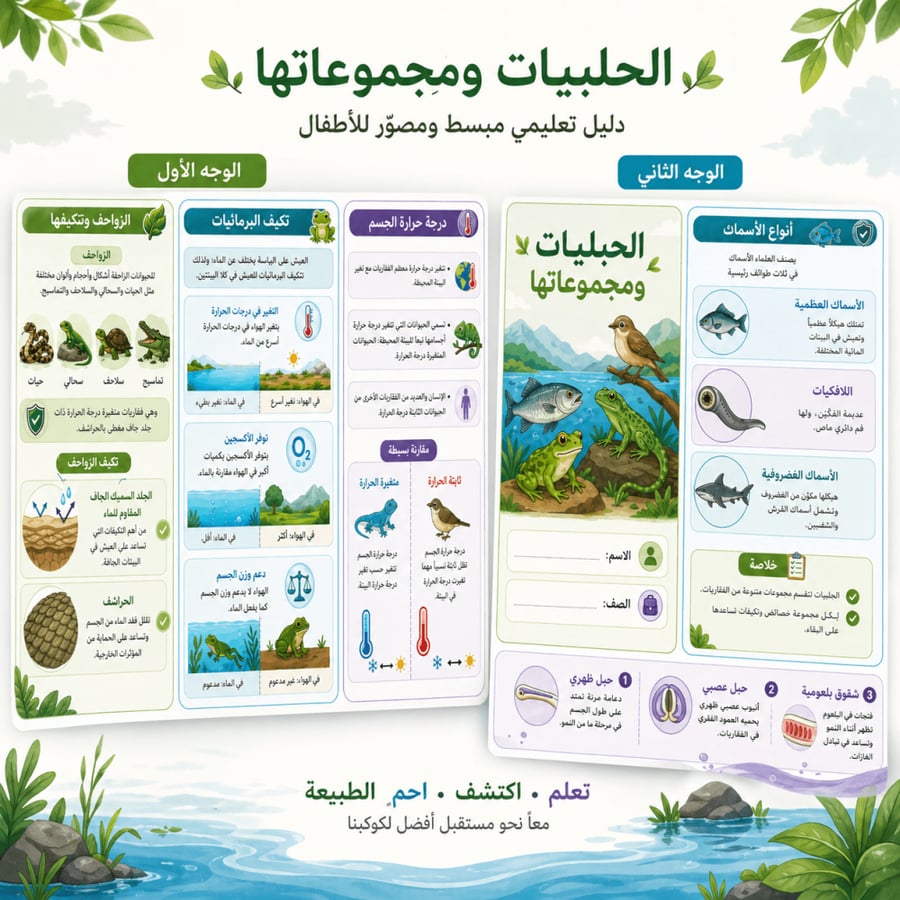
Brochure of the spines and their collections
11ر.س
18ر.س-39%Product description
Pamphlet of chordates and their groups
Introduction
Chordates are a group of living organisms that share distinctive characteristics, making them unique and interesting to study. This pamphlet provides you with a comprehensive overview of the world of chordates, from their diverse types and amazing adaptations to their main groups and how they are organized.
Chordates: An Overview
Chordates are characterized by the presence of four main features at some stage of their life cycle, including:
- Notochord: a flexible structure that runs along the body and provides support.
- Dorsal hollow nerve cord: located above the notochord and responsible for transmitting nerve signals.
- Pharyngeal slits: found in the pharyngeal region, with functions varying among different groups.
- Post-anal tail: located behind the anus.
These features appear clearly in early stages of chordate life and may disappear or change in later stages.
Body temperature: an adaptation key
Chordates vary greatly in their ability to regulate body temperature:
- Cold-blooded animals (ectothermic): rely on external sources to regulate their body heat. Their body temperature is directly affected by the surrounding environment. This group includes fish, amphibians, and reptiles.
- Warm-blooded animals (endothermic): have the ability to maintain a relatively constant body temperature regardless of external environmental changes. This group includes birds and mammals.
Understanding body temperature is vital to understanding how these organisms survive and reproduce in their different environments.
Types of fish
Fish are classified within chordates, a diverse group that includes many species living in freshwater and saltwater. Fish are characterized by having gills for breathing, fins for movement, and scales for protection. They vary in shape, size, and behavior, reflecting their different adaptations to various aquatic environments.
Amphibian adaptations
Amphibians, such as frogs and salamanders, are another group of chordates capable of living in two environments: water and land. They breathe through gills during their larval stages, then develop lungs and skin that allow them to breathe on land. Their moist skin helps absorb oxygen and maintain body moisture, making them sensitive to environmental pollution.
Branches of chordate groups
Chordates are divided into main groups based on their evolutionary features, including:
- Fish: the largest and most diverse group, including cartilaginous and bony fish.
- Amphibians: dual-life chordates adapted to living in water and on land.
- Reptiles: creeping chordates characterized by dry skin, scales, and egg-laying reproduction.
- Birds: chordates that evolved to include feathers and wings, and are warm-blooded.
- Mammals: chordates characterized by the presence of mammary glands and hair, and are warm-blooded.
Each of these groups has unique adaptations that allow them to thrive in different environments.

From Riyadh
Questions you might have