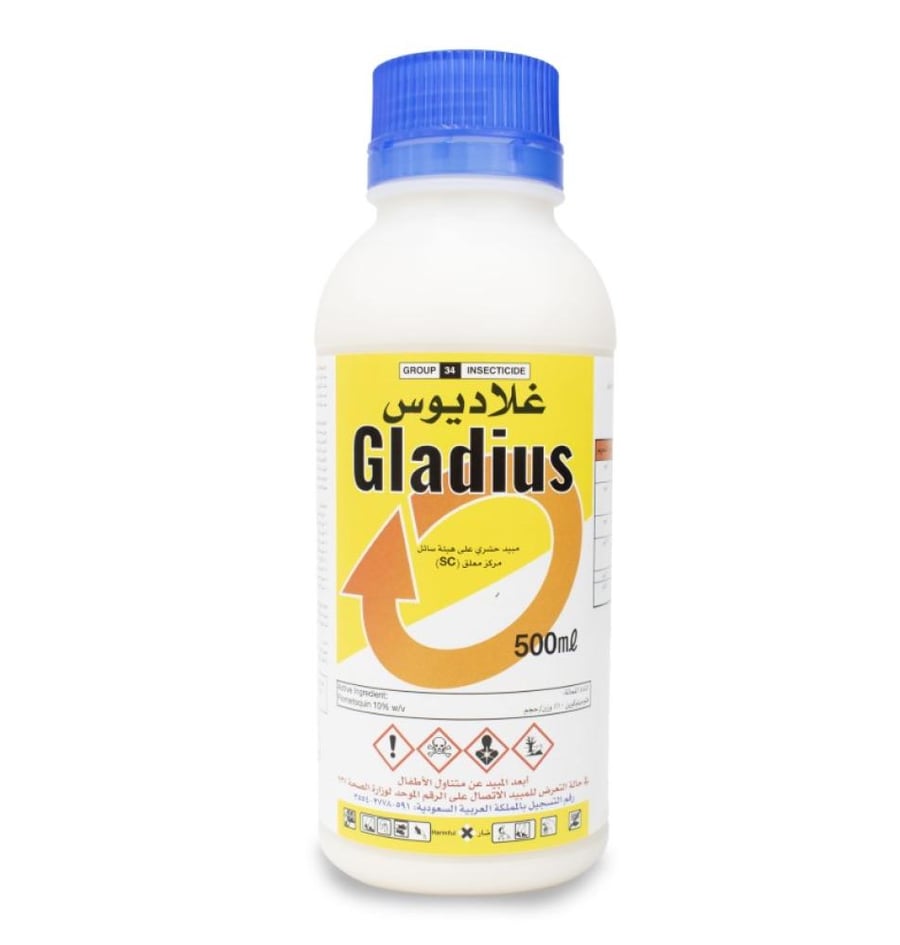


Gladiolus SC insecticide non-systemic for controlling whitefly and thrips 500 ml
319ر.س
Product description
Gladiolus SC non-systemic insecticide for whitefly and thrips 500 ml
Gladiolus SC insecticide contains the active ingredient Flumethrin at 10%, and comes in a concentrated suspension formulation SC. It is used to help control a range of important pest insects such as whitefly, thrips, moth, and almond bolder, which are pests that affect plant growth and crop quality if not managed in time. Gladiolus is characterized by its contact effect against target pests, with good ability for partial translocation within plant tissues, helping to provide protective and curative protection when used according to label instructions. It is suitable for use in vegetables, fruits, cotton, and some other crops within integrated pest management programs.
Non-systemic insecticide for whitefly and thrips
Gladiolus 10% SC relies on Flumethrin, an active ingredient used to control insects that cause direct damage to leaves, new growth, and fruits. The importance of the product is especially evident in controlling whitefly and thrips, which are pests that can spread quickly in vegetables, protected houses, and open farms when conditions are favorable. The product helps reduce pest activity when applied with good coverage, especially on the undersides of leaves and new growth areas, with the importance of using it within a pesticide rotation program to reduce resistance development.
Gladiolus SC specifications
Trade name: Gladiolus 10% SC
Product type: Non-systemic insecticide
Active ingredient: Flumethrin
Active ingredient concentration: 10%
Formulation type: Concentrated suspension SC
Mode of action: Contact with internal translocation within plant tissues
Scent: Not specified
Target pests: Whitefly, thrips, moth, almond bolder
Suitable crops: Vegetables, fruits, cotton, citrus, and some other crops as per label
Country of origin: Japan
Package size: 500 ml
Features of Gladiolus insecticide for whitefly
Helps in controlling whitefly, thrips, and targeted insect pests.
Works by contact against visible insects on the plant.
Suitable for use on most crops according to label recommendations.
Features an easy-to-prepare and spray concentrated suspension SC formulation.
Does not leave visible residues when used correctly.
Can be used within modern agricultural systems and integrated control programs.
Helps provide plant protection when used early and at the correct dose.
Suitable for prevention and intervention at the onset of infestation depending on crop and pest type.
Uses of Gladiolus 10% SC in pest control
Used within pest control programs targeting insects that spread on leaves and new growth, especially pests causing weak growth, leaf deformities, or fruit quality decline. Its importance increases when used at the beginning of infestation, as early intervention helps limit pest spread before population levels increase.
Main uses include:
- Controlling whitefly on tomatoes, peppers, and eggplants.
- Controlling whitefly on watermelon, cucumber, and zucchini.
- Controlling thrips on strawberries and citrus.
- Assisting in controlling diamondback moth in squash.
- Controlling almond bolder in cotton according to label instructions.
- Used within integrated pest control programs for vegetables and fruits.
You can browse similar products through the agricultural pesticides section or go to the agricultural insecticides section to select suitable pesticides based on pest type and crop.
Method of using Gladiolus SC
Use Gladiolus according to crop type and target pest, with a mandatory reading of the product label before preparation and spraying. According to product data, the recommended doses are:
- Vegetables such as tomatoes, peppers, and eggplants: against whitefly at 100 ml per 100 liters of water, with a pre-harvest interval of one day.
- Watermelon, cucumber, and zucchini: against whitefly at 50 to 100 ml per 100 liters of water, with a pre-harvest interval of one day.
- Strawberries: against thrips at 100 ml per 100 liters of water, with a pre-harvest interval of 3 days.
- Squash: against diamondback moth at 100 to 150 ml per 100 liters of water, with a pre-harvest interval of 3 days.
- Cotton: against almond bolder at 100 to 150 ml per 100 liters of water, with a pre-harvest interval of 4 days.
- Citrus: against thrips at 25 to 50 ml per 100 liters of water, and against citrus rust mite at 50 to 75 ml per 100 liters of water, with a pre-harvest interval of 7 days.
Spray the solution well on the plant, focusing on the undersides of leaves and pest gathering areas. To improve coverage quality, use an appropriate hand sprayer from the section of manual agricultural sprayers, or browse the section of sprayers, fertilizers, and pesticides.
Best timing to use Gladiolus
It is preferable to use Gladiolus when infestation first appears, especially when whitefly or thrips are observed on new leaves or the undersides of leaves. Also, spraying is recommended early in the morning or before sunset to avoid high temperatures and improve the persistence of the spray solution on the plant. Do not wait until infestation becomes severe, as whitefly and thrips are fast-spreading pests, and control may become more difficult with delayed intervention or poor coverage.
Pre-harvest interval
The pre-harvest interval varies depending on the crop, and according to product data, it is as follows:
- Tomatoes, peppers, eggplants, watermelon, cucumber, and zucchini: one day.
- Strawberries and squash: 3 days.
- Cotton: 4 days.
- Citrus: 7 days.
Adhere to the pre-harvest interval indicated on the product label for each crop and do not harvest before it ends.
Precautions for using Gladiolus insecticide
- Do not enter the field until 12 hours after treatment.
- Read the entire product label before preparation and use.
- Wear gloves, mask, and protective gear during spraying.
- Do not mix with oils or growth regulators.
- Do not mix with alkaline pesticides or copper compounds.
- Avoid contact of the solution with skin or eyes.
- Do not eat, drink, or smoke during use.
- Wash hands and face thoroughly after spraying.
- Keep away from children, animals, food, and fodder.
- Do not reuse empty containers for other purposes.
- Follow the dosage and pre-harvest interval according to crop.
Resistance management when using Gladiolus 10% SC
To maintain the effectiveness of Gladiolus, do not rely on it alone throughout the season. It is best used as part of an integrated control program based on rotating pesticides from different groups, early pest monitoring, improving spray quality, and removing sources of infestation as much as possible. Crop rotation is especially important with pests like whitefly and thrips, as they can reproduce rapidly and develop resistance if the same active ingredient or mode of action is used repeatedly.
Frequently asked questions about Gladiolus SC
Is Gladiolus suitable for controlling whitefly? Yes, Gladiolus helps in controlling whitefly on several crops such as tomatoes, peppers, eggplants, cucumbers, and zucchini when used according to the specified dose and pre-harvest interval.
Does Gladiolus control thrips? Yes, Gladiolus is used to assist in controlling thrips, especially in strawberries and citrus according to the doses mentioned on the label.
Is Gladiolus an systemic insecticide? Gladiolus is classified as a non-systemic insecticide, and it works mainly by contact, with some translocation within plant tissues according to product data.
What is the active ingredient in Gladiolus? Gladiolus contains Flumethrin at 10%.
Can Gladiolus be mixed with agricultural oils? It is not recommended to mix it with oils or growth regulators, and it should not be mixed with alkaline pesticides or copper compounds according to usage precautions.
What is the pre-harvest interval for Gladiolus? It varies depending on the crop; one day for some vegetables, 3 days for strawberries and squash, 4 days for cotton, and 7 days for citrus.
Gladiolus SC for whitefly and thrips
Gladiolus SC is a suitable option within programs controlling whitefly, thrips, and some other insect pests in vegetables, fruits, and cotton. For best results, it should be used at the beginning of infestation, with good plant coverage, adherence to the dose and pre-harvest interval, and rotation with other pesticides to reduce resistance risks.
You can browse more pest control solutions and spraying supplies through the Saudi Seeds store and choose the appropriate product based on pest type and crop.
Acaris 50 EC acaricide for mites and tunnel makers 1 liter

From Jeddah