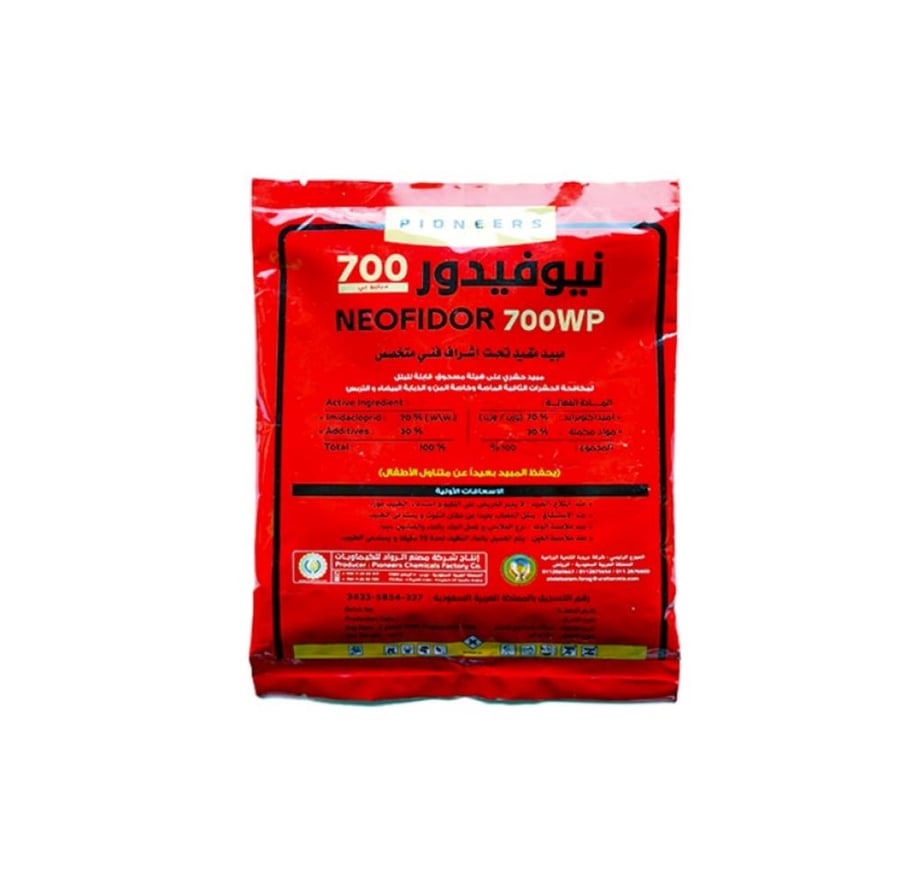

Newfidor 700 watt insecticide for control of scale, whitefly, and thrips 100 grams
49ر.س
Out of Stock
Product description
Neofidor 700 WP insecticide for combating green aphids, whiteflies, and Tetranychus 100 grams
Neofidor 700 WP
Neofidor 700 WP
Insecticide agricultural product in the form of a wettable powder WP, containing the active substance Imidacloprid at 70%, used to assist in controlling piercing-sucking insects such as aphids, whiteflies, Tetranychus, leafhoppers, and some pests that affect vegetables, ornamental plants, and various crops when used according to the instructions on the label.
The product is characterized by its high concentration and ease of mixing with water, and can be used as a spray on the foliage or watering through the root system depending on the crop type, pest, and recommended method of application.
It is suitable within integrated pest management programs, especially in greenhouses and crops affected by insect vectors of viral diseases such as whitefly on tomatoes.
Description of Neofidor 700 WP
Neofidor 700 WP is from the group of neonicotinoid insecticides, known for their effect on the nervous system of insects.
The product works by contact and ingestion, and helps control pests that feed on plant sap such as aphids, whiteflies, and Tetranychus, which cause weak growth, leaf deformities, and can transmit some viral diseases between plants.
This type of insecticide requires precise use, as the success of treatment depends not only on the potency of the active ingredient but also on the timing of spraying, plant coverage, severity of infestation, pest type, and crop sensitivity.
It is also important not to repeatedly use the same chemical group consecutively to reduce the likelihood of pests developing resistance.
Product specifications
Name: Neofidor 700 WP insecticide for combating green aphids, whiteflies, and Tetranychus 100 grams
English name: Neofidor 700 WP
Product type: agricultural insecticide
Composition: WP wettable powder
Active ingredient: Imidacloprid
Active ingredient concentration: 70%
Weight: 100 grams
Mode of action: contact and ingestion
Chemical group: Neonicotinoid
Use: control of aphids, whiteflies, Tetranychus, leafhoppers, leaf miners, some scale insects depending on the crop and instructions on the label
Application methods: spray on foliage or watering through the root system according to recommendations
Uses: vegetables, greenhouses, ornamental plants, fruit trees, grains, and some crops according to technical recommendations and the label
Features of Neofidor 700 WP
Contains Imidacloprid at a high concentration of 70%.
Suitable for controlling piercing-sucking insects such as aphids, whiteflies, and Tetranychus.
Helps reduce activity of pests that transmit some viral diseases between plants.
Can be used as a spray on the foliage or watering as per agricultural recommendation.
Wettable powder formulation mixed with water before use.
Suitable for vegetables in greenhouses, some ornamental plants, and crops.
Works by contact and ingestion.
Suitable within integrated pest management programs when rotated with insecticides from different groups.
100-gram package suitable for specific agricultural treatments.
Target pests
Neofidor 700 WP is used to help control a range of agricultural pests, including:
- Aphids
- Whiteflies
- Tetranychus
- Leafhoppers
- Leaf miners
- Some scale insects depending on the crop
- Some piercing-sucking pests that affect vegetables and ornamental plants
It is not recommended to use it randomly for all types of insects; pests should be identified first, then the appropriate dose and application method should be chosen according to the label.
Suitable crops for use
Based on available data, Neofidor can be used on several crops such as:
- Vegetables in greenhouses
- Tomatoes
- Peppers
- Potatoes
- Beans
- Eggplants
- Cucurbits
- Ornamental plants in greenhouses
- Some fruit trees and grains according to technical recommendations and the label
Before using the product on any sensitive crop or new variety, it is preferable to conduct a limited trial on a small part of the plant and observe it before widespread spraying.
Recommended application rates
For vegetables in greenhouses such as peppers, tomatoes, potatoes, beans, eggplants, and cucurbits, the product is used to control aphids, leafhoppers, Tetranychus, and leaf miners at approximately:
15 to 25 grams per 100 liters of water
For whitefly control, approximately:
20 to 40 grams per 100 liters of water
For ornamental plants in greenhouses when controlling aphids, whiteflies, and scale insects, approximately:
35 to 40 grams per 100 liters of water
These are approximate guidelines based on product data; the label should be considered the final reference before application, especially regarding the crop, safety period, and number of sprays.
Safety period
For some crops in greenhouses, a safety period of 7 days is mentioned for certain uses. However, the safety period may vary depending on the crop, pest, and application method, so the label should be checked before harvest and not rely on a single figure for all crops.
Usage method
Identify the pest, crop, and stage of infestation before preparation.
Fill the sprayer with an appropriate amount of water.
Add the required amount of Neofidor according to the usage rate.
Mix the solution well until the wettable powder dissolves in the water.
Spray the solution on the foliage, ensuring good coverage of the leaf surfaces, especially the underside where whiteflies and Tetranychus are usually found.
It can be used as a root drench if clear instructions on the label or from a specialist are available.
Avoid spraying during high temperatures or strong winds.
Preferably spray early in the morning or late in the afternoon.
Do not mix with other pesticides or fertilizers unless compatibility is confirmed.
Tips for best results
Inspect plants carefully before spraying and identify the infestation site.
Focus on the underside of leaves when controlling whiteflies and aphids.
Do not wait until the infestation becomes very severe; early intervention yields better results.
Avoid repeatedly using Imidacloprid alone in every treatment.
Rotate with insecticides from different chemical groups within a resistance management program.
Do not spray during flowering or when pollinators are active unless the label permits and clear precautions are taken.
Test the product on a small part of ornamental plants before full spraying, as some varieties may be sensitive.
Observe the pre-harvest safety period.
Do not increase the dose arbitrarily; a high dose may harm the plant and does not always produce better results.
Use a suitable sprayer that provides uniform coverage without wastage.
Precautions for use
Neofidor 700 WP is a concentrated insecticide and must be used carefully.
Use under the supervision of a qualified technician or person trained in handling agricultural pesticides.
Read the entire product label before use.
Wear gloves, a mask, and protective glasses during preparation and spraying.
Avoid inhaling the powder or spray mist.
Do not eat, drink, or smoke during preparation or application.
Do not spray on people or animals.
Do not use near drinking water sources or fish ponds.
Avoid contact of the insecticide with bees and pollinators as much as possible.
Keep the product away from children, food, and feed.
Wash hands and tools thoroughly after use.
In case of accidental exposure or abnormal symptoms, seek medical help immediately and show the product container or label.
Difference between Neofidor and contact insecticides
Some insecticides work by contact only, requiring direct insect contact or coverage of the area where the insect moves.
Neofidor, based on Imidacloprid, is used against sap-sucking pests and can be applied as a spray or watering according to recommendations.
This makes it suitable for some integrated control programs for aphids, whiteflies, and Tetranychus, but it is not a substitute for all insecticides or all insect types.
It is best used within an integrated program that includes inspection, removal of infested leaves if needed, sticky traps for monitoring whiteflies, rotation of insecticides, and improving ventilation in greenhouses.
Related sections
You can browse similar products in the insecticides and pest control section, as well as the agricultural sprayers and sprayers section to choose appropriate application tools.
For crops and greenhouses, refer to the seeds or fertilizers section within an integrated crop care program.
Frequently Asked Questions
What is Neofidor 700 WP?
Neofidor 700 WP is an agricultural insecticide in the form of a wettable powder containing 70% Imidacloprid, used to control some piercing-sucking insects such as aphids, whiteflies, and Tetranychus.
What is the active ingredient?
The active ingredient is Imidacloprid at 70%.
What is the package size?
The package size is 100 grams.
Is it used for whitefly?
Yes, it is used to control whiteflies on some crops at approximately 20 to 40 grams per 100 liters of water according to product data and label instructions.
Is it used for aphids and Tetranychus?
Yes, it is used to control aphids, Tetranychus, leafhoppers, and leaf miners on some vegetables at approximately 15 to 25 grams per 100 liters of water.
Is it suitable for ornamental plants?
It can be used on ornamental plants in greenhouses according to the provided data, but the product should be tested on a small part first as some ornamental varieties may be sensitive.
Can it be mixed with other pesticides?
Mixing is not recommended unless compatibility is confirmed and according to label instructions; consulting a specialist before mixing is advised.
Is there a pre-harvest safety period?
Yes, a safety period of 7 days is indicated for some uses in protected vegetables, but it may vary depending on the crop, pest, and application method; check the label before harvest.
Summary of the product
Neofidor 700 WP insecticide for controlling aphids, whiteflies, and Tetranychus at 100 grams is a concentrated agricultural insecticide containing 70% Imidacloprid, used to help control piercing-sucking insects on vegetables, ornamental plants, and some crops.
Suitable for foliar spraying or watering according to label instructions, it provides the best results when used as part of an integrated pest management program with crop rotation and avoiding repeated use of the same chemical group.
Use with caution and under expert supervision, adhering to recommended doses and safety periods before harvest.

From Jeddah