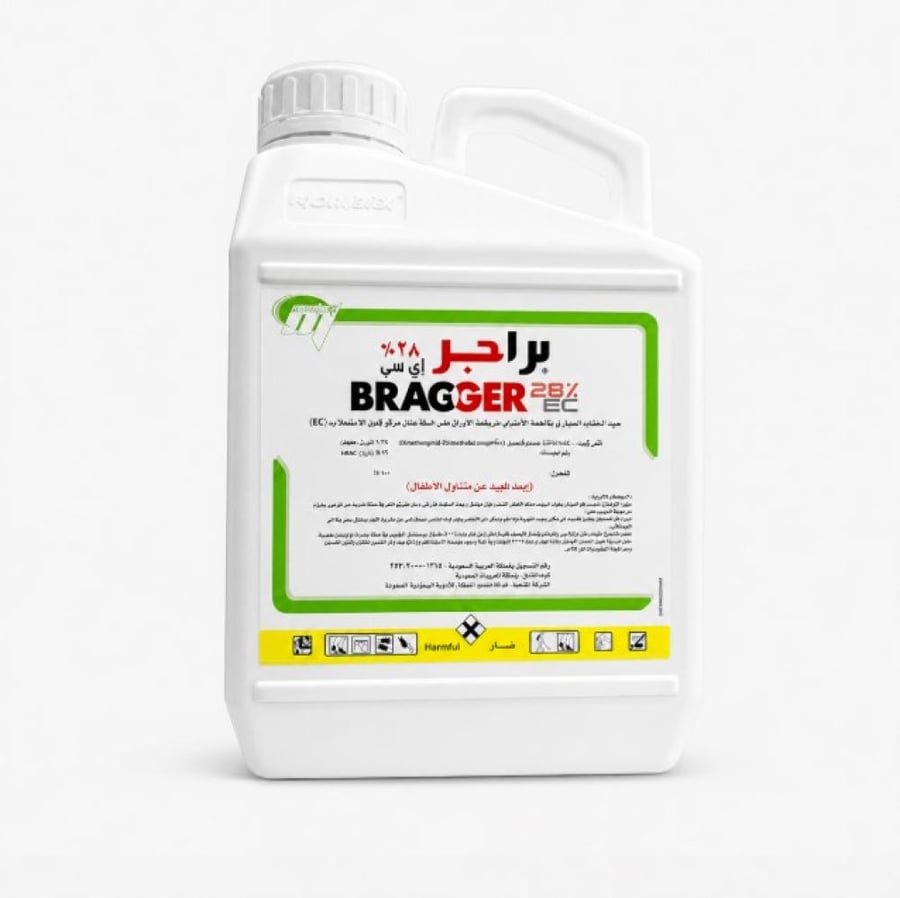
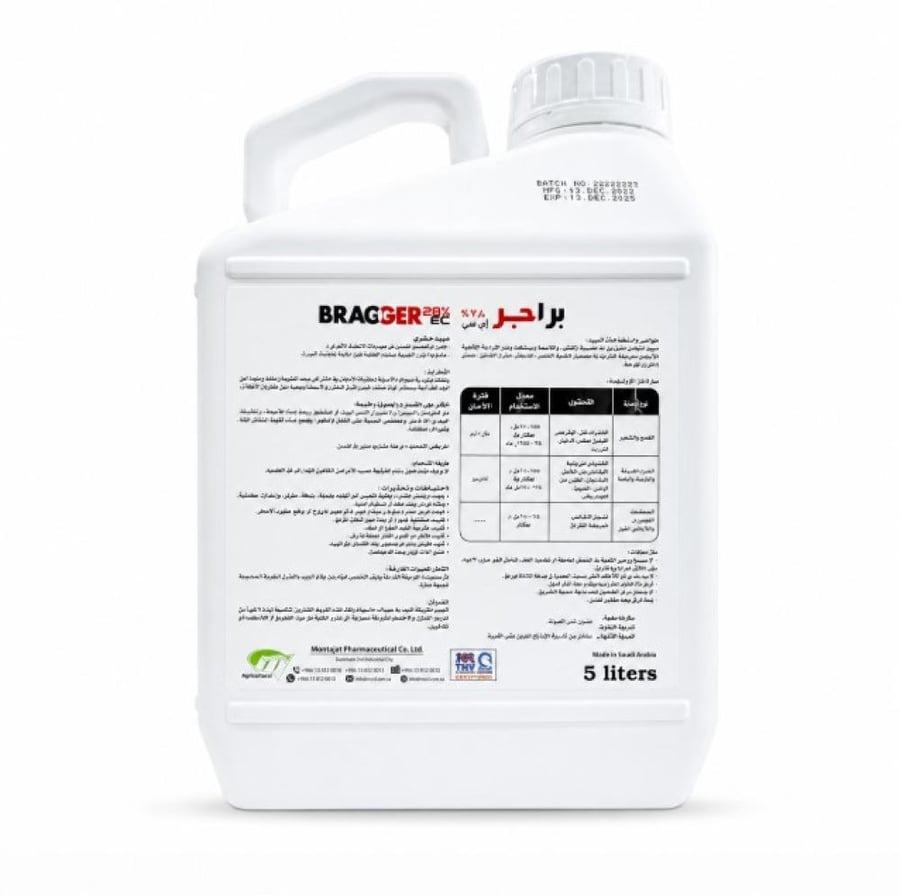
Brager 28 EC selective herbicide for controlling broadleaf weeds after germination, 1-liter capacity
59ر.س
Product description
Brajer 28 EC Herbicide Selective Weed Control for broadleaf weeds after emergence 1 for Brajer 28 EC Herbicide Selective Contact containing the active ingredient Bromoxynil Octanoate Bromoxynil Octanoate at a concentration of 28%, and comes in a concentrated emulsion EC. Used after emergence to help control broadleaf weeds within field crops, especially wheat, barley, maize, millet, and green surfaces, with adherence to label instructions and recommended doses. Brajer relies on direct effect on the green tissues of the targeted weeds, as it works by contact and affects the photosynthesis process inside the weeds, helping to weaken and wilt them in a short period when used at the appropriate timing. It is considered a practical option within weed management programs after emergence, especially when targeting small, actively growing weeds before they increase their ability to compete with the crop for water, nutrients, and light.
Selective post-emergence herbicide for broadleaf weeds
Brajer 28% EC is used after weeds appear inside the field, allowing for more precise targeting of broadleaf weeds compared to random control. The importance of this type of herbicide is evident in fields suffering from competitive weeds such as wild radish, shepherd’s stick, Tareeb, Khniz, radish, sorrel, and other broadleaf weeds that grow after emergence.
Since Brajer is a contact herbicide, good coverage during spraying is a key factor in the result. The better the spray solution reaches the green leaves of the targeted weeds, the clearer and faster the response. Therefore, it is recommended to spray when weeds are small and in the active growth stage, avoiding spraying on large or mature weeds as much as possible.
Specifications of Brajer 28 EC
Trade name: Brajer 28% EC
Product type: Selective contact herbicide
Formulation: Concentrated emulsion EC
Active ingredient: Bromoxynil Octanoate
Active concentration: 28% weight/volume
Mode of action: Contact herbicide
Use timing: Post-emergence
Target weeds: Broadleaf weeds
Suitable crops: Wheat, barley, maize, millet, and green surfaces according to label instructions
Country of origin: Saudi Arabia
Package size: 1 liter
Advantages of Brajer broadleaf herbicide
Specialized selective herbicide for broadleaf weeds.
Used after emergence to target weeds appearing inside the field.
Works by contact and provides a clear effect when weeds are well covered.
Helps reduce weed competition for water, nutrients, and light.
Suitable for use in wheat, barley, maize, and some green surfaces.
EC formulation provides good coverage on leaf surfaces when prepared correctly.
Effective when spraying small weeds in the active growth stage.
Can be integrated into weed control programs, considering compatibility during mixing.
Uses of Brajer 28% EC in weed management
Brajer is used to control broadleaf weeds that appear after emergence inside field crops. Early control is important to reduce weed pressure on the crop, as weeds growing alongside the cultivated plant begin to consume water and nutrients and reduce light access to the crop, which may affect growth and yield.
According to product data, some weeds Brajer helps control include:
Wild radish, shepherd’s stick, Tareeb, Khniz, radish, sorrel, and other broadleaf weeds that grow after emergence.
You can browse similar products in the agricultural pesticides section or go directly to the herbicides section to choose specific weed control products based on crop type and weed growth stage.
Method of using Brajer 28 EC
Brajer is used only after emergence because the herbicide works by contact and requires green leaves of the targeted weeds to achieve a clear result.
According to product data, the recommended doses are:
Wheat and barley: used for broadleaf weed control at 10 to 15 liters per hectare.
Spray water amount for wheat and barley: from 200 to 400 liters of water per hectare.
Pre-harvest interval for wheat and barley: 42 days.
Maize and millet: used after broadleaf weeds appear at 10 to 15 liters per hectare.
Spray water amount for maize: from 200 to 400 liters of water per hectare.
Pre-harvest interval for maize: 42 days.
Prepare the spray solution in a clean tank, adding the required amount of herbicide to water with good stirring, then complete the required water volume according to the spray area.
Since the herbicide is contact, focus on fully covering the green leaves of the targeted weeds.
For better distribution, use a suitable sprayer from the manual agricultural sprayers section or browse the sprayers, fertilizers, and pesticides section to select appropriate spraying tools based on the field nature and area.
Best timing for spraying Brajer after emergence
The best performance of Brajer is achieved when spraying early on small weeds in the active growth stage because the herbicide is contact and depends on direct contact of the spray with the weed leaves. The smaller the weeds and the better the coverage, the faster and clearer the control.
It is preferred to spray early in the morning or late in the evening to improve spray efficiency and reduce vaporization. Avoid spraying during strong winds or high temperatures, as this may reduce the solution’s reach to the targeted weeds or increase drift to nearby sensitive crops.
Precautions for using Brajer herbicide
Use only after emergence; do not use before weeds appear.
Ensure good coverage of weeds during spraying because the herbicide works by contact.
Prefer to spray when weeds are small and at the beginning of growth.
Avoid spraying large or mature weeds as much as possible.
Do not spray during strong winds or high temperatures.
Avoid drift to nearby sensitive crops.
Wear gloves, mask, and protective glasses during preparation and spraying.
Do not eat, drink, or smoke during use.
Wash hands and face thoroughly after finishing spraying.
Wash spraying equipment well after use.
Store the herbicide in its original container, away from children, water sources, food, and fodder.
Do not reuse empty containers for other purposes; dispose of them safely.
Do not mix the herbicide with other products unless compatibility is confirmed and follow the company’s instructions.
Integrated weed management
Brajer helps control broadleaf weeds after emergence but is more effective when used as part of an integrated weed management program. This includes choosing the appropriate planting timing, reducing weed seed presence in the field, early weed emergence monitoring, and using the herbicide at the right stage instead of waiting until weeds are large and competitive.
It is also advised not to rely on a single herbicide throughout the season; instead, rotate control methods and active substances as needed to reduce weed pressure and improve long-term management efficiency.
Frequently Asked Questions about Brajer 28 EC
Does Brajer work before or after emergence?
Brajer is used after emergence because it is a contact herbicide and requires green leaves of the targeted weeds to work efficiently.
What types of weeds does Brajer control?
Brajer is designed to control broadleaf weeds such as wild radish, shepherd’s stick, Tareeb, Khniz, radish, sorrel, and similar weeds.
Is Brajer suitable for wheat and barley?
Yes, Brajer is used in wheat and barley to control broadleaf weeds after emergence, following the dosage and pre-harvest interval specified on the label.
What is the active ingredient in Brajer 28% EC?
Brajer contains Bromoxynil Octanoate at 28%.
Why is good coverage important when spraying Brajer?
Because Brajer is a contact herbicide, its effectiveness depends on the spray solution reaching the leaves of the targeted weeds. Poor coverage may reduce control results.
Can Brajer be mixed with other herbicides?
It is not recommended to mix arbitrarily. Confirm compatibility and follow the company’s instructions or consult an agricultural specialist before mixing with other herbicides or fertilizers.
Brajer 28 EC for broadleaf weed control
Brajer 28 EC is a suitable choice within broadleaf weed control programs after emergence in field crops like wheat, barley, and maize. The product helps reduce weed competition with the crop when used at the correct time, with adherence to dosage, coverage quality, pre-harvest interval, and safety instructions on the label.
You can browse more herbicides and spraying supplies through Saudi Seeds Store and select the appropriate product based on weed type and crop.

From Jeddah