
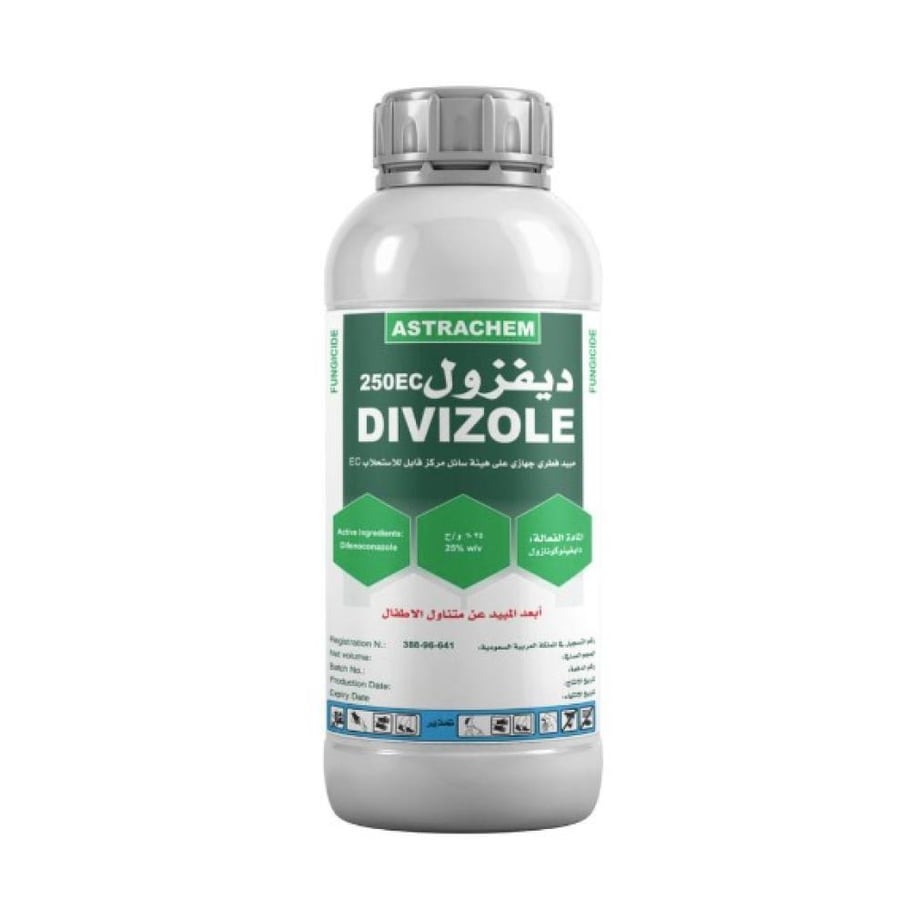

Divesol 250 SC fungicide device for controlling powdery mildew, leaf spots, and blight, 1 liter
149.01ر.س
Product description
Divizole 250 SC systemic fungicide for control of powdery mildew, leaf spots, blight. 1 liter. Divizole 250 SC systemic and protective fungicide contains the active ingredient Difenoconazole at 25%, and is used to help combat a wide range of fungal diseases affecting crops, such as powdery mildew, leaf spots, blight, rust, and some molds when used according to the label instructions. Divizole works inside plant tissues by inhibiting ergosterol formation in fungal cell walls, limiting fungal growth and spread. It is characterized by its ability to move within the plant to protect new growth, making it a suitable choice in fungal control programs that require a fungicide combining prevention and treatment, especially in vegetables, fruit trees, grapes, wheat, and cereal crops.
Specifications of Divizole 250 SC Difenoconazole
Trade name: Divizole 250 SC
English name: Divizole 250 EC
Product type: Systemic and protective fungicide
Active ingredient: Difenoconazole
Active ingredient concentration: 25%
Formulation type: EC (Emulsifiable Concentrate)
Volume: 1 liter
Country of origin: Saudi Arabia
Manufacturer: Astra Chem ASTRACHEM
Odor: Moderate
Mode of action: Systemic, inside plant tissues
Target diseases: Powdery mildew, leaf spots, blight, rust, some fungal molds
Suitable crops: Wheat, barley, tomatoes, cucumbers, onions, garlic, citrus, peppers, grapes, apples, according to label recommendations.
Features of a systemic fungicide for powdery mildew and leaf spots
Divizole 250 SC is highly effective against several common fungal diseases affecting leaves and fruits, and quality production. The product helps reduce the spread of powdery mildew, which often appears as a white layer on leaves, and is part of control programs for leaf spots, blight, and rust that can weaken the vegetative growth and reduce growth efficiency.
One of the main advantages of Divizole is that it combines preventive and curative effects, as it can be used before disease outbreaks under suitable conditions or at the first signs of symptoms. Its ability to move within the plant helps protect new growth and reduce disease development, with the importance of adhering to recommended doses and avoiding excessive reuse of the same active ingredient.
Uses of Divizole for controlling blight, rust, and leaf diseases
Divizole 250 SC is used in wheat and barley to help control rust and powdery mildew, which can affect grain yield if they spread during sensitive growth stages. It is also used in tomatoes and cucumbers to combat blight and mold, and in onions and garlic to control white mold and blight.
In citrus, it is part of fruit rot control programs, while in peppers, grapes, and apples, it is used against powdery mildew. Its importance is evident in crops exposed to high humidity, frequent dew, poor ventilation, or dense vegetative growth, factors that often promote fungal disease spread.
Application methods of Divizole 250 SC according to crop
Based on provided data, Divizole is used in wheat and barley at a rate of 100 ml per 100 liters of water to control rust and powdery mildew. In tomatoes and cucumbers, it is used at 100 ml per 100 liters of water for blight and mold. In onions and garlic, at 100 ml per 100 liters for white mold and blight. In citrus, it is used at 200 ml per 100 liters to control leaf rot and mold. In peppers, grapes, and apples, it is used at 50 to 100 ml per 100 liters for powdery mildew.
Spraying should be repeated every 10 to 14 days depending on disease severity, weather conditions, and agricultural engineer recommendations, with adherence to pre-harvest withholding periods.
Optimal timing for spraying Divizole on crops
Divizole should be used at the first appearance of symptoms or preventively when conditions favor fungal disease spread, such as high humidity, plant crowding, poor ventilation, or a history of previous infections in the same crop. Early intervention offers better chances to limit disease spread.
Spraying is recommended early morning or after sunset to avoid high temperatures and reduce spray solution evaporation. Good coverage of the vegetative parts, especially new leaves and undersides, is essential to improve treatment efficacy.
Pre-harvest interval and safety precautions for Divizole
According to provided data, harvesting is prohibited before 14 days from the last application. This period must be observed, and the crop should not be marketed before the safety period specified on the label for each crop.
Divizole should not be mixed with alkaline pesticides or copper-based compounds without a simple compatibility test, as improper mixing may reduce effectiveness or harm the plant. Gloves and masks should be worn during preparation and spraying, and the sprayer should be thoroughly cleaned after use. Store the container in a dry, shaded place away from children, animals, food, and water sources.
When to choose Divizole as part of the fungal control program?
Divizole 250 SC is suitable when fungal diseases such as powdery mildew, rust, leaf spots, blight, or some fruit molds are present, especially when a systemic fungicide with both preventive and curative action is required. It is also appropriate for crops needing protection of new growth during disease activity periods.
To enhance program efficiency, it is not recommended to rely solely on Difenoconazole throughout the season. It is better to rotate fungicides with active ingredients from different groups, improve ventilation, regulate irrigation, remove infected parts if needed, and reduce prolonged leaf wetness.
Frequently asked questions about Divizole 250 SC
What is the active ingredient in Divizole 250 SC?
Divizole contains Difenoconazole at 25%.
Is Divizole suitable for powdery mildew?
Yes, it is used to help control powdery mildew on crops like peppers, grapes, apples, as well as wheat and barley according to usage recommendations.
Is Divizole a systemic fungicide?
Yes, it works systemically inside plant tissues and helps protect new growth and reduce disease spread.
What is the recommended dosage of Divizole?
Doses vary depending on the crop and disease; for some crops, 50 to 100 ml per 100 liters of water, and 200 ml per 100 liters for citrus, depending on the targeted use.
What is the pre-harvest interval?
The pre-harvest interval is 14 days from the last application, with adherence to the label instructions for each crop.
Related sections
You can browse fungal disease control products in the Fungicides section, or access broader options in the Agricultural Pesticides section. For uniform liquid spray coverage, suitable tools can be selected from the Hand Sprayers or Sprayers and Fertilizers sections. To improve farming environment and reduce plant stress, browse the Soil and Growing Media section.
Marketing conclusion
Divizole 250 SC systemic fungicide is suitable for controlling powdery mildew, leaf spots, blight, rust, and some fruit molds in various crops. With Difenoconazole 25% and an emulsifiable concentrate (EC) formulation, it offers a practical option for farmers needing long-term preventive and curative protection when following recommended doses, safety periods, and safety instructions.
Establish 200 SL insecticide for ants and whiteflies, 1 liter.

From Jeddah