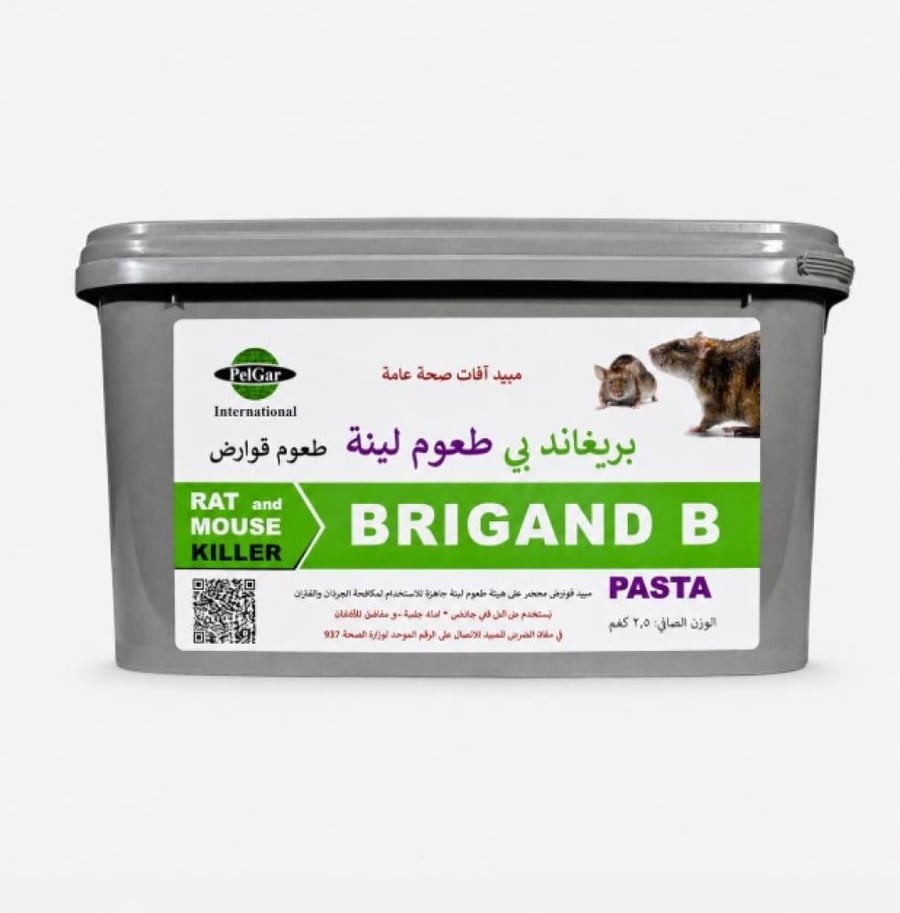


Brigand with soft flavors for mice and rats control 2.5 kg
139ر.س
Out of Stock
Product description
Brigand B Pasta soft bait for rodent control 2.5 kg Brigand B Pasta soft bait for rodent control 2.5 kg is a ready-to-use rodenticide in the form of soft "Pasta Bait," designed to help control mice and rats inside and around buildings, and in sites that require highly attractive bait and easy distribution within bait stations. The product contains the active ingredient Brodifacoum at a concentration of 0.005%, an effective substance used in rodent baits when following the instructions on the label and safety precautions. The product features a soft formulation that helps attract rodents, especially in locations with competing food sources, such as restaurants, warehouses, farms, service rooms, drainage areas, and public buildings. It can be used within rodenticide programs, with the necessity of placing it inside rodent bait stations to reduce access by children and non-target animals.
Product description
Brigand B Pasta comes in the form of ready-to-use soft baits, without the need for mixing or preparation. The soft nature of the bait increases its palatability for rodents, especially in places where mice and rats are accustomed to various foods or where attracting them with dry baits is difficult. The product contains Denatonium Benzoate at a concentration of 0.001%, a bitter substance added to reduce accidental consumption by non-target species. However, it remains a toxic rodenticide and must be handled with extreme caution, stored away from children, pets, food, and feed.
This product is also classified under soft rodent baits, suitable for sites that need a ready and concentrated bait as part of an organized control program.
Features of Brigand B soft bait
- Ready-to-use soft bait.
- Suitable for controlling mice and rats inside and around buildings.
- Contains active ingredient Brodifacoum 0.005%.
- Contains bitter Denatonium Benzoate 0.001% to reduce accidental ingestion.
- Highly attractive, paste-like formulation for rodents.
- Suitable for sites with competing food sources.
- Can be used in homes, farms, restaurants, warehouses, and public buildings.
- Relatively resistant to humidity and storage conditions when stored properly.
- Large package weighing 2.5 kg suitable for professional use or multiple-site locations.
- Registered and approved in Saudi Arabia under number PHPR-2023-P-0057 according to product data.
Suitable uses
Brigand B soft bait is used for rodent control inside and around:
- Homes and residential buildings.
- Restaurants, kitchens, and service areas.
- Food and non-food warehouses.
- Farms, barns, and agricultural buildings.
- Commercial and public buildings.
- Waste stations and sewage areas.
- Electrical rooms, service rooms, and back corridors.
- Sites requiring solutions within public health pesticides.
It can be integrated into a broader pest control program for insects, pests, and rodents when there is recurrent infestation or clear rodent activity at the site.
Technical specifications
Item | Details
---|---
Product name | Brigand B soft bait for rodent control
Trade name | Brigand B Pasta
Product type | Ready-to-use rodenticide
Form | Soft bait / paste
Active ingredient | Brodifacoum
Active ingredient concentration | 0.005%
Additional bitter agent | Denatonium Benzoate
Additional agent concentration | 0.001%
Inert materials | 99.994%
Net weight | 2.5 kg
Manufacturer | PelGar International
Country of origin | United Kingdom / Britain
Registration number | PHPR-2023-P-0057
Usage | Rodent control
Method of use
Do not handle the bait directly with bare hands; gloves must be worn when handling. Place the bait inside safe bait stations, then position the stations along walls, near burrows, along rodent paths, behind equipment, or in corners showing signs of droppings or gnaw marks. For mice, place approximately 20 to 30 grams per station, check and renew every 5 to 7 days depending on consumption. For rats, place approximately 100 to 150 grams per station, renew as needed until activity decreases or stops. Do not scatter the bait randomly or leave it exposed, especially in places accessible to pets, birds, or children. Using bait stations helps organize control, protect the bait from tampering, and reduce risks.
Tips to improve control efficiency
- Inspect the site before placing bait to identify rodent pathways.
- Place bait along walls, not in the middle of the area.
- Use closed, secure bait stations.
- Do not place bait near exposed food or feed.
- Remove alternative food sources as much as possible.
- Seal openings and burrows after confirming reduced activity.
- Regularly inspect stations and renew bait when consumed.
- Dispose of dead rodents in a healthy and safe manner.
- After completing the control program, collect leftover bait and do not leave it at the site.
- Do not mix this product with other baits or pesticides randomly.
Precautions and warnings
This product is a toxic rodenticide and should only be used according to label instructions and by qualified personnel or specialists during professional use. Keep out of reach of children and pets. Do not use in places with exposed food. Do not place where birds or non-target animals can easily access it. Do not touch the bait directly with bare hands; gloves must be worn during preparation and distribution. Store in its original, tightly closed container. Do not store with food, feed, or kitchen utensils. In case of accidental exposure or suspected ingestion, contact emergency services or poison centers immediately; in Saudi Arabia, contact the unified number of the Ministry of Health 937 with the product container or label.
When to choose soft bait instead of blocks or grains?
Soft bait is suitable when rodents are less responsive to dry baits or when there are many food sources in the area. The nature of soft bait may be more attractive in environments like restaurants, warehouses, farms, and drainage areas. For sites needing more stable bait within stations or in conditions with higher humidity, wax blocks may be appropriate. In some locations, wheat and grain-based baits or pellets can be used depending on rodent feeding patterns and infestation environment.

From Jeddah