

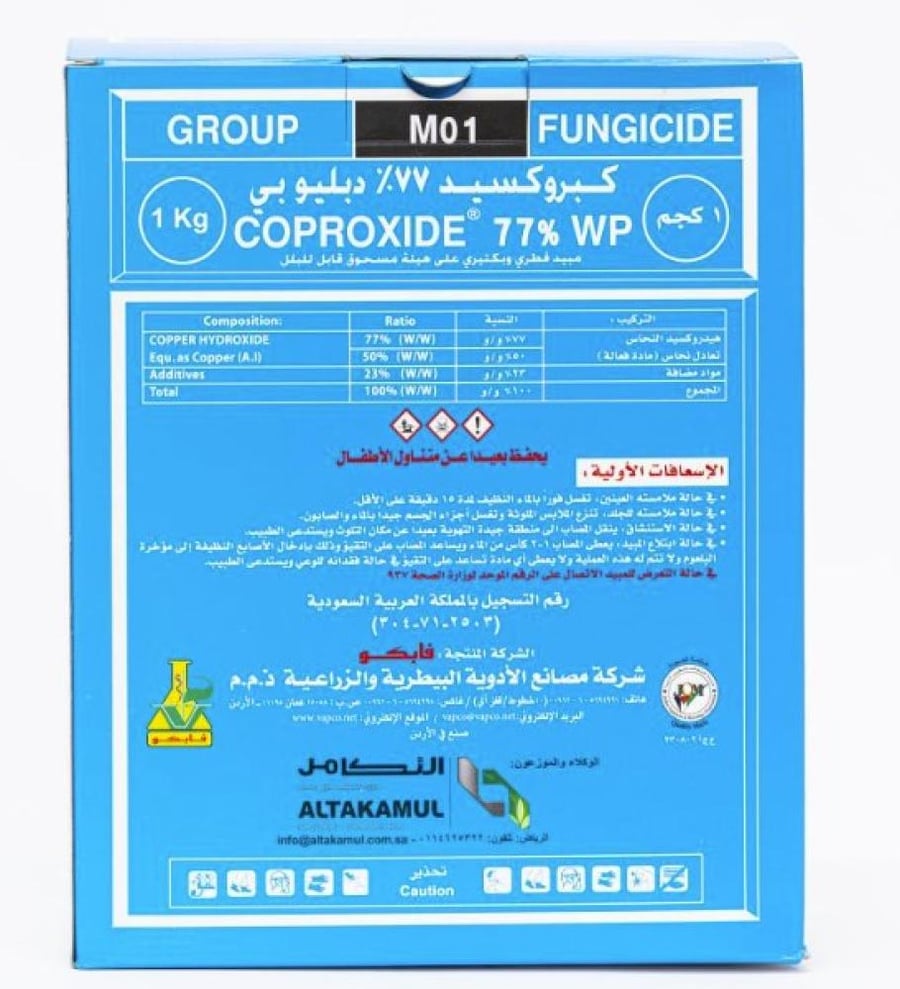

Hydrogen peroxide 77% WP, fungicide and bactericide, preventive, for control of blight, spotting, mold, and powdery mildew, 1 kilogram
99ر.س
Product description
Product description: Cuproxide 77% WP Copper Hydroxide 77% WP fungicide and bactericide preventive contains hydroxide copper 77%, approximately equivalent to 50% active copper. The product comes as a wettable powder WP, and is used to protect crops from a number of fungal and bacterial diseases such as early blight and late blight, leaf spots, powdery mildew, mold, anthracnose, and some bacterial spots depending on the crop and instructions for use. Cuproxide relies on forming a protective copper layer on the surface of leaves and fruits, helping to reduce the growth of fungi and bacterial spores before infection spreads. Therefore, it is suitable for preventive use in early stages of plant growth, or when conditions of humidity, rain, and heat favor disease spread. For optimal efficiency, the plant should be well covered from both sides, and spraying repeated according to the severity of infection and weather conditions.
Technical specifications of Cuproxide 77% WP Copper Fungicide
Trade name: Cuproxide 77% WP
English name: Cuproxide 77% WP
Product type: Fungicide and bactericide preventive
Active ingredient: Copper Hydroxide
Concentration: 77%, approximately equal to 50% active copper
Composition: WP wettable powder
Manufacturer: VAPCO
Country of origin: Jordan
Size: 1 kg
Use: Control of blight, spots, mold, powdery mildew, anthracnose, and some bacterial diseases depending on the crop
Features of Cuproxide for controlling blight and spots
Contains a high percentage of copper hydroxide, making it suitable for prevention of several fungal and bacterial diseases.
Helps combat early and late blight on crops such as tomatoes, potatoes, peppers, and eggplants.
Suitable for prevention programs against powdery mildew and leaf spots in cucurbits and vegetables.
Forms a protective layer on the surface of leaves and fruits, reducing the chances of fungi and bacterial spores growth.
Supports control of anthracnose and some leaf and fruit rot in fruit trees and suitable crops.
Its WP formulation helps with good distribution when mixed properly with water.
Useful within integrated disease management programs, especially when used before infection spreads.
Uses of Cuproxide 77% WP in agricultural crops
Used in prevention programs against fungal and bacterial diseases affecting leaves, stems, and fruits, including:
Controlling early and late blight in tomatoes and potatoes.
Reducing bacterial spots in peppers, eggplants, and some vegetables.
Controlling powdery mildew and leaf spots in cucumbers, zucchinis, and gourds.
Helping control leaf and white mold in onions and garlic.
Controlling anthracnose and leaf scorch in citrus, grapes, and olives.
Reducing bacterial leaf spots in beans and legumes.
Used as a preventive spray when conditions favor disease spread, such as high humidity, rain, or dense vegetative growth.
Method of using Cuproxide WP for preventive spraying
First, mix Cuproxide 77% WP in a small amount of water with good stirring until a uniform suspension forms, then add the mixture to the spray tank, fill with water, and continue stirring.
Spray the plant until the leaves are covered from both sides, focusing on new growth and initial infection areas.
Recommended dosages depending on the crop:
Tomatoes, potatoes, peppers, eggplants: 150 to 200 grams per 100 liters of water for controlling early and late blight and bacterial spots.
Cucumbers, zucchinis, gourds: 200 grams per 100 liters of water for controlling powdery mildew and leaf spots.
Onions and garlic: 200 grams per 100 liters of water for controlling leaf mold and white mold.
Citrus, grapes, olives: 200 to 250 grams per 100 liters of water for controlling leaf scorch, mold, and anthracnose.
Beans and legumes: 150 grams per 100 liters of water for controlling bacterial leaf spots.
It is preferred to repeat spraying every 7 to 10 days or as needed, especially under conditions conducive to disease spread such as high humidity, rain, or increased vegetative growth.
Pre-harvest interval for Cuproxide 77% WP
Stop spraying at least 7 days before harvesting vegetables, and 14 days before harvesting fruit trees, with a mandatory check of the label and approved recommendations for each crop before actual use.
Precautions for using copper-based pesticides
Wear gloves and a mask during preparation and spraying to reduce direct contact.
Do not spray during high temperatures or strong winds.
Avoid spraying near bees or water sources.
Do not mix with alkaline pesticides or mineral oils to prevent reactions or increased plant sensitivity.
Do not use higher doses than recommended to avoid stress or burns on sensitive plants.
Workers should not enter the field until the spray residue dries on plants.
Store in a cool, dry place away from children, animals, and food sources.
Frequently asked questions about Cuproxide 77% WP
What is the active ingredient in Cuproxide?
The active ingredient is copper hydroxide at 77%, approximately equal to 50% active copper.
Is Cuproxide a fungicide or bactericide?
It is a preventive fungicide and bactericide, used to reduce the spread of blights, spots, powdery mildew, and some bacterial diseases.
Is Cuproxide used for powdery mildew?
Yes, it is used within powdery mildew control programs in cucurbits and some suitable crops according to dosage and label instructions.
What is the dosage of Cuproxide per 100 liters of water?
The dosage usually ranges between 150 and 250 grams per 100 liters of water depending on the crop and target disease.
Can Cuproxide be mixed with mineral oil?
It is not recommended to mix with mineral oils or alkaline pesticides unless the label or an agricultural specialist confirms compatibility after testing.
Marketing conclusion
Cuproxide 77% WP is a suitable choice for farmers needing a preventive copper pesticide to combat blight, spots, mold, powdery mildew, and some bacterial diseases. Early application with good leaf coverage and repeated spraying according to conditions supports crop protection and improves product quality within an integrated control program.
Related sections:
The product can be linked with the section on agricultural pesticides, fungicides, pest and insect control, and can be supported by the section on agricultural sprayers to choose the appropriate spraying tool.

From Jeddah