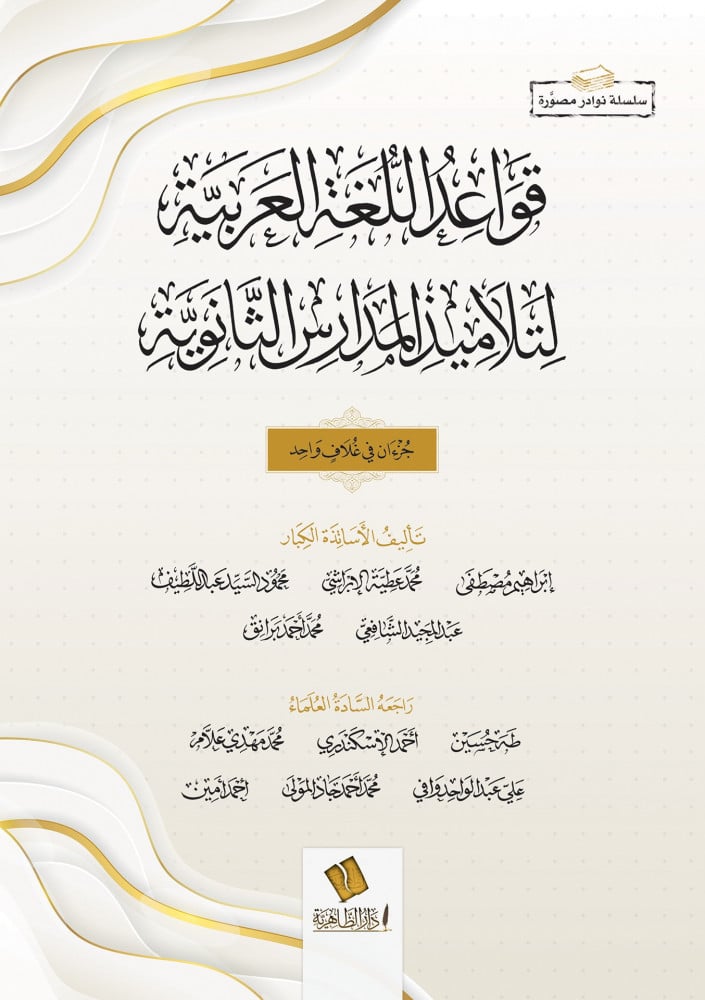
Arabic language rules for high school students
50ر.س
Product description
This book, this edition of "Illustrated Nadir Series" at Dar Al-Zahiriyah, combines the first book for the first secondary year and the second book for the second secondary year, from a series of books that the Ministry of Education in Egypt saw fit to compile in Arabic grammar for secondary schools in the fourth decade of the previous century. It was authored by a special commission appointed by the Ministry of Education, consisting of esteemed professors Ibrahim Mustafa, Muhammad Atiyya Al-Ibrahimi, Mahmoud Al-Sayed Abdul Latif, Abdul Majid Al-Shafi’i, and Muhammad Ahmad Barangh. They established its plan and reviewed it, with a committee composed of scholars Dr. Taha Hussein, Ahmed Al-Iskandari, Muhammad Mahdi Allam, Ali Abdul Wahid Wafi. The first edition of this book appeared in 1936, the second in 1937, and this is the third edition, issued in 1938. It was reviewed by, in addition to Dr. Taha Hussein, the two great teachers Muhammad Ahmad Jad Al-Mawla and Ahmed Amin. Subsequent editions continued until 1953.
The authors of this series decided to present the rules, explanations, and applications gradually, to suit students’ understanding. The authors preferred methods that make it easier for students to comprehend and benefit from. Sometimes, the application is a complement to the rule to help the teacher guide the student’s thinking.
This series was preceded by a similar series prepared by the committee on Arabic grammar rules for elementary schools. The first part of that series was on sentence formation for the second grade of primary school, and the second and third parts covered the third and fourth grades. After that, a book on practicing grammar rules for elementary stage was also prepared.
As for the third and fourth secondary years, students study rhetoric. In the third year, they study the science of meanings, and in the fourth year, they study the science of expression and Badi’. The committee authored two valuable books on these subjects.

From Taif