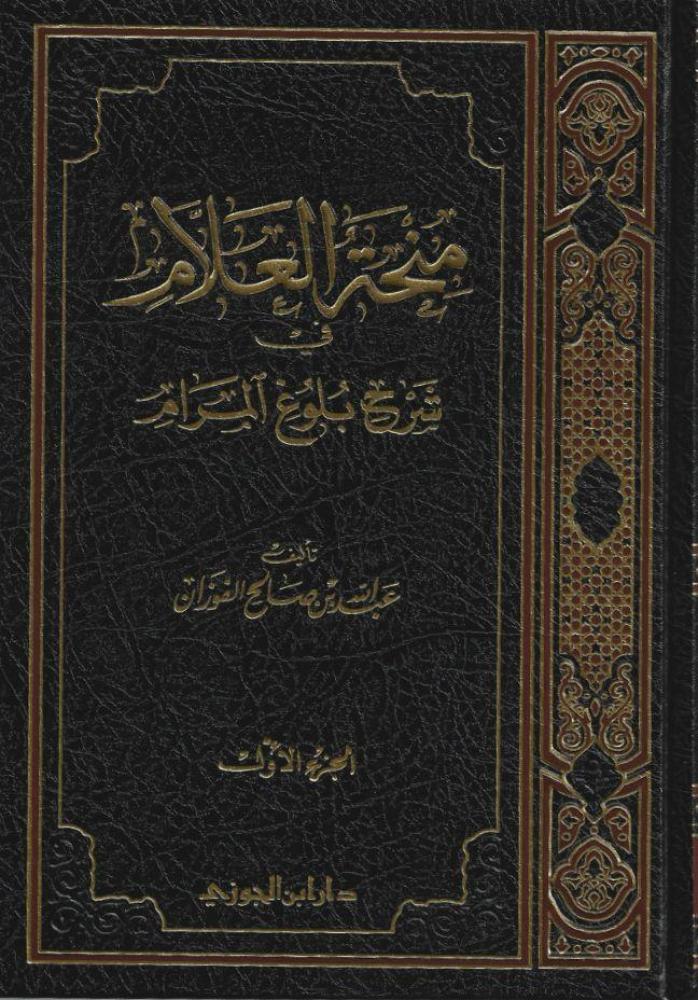

Al-Alam Grant in explaining Bulugh al-Maram 1/11
510ر.س
Out of Stock
Product description
Indeed, knowledge is the noblest of pursuits, and the highest of desires, through which the servant reaches the stations of the righteous and the pious, and the highest degrees in this world and the Hereafter. And among the noblest sciences, and the most exalted in rank — after the Book of Allah — is the knowledge of the Sunnah of the Messenger of Allah, peace be upon him, narration and understanding, and both are the foundation of evidence for Islamic rulings. The predecessors paid attention to this type of evidence, and they adopted various methods in their writings on it. One of these methods is to focus only on the Hadiths of Islamic rulings, and to isolate them from Hadiths about beliefs, battles, virtues, manners, and others, to facilitate memorization for students and to make it easier to reference during evidence gathering. Among those who wrote according to this method is the Hafith Ahmad ibn Ali ibn Hajar al-Asqalani, may Allah have mercy on him, who died in the year 852 AH. He compiled in his book "Buloog al-Maram min Adillah al-Ahkam" the fundamentals of Hadiths of Islamic rulings, arranged them according to well-known jurisprudential chapters, to make it easier for the reader to review them. He did not restrict himself to authentic Hadiths but also included some weak Hadiths to inform the student of what has been reported about the issue through weak narrations, for knowing the authentic is knowledge, and knowing the weak is also knowledge. And so that the student may strive in studying them, if there are supporting evidences or other chains of narration, he researched them, and it became clear whether some could strengthen others or not. The Hafith limited himself to general books and chapters without assigning each Hadith a specific title — as al-Majd ibn Taymiyah did in "Al-Muntaqa" — and he mentioned at the end the "Jami'" book for manners, as if he intended to provide the student with these Hadiths after memorizing the Hadiths of rulings, because they are most in need of them. The book contains 1,568 Hadiths, and this number may increase or decrease depending on different editions of the book or differing views on the narrations and reports.
This book is distinguished by many merits, which the observant reader can deduce. Among the most prominent are:
1- He arranged his books, chapters, and Hadiths according to the jurisprudential chapters, as previously mentioned, stating the name of the book, then the chapter, then listing the relevant Hadiths. Sometimes he mentions the book name and then lists the Hadiths without specifying the chapter, as he did in the "Funerals" and the beginnings of "Zakat," "Sawm," "Marriage," and others.
2- He limited himself to the raised Hadiths, mentioning only a few Muwatta (stopped) Hadiths, as in the "Marriage" chapter, "Ilaa" chapter, "Waiting" chapter, and others.
3- He summarized long Hadiths beautifully, without changing the wording or rearranging the order, focusing only on the point of evidence.
4- He omitted the chains of narration, only mentioning the highest narrator, and sometimes mentioning those before him for a purpose, which is very rare.
5- He usually indicates the level of the Hadith's authenticity, whether sound, good, or weak, either by quoting others or by his own judgment. This is one of the most important merits, though he rarely explained the reason for weakness, perhaps for brevity. These merits were absent in al-Majd ibn Taymiyah's "Al-Muntaqa," which only included the chain and the source without specifying its grade.
6- Sometimes he mentions issues in the chains such as sendings, interruptions, or stopping, and may prefer one chain over another if there are multiple, all in brief phrases.
7- Occasionally, he mentions narrations and Hadiths related to the main Hadith, and does so for a benefit, such as restricting an absolute, clarifying an ambiguous point, or resolving a contradiction. I have paid much attention to this aspect, noting the Hafith's purpose in mentioning these reports after the original Hadith, which scholars in my knowledge have overlooked.
Allah has granted this book acceptance among scholars old and new. Scholars praised it, students circulated it, and they committed to its teaching in some curricula. Scholars explained and clarified it, and it was served in the Hadith sciences through its references and citations from sources, among other efforts.
My method in explaining the book is as follows:
First: I discuss each Hadith in the form of points, after placing a title for the Hadith that specifies its subject and clarifies its meaning. These points are:
- The first point: in the biography of the narrator, to briefly identify him.
- The second point: in verifying the Hadith of the chapter, relying on the sources mentioned by the Hafith, arranged as he mentioned, unless there is a reason to add more, in which case I specify its location in the volume or page, or simply the number if sufficient. I may mention the book name and chapter to clarify the subject and location of the Hadith, especially in "Sahih al-Bukhari," "Sahih Muslim," and the Sunan, noting that the chapters in "Sahih Muslim" are not from him. I then cite the chain of narration, including only what is needed, sometimes quoting the wording of the Hadith from its source if the Hafith did not mention it fully or if there is some difference. Then I judge the Hadith as the Hafith did, adding what supports it from scholars’ statements. I also mention related narrations that the Hafith sometimes brings after the original Hadith, explaining the purpose of their inclusion. If there are other narrations from which rulings can be derived, I usually mention them.
- The third point and beyond: concern issues related to the Hadith, starting with explaining the wording of the Hadith and including the biographies of those mentioned in the text.
Second: I limit myself to jurisprudential issues derived from the Hadith, without diverging into other issues, because the goal is to clarify the jurisprudence of the Hadith, not to list all jurisprudential matters. This belongs to the books of fiqh. I aim to avoid lengthening the explanation to prevent increasing the size of the book. I usually mention references for jurisprudential issues, and what I have quoted from Sheikh Abdul Aziz bin Baz, may Allah have mercy on him, is attributed to its source, or from the "Buloog" explanation recordings. At the end of the book, there will be comprehensive indexes, God willing.
Third: I do not address controversial issues or debates over evidence, but I stick to the chosen opinion supported by evidence, and I avoid what lacks evidence unless the disagreement is strong or the Hafith has mentioned evidence for both sides, for example, I mention the disagreement and clarify the preferred opinion to resolve apparent contradictions that might be inferred from the evidence of either side.
Finally, I ask the dear reader, if he notices any slip of the pen or misunderstanding in what I have written, to kindly write to me with reward and gratitude, so I can correct it in the future. The ear is attentive, and the chest is open. What a person writes is subject to error, and shortcomings are inevitable. I named this explanation: "The Gift of the Scholar in Explaining Buloog al-Maram." Sheikh Dr. Abdullah bin Saleh Al-Fawzan

From Taif