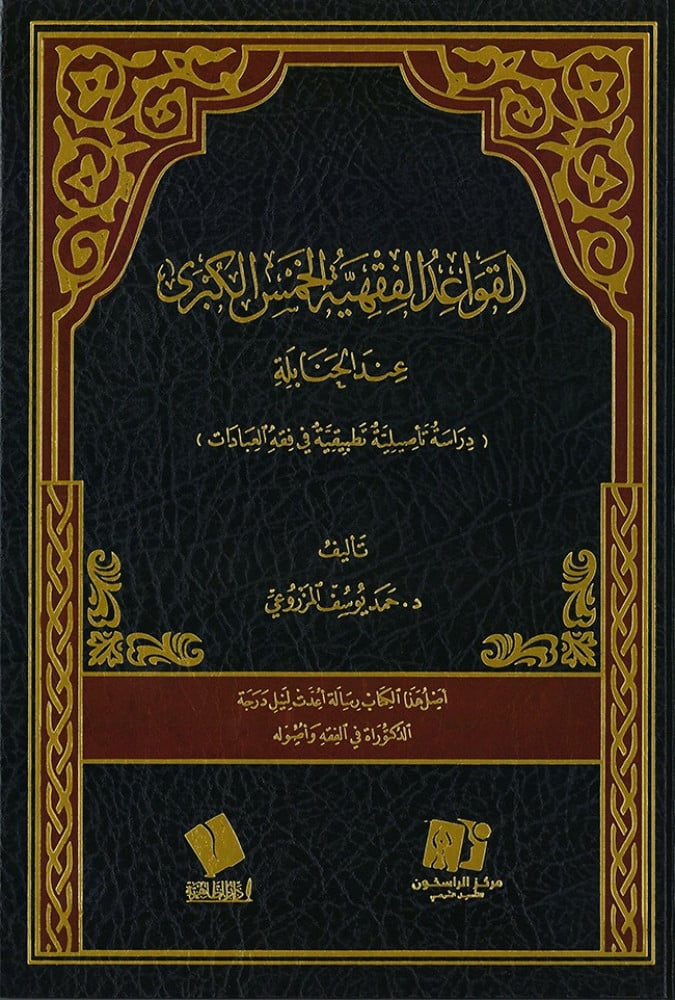
The five major jurisprudential rules among the Hanbali
40ر.س
Out of Stock
Product description
Recently published is the book "The Five Major Jurisprudential Maxims among the Hanbali" (A Foundational and Practical Study in Worship Jurisprudence), authored by Professor Dr. "Hamad Youssef Al-Marzouei." This book is based on a scholarly thesis prepared to obtain a PhD in Jurisprudence and Its Principles from the College of Graduate Studies at the University of Jordan in 2017 AD. The book was published as part of the publications of "Dar Al-Zahiriyah."
The author discusses in this study the topic of "The Five Major Jurisprudential Maxims among the Hanbali and their applications in worship jurisprudence, both foundationally and derivatively." By the five major jurisprudential maxims, the author means:
The first maxim: Matters are judged by their intentions.
The second maxim: Certainty is not removed by doubt.
The third maxim: Hardship entails ease.
The fourth maxim: Custom is authoritative.
The fifth maxim: Harm should be removed.
The first chapter begins by explaining the meaning of the jurisprudential maxim, its foundational basis, its evidentiary status, its importance, and how Hanbali jurists have used it in their jurisprudential and foundational branches, through mentioning examples from their books on jurisprudential maxims and defining them and their authors.
The second chapter is dedicated to mentioning examples of Hanbali jurists' applications of the five major jurisprudential maxims in the books of purification and prayer.
The third chapter completes the mention of jurisprudential applications of the five major maxims in the books of Zakat, fasting, and Hajj, thus covering issues and applications of worship.
The author then explains how Hanbali jurists derive the five major jurisprudential maxims and base rulings on them in their jurisprudential branches.
The final chapter presents examples of contemporary applications of the five major jurisprudential maxims in worship jurisprudence according to the Hanbali school, illustrating the Hanbali view on these developments through deriving rulings in accordance with the five maxims.
The thesis concludes with the main findings and recommendations.
Among the most important results of the thesis is clarifying the evidentiary authority of the five major jurisprudential maxims, the possibility of deriving rulings for new issues through them, and their broad scope, comprehensiveness, and suitability for general issues and rulings.

From Taif