

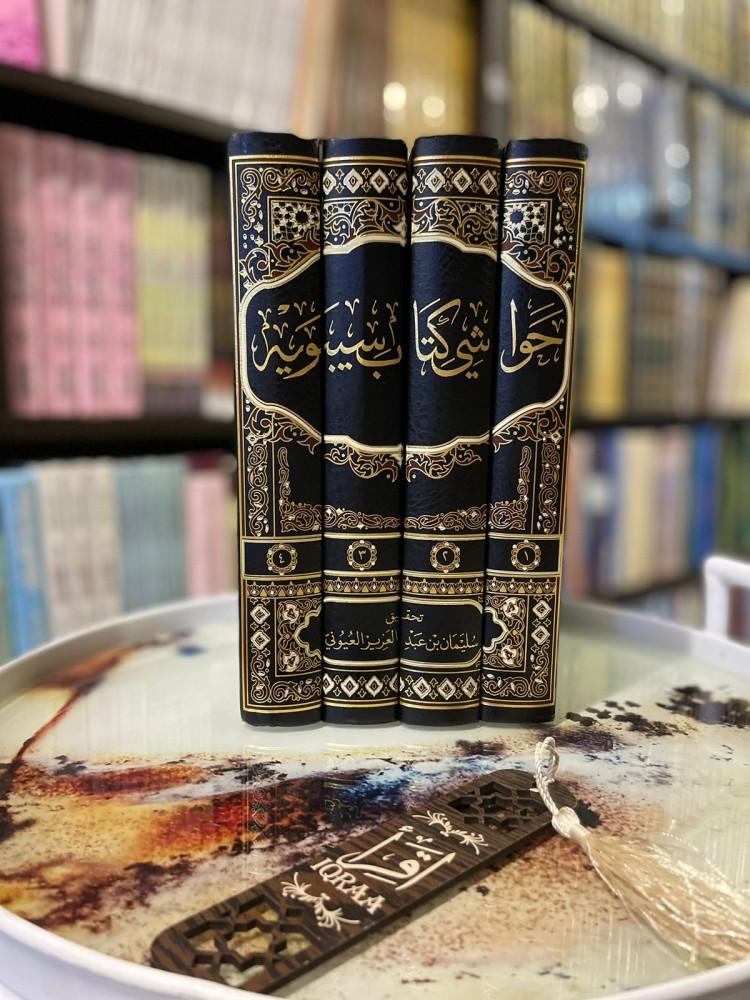


Notes of the book Sibawayh 1/4
275ر.س
Out of Stock
Product description
It contains many annotations from scholars, including: Al-Akhfash Al-Awsat, Abu Ishaq Al-Zajaj, Abu Umar Al-Jurmi, Abu Bakr Ibn Al-Sarraj, Abu Othman Al-Mazini, Al-Akhfash Al-Asghar, Abu Al-Abbas Al-Mubarrad, Abu Jaafar Al-Nahhas, Judge Ismail Ibn Ishaq, Abu Ali Al-Farsi, Abu Al-Abbas Thalab, and Abu Ali Al-Ghasani. It is certain to this day that Ibn Shelawayh's book "Al-Kitab" is the first grammatical book that reached us, and what is notable about it is that it gathers a number of Arabic sciences within it, such as grammar, morphology, phonetics, and others. Most likely, he relied in his book on sources that preceded him, as it is unlikely that a large book like Ibn Shelawayh's appeared all at once without previous books that were smaller in size, topics, chapters, or details, or other things. It was said that "it is a book of Isa Ibn Omar called 'Al-Jami'," and its elaboration, filled with the words of Al-Khalil and others, and that it was the book that he worked on, so when he completed it through research and filling, it was attributed to him. Whatever the case may be regarding the origin of the book, it contains quotations from many scholars, including Al-Khalil Ibn Ahmad Al-Farahidi, whose sayings and opinions are abundant in the book. When the phrases "I asked him," or "he said," or "we recited," appear, they refer to Al-Khalil. Among others are Yusuf Ibn Habib Al-Basri, Abu Al-Khatab Al-Akhfash, Isa Ibn Omar, Abu Amr Ibn Al-Alaa, Abdullah Ibn Abi Ishaq, Al-Asma'i, and Abu Zaid. The book does not contain an introduction or conclusion, and it is characterized by the following: First, citing the Quran, which is undoubtedly the peak of eloquence and rhetoric. Second, rarely citing the Hadith of the Prophet, perhaps because some of the Hadiths are heavy in meaning rather than in wording, and for this reason, some grammarians did not cite them. Linguistic studies have proven the correctness of citing them. Third, citing poetry from poets of the era of proof, about a thousand examples, and also citing Arab proverbs and the speech of eloquent Arabs. Fifth, brevity of expression and ambiguity, so that the reader often needs to pause for a long time to understand the intended meaning of Ibn Shelawayh. Sixth, lacking organized arrangement in chapters; he started with the chapter on the science of speech in Arabic, then the chapter on metaphorical speech in Arabic, the chapter on the subject and predicate, the chapter on words for meanings, the chapter on what occurs in words of attributes, the chapter on straight speech and inference, the chapter on what poetry can contain, the chapter on the doer who extends his action to an object, and the object that the action did not extend to, nor did his action extend to another object... Seventh, presenting the rule and its examples mixed with explanations and showing the basis of analogy, along with presenting different opinions on the research topic, preferring some over others, and sometimes proposing hypotheses with their judgments. The book we have is classified under grammar, and he did not classify anything like it before or after him. As you will see, the book has no introduction or conclusion, and he intended to return to it because he still had some of it and nothing remains in his soul. This is supported by the fact that he did not name it, nor read it to anyone, nor did anyone read it to him. Even Yunus, one of his teachers, did not know about the book during his lifetime or after his death. Scholars agreed after his death to call these papers only "the book," without describing it or attributing a specific name to it, and some of them accepted this naming and agreed upon it. The "book" became the title of Ibn Shelawayh's work, so it was said that if someone read the book, it would be known that it was Ibn Shelawayh's book. If they read half of it, there is no doubt that it is Ibn Shelawayh's book. This book was given as a gift to kings and ministers as the best gift during the Abbasid era.

From Taif