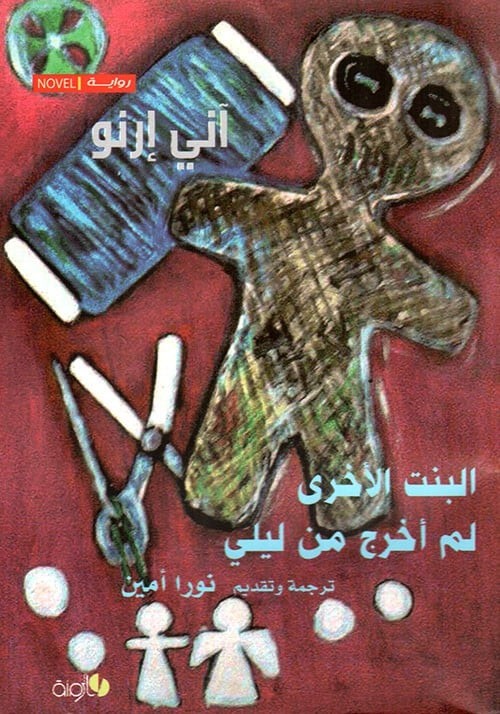
The other girl - I did not go out of my night
30ر.س
45ر.س-33%Product description
The identification between me and Erno doubled during reading "The Other Girl" (published in French in 2011) for a main reason that I lost a younger sister like her, and I wrote about her a story titled "February Girl" within my first collection of stories. The difference is that I saw my little sister "Yasmin," who passed away two months after her birth, while Erno was born two years after her sister "Janet" died, and she only learned about her at age ten, as the late little one remained the sacred secret in the parents' lives, and our writer lived under the dominant shadow of the one who choked her with diphtheria. And because old photos are all that connect "the two girls," Annie's text "The Other Girl" begins with describing a Sibia picture, an oval of the baby Janet, and how she thought it was her own picture, meaning from the beginning we find ourselves facing confusion: I / she. And this is the dominant confusion throughout the entire text starting from the title. What comes to mind when reading the title "The Other Girl" is that it refers to the sister being spoken about, but we later discover that the writer means herself by "the other girl"! The self has abandoned its centrality and become the last, and the absent sister has taken the center and displaced her present sister to the margin. The sibling relationship itself is questionable according to Erno, as only the civil registry confirms it. "But you're not my sister, you never were my sister. We never played together, we never ate together, and we never slept together. I never touched you, and I never hugged you. I never saw your eye color. I never saw you. You are without a body, without a voice, just a flat image in black-and-white photography." The feelings expressed by the writer here are very complex, a mixture of jealousy and competition with a hidden shadow, and guilt because she survived tetanus while her sister, who is the motive and justification for the story, passed away. "I don't write because you died. You died so I could write. There is a big difference." But how does Erno write what she does not acknowledge existing, what she only sees as complete absence hidden in the hearts of the father and mother as their greatest secret? She does this by observing and dissecting the effect of all this on her: "You only exist through your imprint on my existence. To write you is to merely observe your absence. You are an empty shape impossible to fill with writing." It is notable that Annie Erno describes her text, in more than one place, as a letter. And indeed, it is a letter addressed to Janet wherever she is. The present challenge here is that "the pronoun of address is a trap. It contains something suffocating, and it establishes a fictitious intimacy between the I and the you through the outpouring of complaint. It brings closer so it can blame. And gently, it tends to make you the reason for my existence, and to diminish the universality of my existence because of your disappearance." Thus, Erno continues chasing a shadow, considering that her written message to Janet is a debt repaid in imagination by granting her sister the existence that her death gave her. If Janet had lived, Annie would not have come into the world because her parents had been determined from the start to have only one child. The second text included in the book is "I Have Not Left Lily," in which Erno narrates her mother's illness with Alzheimer's and details her stay in the elderly ward at the "Pontoise" hospital. The book, published in French in 1997, was written as a diary during her mother's illness, whom Annie Erno's readers know well through the text "Woman." In "I Have Not Left Lily," readers get to see another face of Mrs. Dushasen—her face of illness and decline—and a different aspect of the writer's relationship with her. Whether in "The Other Girl" or "I Have Not Left Lily," Annie Erno maintains her private secret as a writer skilled at penetrating the depths of human feelings with all their complexity. Finally, it is worth noting the revealing introduction by Noura Amin to both texts, which serves as an ideal entry point to get to know Erno and her literary world.
