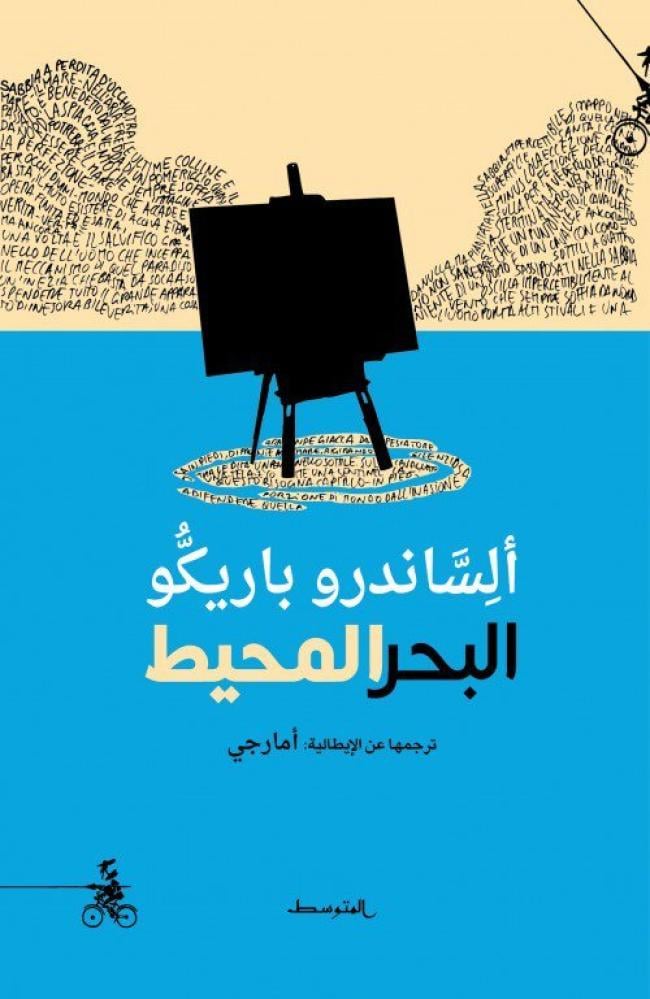
The ocean surrounding
60ر.س
Product description
The Sea the Ocean tells a story of a French Navy frigate sinking long ago in one of the oceans. The men on board try to survive on a raft they made for that purpose. The sea is the place where the fates of strange characters gather; such as Bartlett who tries to determine where the sea ends, or the painter Blassun who paints with the waters of the sea, and others of characters each searching for their own self, characters whose lives are hanging on the edge of the ocean, and their destinies are stamped with the conditions of the sea. And on the sea also overlooks the "Almair Inn" where many stories meet and fuse into some of them. Thus, through the sea, as an existential metaphor and symbol of existence, the skilled Barrico tells us about his surreal characters, moving between several stylistic forms, narrative and poetic. "An extraordinary novel... a book about being and existence, a metaphysics played with the cunning of an old wise clown, it is a novel that at least suggests that there are more things in life than any rationalist might tell you." Tom Bonsha - Tomatzovsky (The Independent) "Once again, with his novel The Ocean, the magician accomplishes his work skillfully: he creates a world, a maritime world... sensory, astonishing, and painful, as if it were a real world." Le Monde newspaper. "The Sea the Ocean is a novel that branches out and unfolds in its own way from poetic implication. Mr. Barrico is a cubist novelist, with a style that looks at multiple aspects of things at the same time. He takes us from one rhetorical style to another, from a form of symbolic poetry to a magnificent narrative adventure to a disorienting comedy." Richard Bernstein (The New York Times) "Surreal... erotic... The Sea the Ocean is a very romantic and wonderfully lyrical novel." Jenny McVie (The New York Times) "The Sea the Ocean is a kind of book, dragging along with it qualities like jellyfish: possessive, inward, lyrical, enchanting, hypnotic, gloomy, tragic [...]. Mosaically and multi-faceted like a poem, this novel recalls the saying of Archibald MacLeish, 'Poetry does not have to mean, but to be.' But this is not poetry, it is a novel, and here lies the problem." Wendy Orent (News Observer) "Barrico occasionally reminds us of Kafka as well as Salinger, Perek as well as Pasternak, and perhaps even Calvino; but ultimately, and without leaving room for doubt, he reminds us of himself, as one of the masters of ornate cavities and symphonies." Giovanni Gudiči (L’Unità) "Here, atmospheres are blown similar to those of Stevenson, Melville, and Conrad, those atmospheres that form a solid inspiration for this story, which, nonetheless, feeds on the vague metaphysical tensions emanating from the myth of the sea." Stefano Giovanardi (La Repubblica) "This book, dripping with fatigue and brokenness, which, in principle, embraces the literary heritage of sea writers—prophets and cursed ones—succeeds in maintaining its own thread of joy, of joyful and dismissive Mozartean music." Lorenzo Mondo (La Stampa) "A writer worthy of reading and appreciation, for what he conveys to us of splendor and pleasure." (The Washington Times) "It is the victory of the myth. The sea itself is nothing but a mirage. And Alessandro Barrico is nothing but a poet." (Le Figaro)

Questions you might have