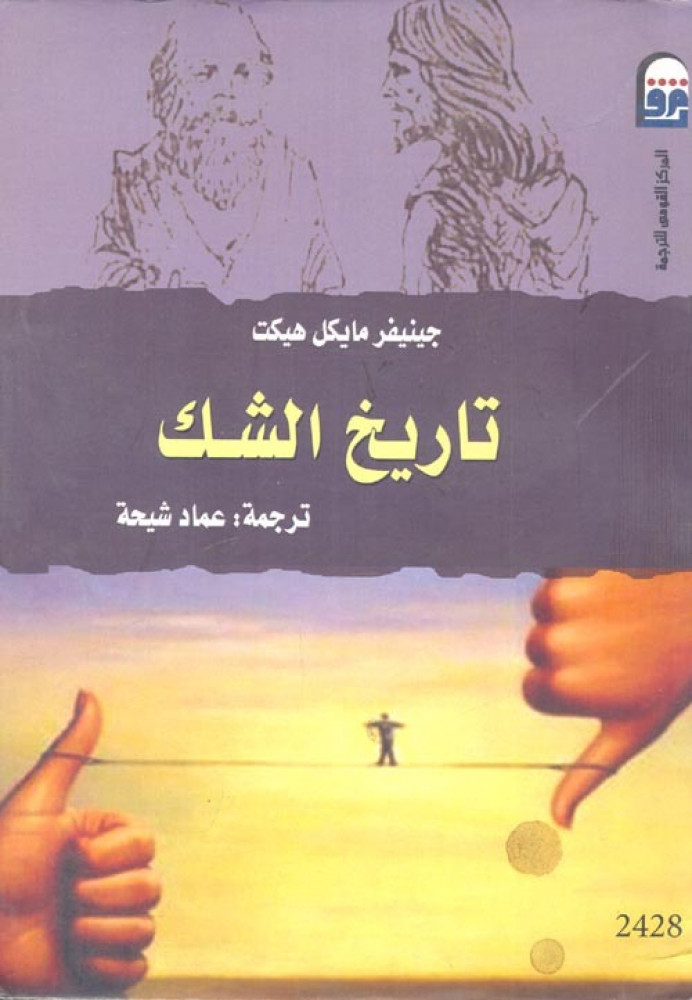
Doubt history
80ر.س
96ر.س-17%Product description
In her massive book, which exceeds eight hundred pages, the American historian and philosopher (Jennifer Michael Hecht), delves into (the history of doubt) - the book's title - through a (panoramic exploratory journey about this history and the complex and intricate issues surrounding it, including faith, certainty, truth, and denial), as the publisher, (the National Center for Translation), mentions, and according to a chronological structure that begins (from the beginnings of recorded history), reaching modern history, investigating religious doubt (across the entire world), as (just as faith takes many different forms, doubt also takes many different forms, from the skepticism of the ancients to modern scientific empiricism, from doubt in multiple gods to doubt in a single god, and to doubt that revives and sustains faith, and doubt that is undoubtedly disbelief), as (Hecht) states. The perspective that (Hecht) adopts regarding the history of doubt in this book is different from viewing it as (a shadow of the history of faith), as she sees it as a separate story, because the view of doubt as a shadow is a mistake in understanding (how skeptical methods reflected certain patterns of social change). The author emphasizes that issues of faith and doubt tend to take highly biased paths, so we find atheists (considering believers naive or followers), while believers tend to consider atheists people who have abandoned themselves to pain, immorality, and meaninglessness. From this perspective, the book (History of Doubt) comes as an effort (to dust off these modern approaches), or these mutual conflicts, which at first glance seem to place great believers and great skeptics at opposite ends, but they resemble each other more than they resemble the indifferent or submissive masses, as (Hecht) explains, reasoning that they (are aware of the fact that we live between two distant realities: on one side, there is a world in our minds, a world of reason, plans, love, and purpose. On the other side, there is the world after our human life). And because we are human, we live in a rupture with meaning, unlike the universe. (Hecht) categorizes doubt into seven groups, two of the oldest forms within the framework of science (materialism and rationalism), and within transcendental non-deifying approaches (often religions without gods). The other three categories emerge from examining ancient doubt, as when people mixed, relativism of cosmopolitanism (a world of multiple cultures and fields, whether on the level of cultural entities or individuals), which resulted in them doubting their own traditions of faith, and a political need for tolerance and general secularism. At the same time, there appeared a moral rejection of injustice, as well as philosophies of a happy life that presented themselves as guides for life without faith. Philosophical skepticism, which questions our ability to know the world entirely, began with Socratic doubt. However, it continued effectively after the ancient Greeks amassed a variety of philosophies, whose extreme diversity led some people to reject them all. The last skeptical category is (the doubt of the zealous believer), as (Hecht) calls it, noting that all these categories and the history in which they appeared are surprisingly intertwined. (Hecht)’s history of recorded doubt traces back to two thousand six hundred years ago, which makes her emphasize that (doubt is older than most forms of faith), as doubt has a resounding history in establishing rules for a happy life and a longing for truth, just as much as faith longs for truth. The author clarifies this throughout her ten chapters, starting with the first four chapters that follow the heroic traditions of doubt in the ancient world, occupied by the Greeks, Hebrews, Easterners, and philosophers and thinkers of ancient Rome. Moving to the fifth chapter, where she examines Christianity and Christian doubt, then transitions through the Middle Ages, where the geography of the Mediterranean, and the issues of Jewish, Christian, and Islamic doubt are discussed in the sixth chapter. Then to the period spanning the European Renaissance, the Reformation, and the Inquisition, and on the other side, the doubt related to the rise of Zen in East Asia, and the Europeans’ encounter with non-deifying Asian religions, in the seventh chapter, leading to the eighth chapter, which covers the period from 1600 to 1800 AD, marked by the scientific revolution and democracy. Then to the nineteenth century, which is the focus of the ninth chapter, a century filled with doubts, with figures whose impact remains prominent in human thought and in our contemporary reality. The book concludes with the tenth chapter, which covers the twentieth century up to the present time.

Questions you might have