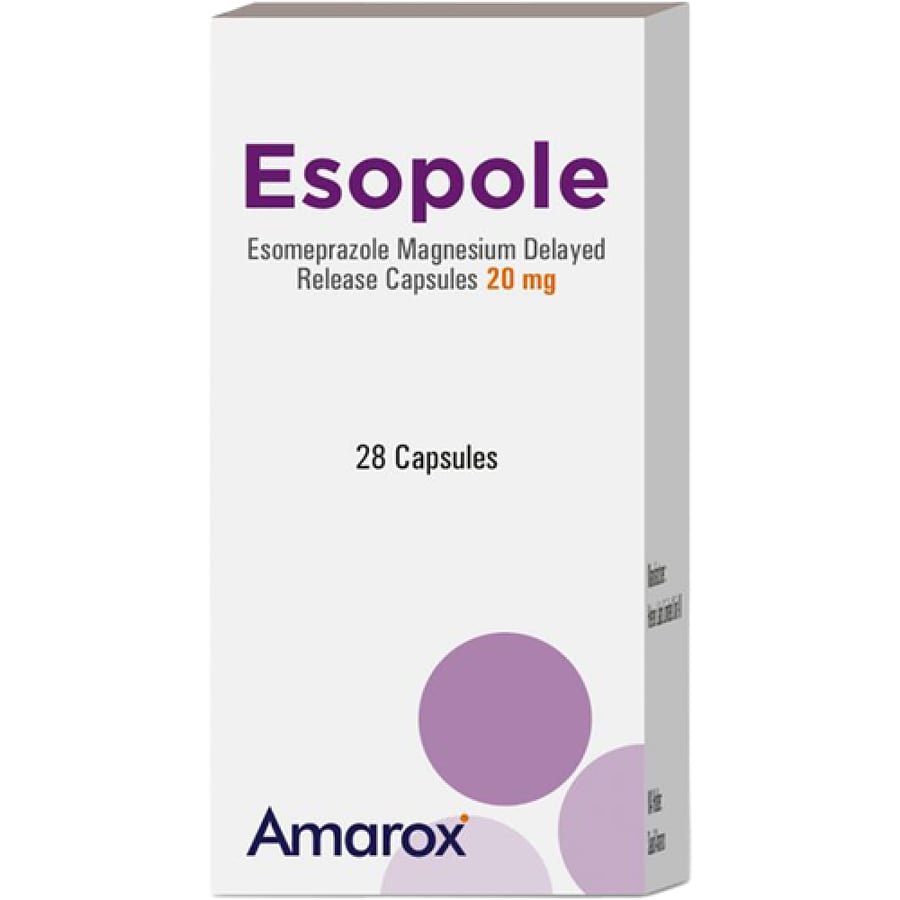
Esopole 20 mg 28 capsules
52.55ر.س
Product description
Product description
Isoprol Capsule for short-term treatment and maintenance of esophageal tube inflammation. This medication works by reducing the amount of acid in the stomach. It helps relieve symptoms of hyperacidity. Also used in short-term treatment of acid reflux into the esophagus, to reduce the occurrence of stomach ulcers associated with frequent use of non-steroidal anti-inflammatory drugs in patients, and for long-term treatment of excessive stomach acid production, reducing the risk of bleeding recurrence in patients with stomach or intestinal ulcers who undergo endoscopy, and for treating bacterial infection with Helicobacter pylori and intestinal ulcers.
It can also be used with other medications for certain conditions as recommended by the doctor. It is used with amoxicillin or clarithromycin for patients with bacterial infection caused by Helicobacter pylori and intestinal ulcers.
Proton pump inhibitors
Isoprol is a prescription medication belonging to a class called proton pump inhibitors (PPIs). PPIs are drugs that significantly reduce stomach acid production. Excess acid production causes stomach and intestinal diseases. Proton pump inhibitors are used to treat such disorders.
Usage instructions
Isoprol Capsule should be taken with food. Patients are advised to mix the granules with food, and only mix the granules with apple juice. This medication should be taken at least one hour before eating. Do not crush or chew the capsules.
Typical dose
The usual dose of Esomeprazole is 20 mg or 40 mg once daily for 4 to 8 weeks. The maximum dose for adults of Isoprol is 40 mg per day. This medication is usually used for 4 to 8 weeks for esophageal tube inflammation, 6 months for stomach ulcers related to frequent use of NSAIDs in patients, 4 weeks for acid reflux into the esophagus, and 10 days for Helicobacter pylori infection and intestinal ulcers.
It is often used at the same time as Clopidogrel. It takes about one hour for this medication to start working.
Special instructions
Patients are advised to mix the granules with food, and only mix the granules with apple juice. If the apple juice mixture or the granules are not fully used, the remaining mixture should not be used. Do not swallow the granules if they have dissolved or melted.
Warnings and precautions
Interference with tests
Blood levels of Chromogranin A may increase, leading to decreased stomach acidity caused by the medication. Elevated Chromogranin A levels can cause false-positive results in neuroendocrine tumor diagnosis. Treatment with Esomeprazole should be temporarily stopped before evaluating Chromogranin levels and consider retesting if initial levels are high. Use the same laboratory for testing (monitoring) Chromogranin A levels.
Drug interactions
Medications that stimulate CYP3A4 or CYP2C19 (such as St. John’s Wort or Rifampin) can reduce the effectiveness of Esoprol.
Avoid co-administration of Esomeprazole with methotrexate (especially at high doses), as it may increase blood levels of methotrexate or its metabolite, potentially causing harmful effects. In case of high-dose methotrexate, consider short-term discontinuation of PPIs including Esoprol in such patients.
Unnoticed skin lesions
Using PPIs including Esoprol may increase the risk of skin lesions in sun-exposed areas. Patients should seek medical help immediately and stop using Esoprol after consulting a healthcare professional.
Gastrointestinal infections
Long-term use of PPIs including Esoprol may increase the risk of gastrointestinal infections such as Clostridium difficile-associated diarrhea. Consider proper diagnosis in patients with worsening diarrhea related to colitis (Clostridium difficile infection).
Vitamin B12 deficiency
Prolonged use of any acid-suppressing medications (more than three years) may cause vitamin B12 deficiency due to lack of hydrochloric acid in stomach juice (achlorhydria). A diagnostic approach should be followed if any clinical symptoms suggest vitamin B12 deficiency.
Interstitium swelling
Patients using PPIs including Esoprol are at increased risk of interstitial swelling between renal tubules, which may be associated with severe allergic reactions without a known cause. Discontinue Esoprol if acute interstitial nephritis develops.
Gastritis
Patients on long-term Omeprazole therapy are at increased risk of developing gastritis (atrophic gastritis).
Gastric cancer (coexisting gastric tumors)
The response depends on the symptoms of Esomeprazole treatment.
Using Esomeprazole with Strontium or Rifampin
Medications that stimulate CYP3A4 or CYP2C19 (such as St. John’s Wort or Rifampin) can reduce Esoprol’s effectiveness.
Avoid co-administration of Esomeprazole with methotrexate (especially at high doses), as it may increase blood levels of methotrexate or its metabolite, potentially causing harmful effects.
In case of high-dose methotrexate, consider short-term discontinuation of PPIs including Esoprol in such patients.
Unnoticed skin lesions
Using PPIs including Esoprol may increase the risk of skin lesions in sun-exposed areas. Patients should seek medical help immediately and stop using Esoprol after consulting a healthcare professional.
Gastrointestinal infections
Long-term use of PPIs including Esoprol may increase the risk of gastrointestinal infections such as Clostridium difficile-associated diarrhea. Consider proper diagnosis in patients with worsening diarrhea related to colitis (Clostridium difficile infection).
Product details:
Brand: Esoprol
Product model: Capsules

From Riyadh