
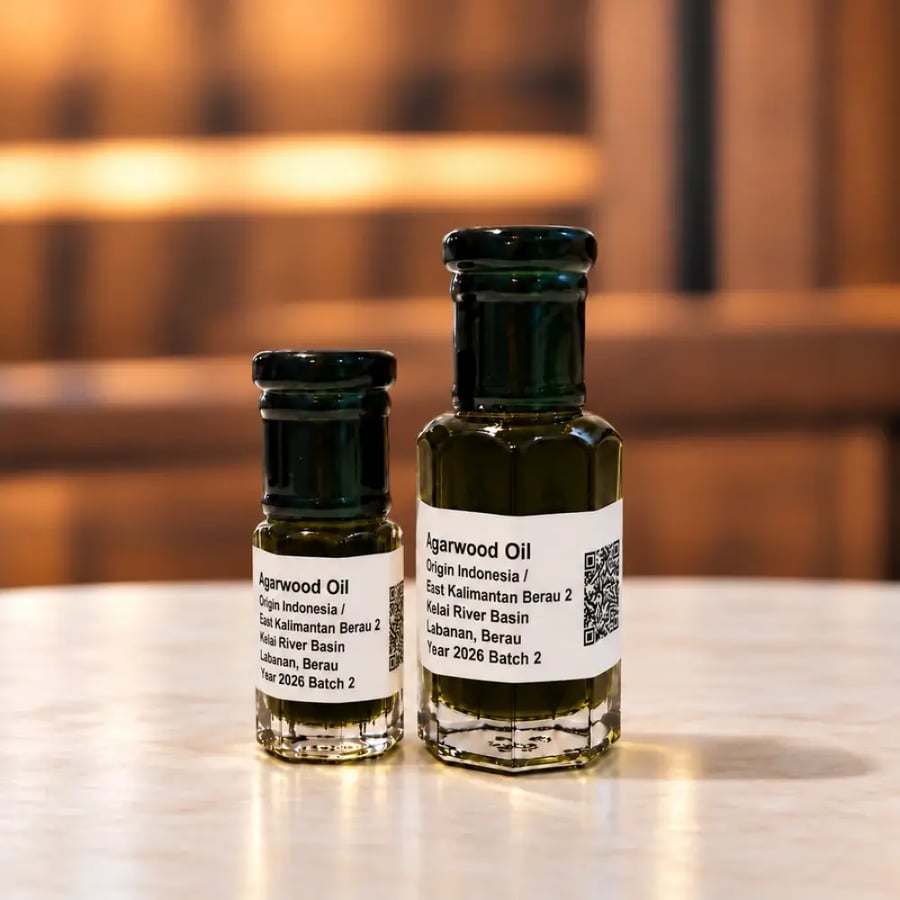

Natural Agarwood Oil — Kalimantan Berau 2
109ر.س
Product description
Product name: Natural Agarwood Oil — Kalimantan Berau 2
Product code: OUD-BER-002
Raw material and wood origin: Kelai River Basin, Berau, East Kalimantan, Borneo, Indonesia.
Oil batch analysis review: A sample from this oil batch was tested using GC-MS, and its report was reviewed as part of product approval.
Accompanying oil batch documents: The product certificate and analysis report are included.
The sample comes in a 1 ml bottle.
The product includes GC-MS analysis and report.
Origin and geographic environment
Region and terrain
Berau lies in East Kalimantan, on the Indonesian side of Borneo. Its landscape extends from the inland Kelai and Segah river basins towards the coast, with lowlands, hills and river valleys.
Forests and environment
The inland tropical forests have layered vegetation and diverse trees. Labanan includes natural production forest, where agarwood trees occur scattered among other forest species.
Wild agarwood trees and distribution
Aquilaria malaccensis, a member of the Thymelaeaceae family, occurs in Labanan forest. Its regional presence describes local botanical diversity; it does not identify the species or lineage of the wood in an individual oil batch.
The species above describe the regional flora. The botanical species or genetic lineage of the batch requires batch-specific documentation.
How is agarwood oil extracted by distillation?
Resin-bearing wood is prepared by reducing its size. Treatment or soaking may be used, depending on the distiller's method. In hydrodistillation, the wood is heated with water in the vessel; in steam distillation, steam passes through the wood. Volatile compounds travel with the vapour to the condenser, where they become liquid. The oil is then separated from the aromatic water.
The raw material, preparation method, distillation duration and operating conditions affect the resulting oil's composition. No single duration or temperature describes every oil. These general steps are not attributed to a particular product batch unless a batch-specific production record is available.
Contributions of chemists in Islamic civilisation
Chemists in Islamic civilisation contributed to experimental practice and descriptions of distillation apparatus and processes, applying this knowledge to material preparation and perfumery. Works attributed to Jabir ibn Hayyan discuss processes such as distillation, sublimation and crystallisation as part of a broader interest in separating and processing substances.
Abu Bakr Muhammad ibn Zakariya al-Razi described substances, apparatus and laboratory operations in practical terms. His writings are an important source for understanding the chemical tools and procedures of his era. Yaqub ibn Ishaq al-Kindi also documented perfumery and the preparation of aromatic materials; his works include the Book of the Chemistry of Perfume and Distillations.
These contributions illustrate the systematic recording of distillation knowledge through descriptions of substances, heating vessels, vapour collection and condensation, and procedures that supported the transfer of expertise and development of its applications.
What is GC–MS analysis?
GC–MS combines gas chromatography with mass spectrometry: compounds are separated chromatographically and their mass spectra are then examined. It is used to examine volatile compounds suitable for the analytical conditions and helps identify sample components and study their chemical composition.
During gas chromatography, a small quantity of appropriately prepared sample is introduced. A carrier gas moves it through a separation column inside an oven with a controlled temperature programme. Compounds travel at different rates depending on their volatility and interaction with the column's stationary phase, and emerge at different retention times.
When compounds reach the mass spectrometer, their molecules are ionised and may break into ionic fragments. The instrument measures mass-to-charge ratios and signal intensities, producing spectra that help distinguish compounds. Spectra are compared with reference libraries such as NIST. Agreement with a retention index or a reliable reference standard increases confidence in identification.
A report typically includes a chromatogram and a table of proposed compound identities, retention times and peak areas; it may also include library match scores. Peak area represents the recorded response under the measurement method. Accurate concentration measurement requires appropriate calibration. Peak-area percentages must therefore not be read as oil-purity percentages or direct mass fractions.
In agarwood oil research, analysis helps describe detected aromatic compounds, compare samples and batches measured by comparable methods, and review unexpected compounds that require interpretation or further verification. Compounds may co-elute within a single peak. Results are also affected by sample preparation, column type, the temperature programme and detection limits.
The report is most useful when read alongside raw-material and production information, experience, and sensory evaluation of aroma and performance. Analysis provides information about the sample's chemical composition within the scope of the method used, while sensory evaluation describes the aromatic experience and its development.
How to read the analytical report
1. Sample identity: Check the sample name, batch number, test date and laboratory. Then review sample preparation, the column, the temperature programme and the compound-identification method.
2. Retention time (RT): The time at which a signal appears under the analytical conditions, rather than a fixed, independent fingerprint. A retention index (RI), when available, helps comparison with references.
3. Peak area (Area%): The area of a peak's signal as a proportion of the total included peak areas. It is not oil purity and cannot be directly converted to a compound's mass fraction without suitable calibration and response factors. A peak area of 20% does not mean 20% purity.
4. Library matching: The proposed compound name and match score support preliminary identification but do not establish identity on their own. Confidence increases when the mass spectrum and retention index agree. A reference standard or further testing may be needed, particularly for an unexpected compound.
5. Integrated evaluation: Read results alongside production information, experience and sensory evaluation of aroma and performance. A single compound is insufficient to establish origin, quality or an added substance; a list of peaks alone does not prove absolute freedom from impurities. This is an educational guide to interpretation, not a new analytical result for the product.

