
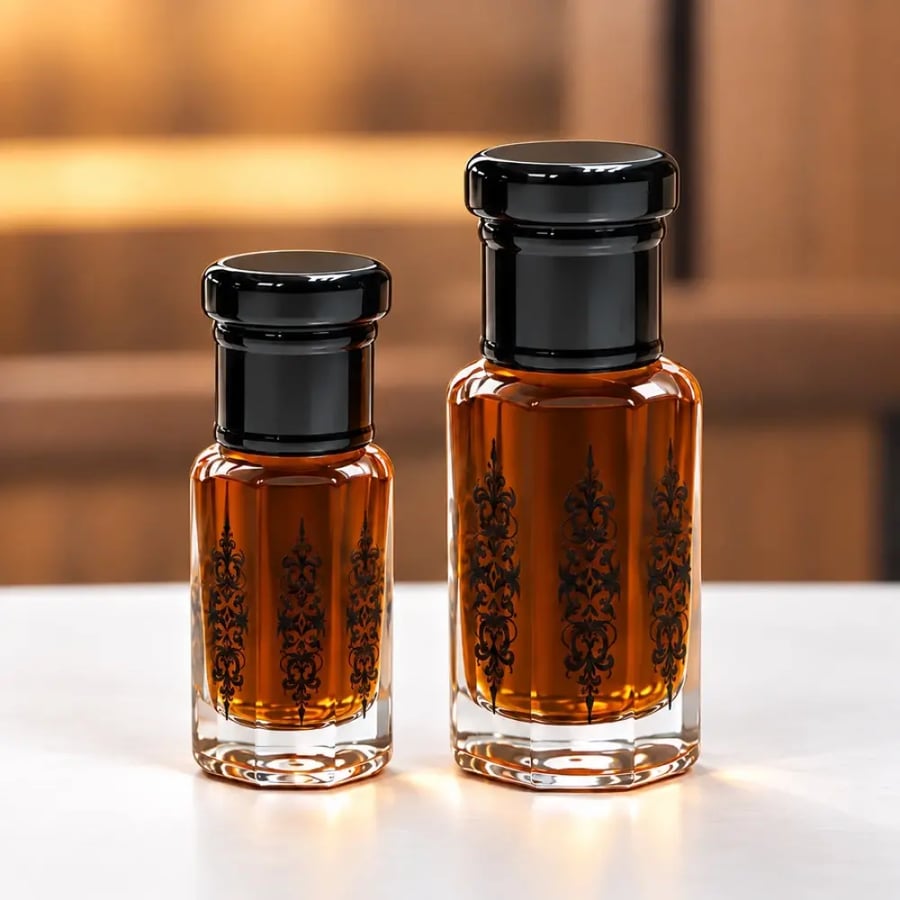
Natural Agarwood Oil — Sumatra
230ر.س
Product description
Try the sample — returns
Every tola or quarter-tola bottle comes with a complimentary sample of the same oil. Try the sample first and keep the main bottle closed with its original seal and heat wrapping intact.
If the scent does not suit you, request a return within the seven days following receipt. Return the unused main bottle in its original condition with its accessories for a full refund of the amount paid for the product, with no deduction for the sample.
The customer pays return shipping for a change of mind without a defect or store error; the store bears costs for a defect or its error. Free delivery is not charged retrospectively. Statutory rights remain unaffected.
Return termsNatural Agarwood Oil — Sumatra
Product type: natural agarwood essential oil.
Natural Agarwood Essential Oil
Includes GC–MS analysis and report
Origin and geographical context
Natural Agarwood Oil — Sumatra
Product code: OUD-SUM-02
Production year: 2026.
Raw wood origin: Forests surrounding Pekanbaru, Riau, Sumatra, Indonesia.
Sumatra: lowland forests and mountains
Sumatra is an Indonesian island in the western Malay Archipelago. The Bukit Barisan mountain range runs along its western side, with forests extending from lowlands and floodplains to mountain environments. Protected forest areas include Gunung Leuser, Kerinci Seblat and Bukit Barisan Selatan. These are geographical examples and do not imply that this product's wood was collected within them.
Wild agarwood trees and their habitat
An April 2019 field survey documented wild Aquilaria malaccensis in community forests in Siak Sri Indrapura and Bengkalis, including Gosip, Perincit and Dosan. Survey sites included peat soils, with trees also recorded on mineral soils at Duri. Agarwood habitat therefore cannot be reduced to a single environment.
Riau in the agarwood trade
A Riau study published in 2022 reports that agarwood was known in Siak during the reign of Sultan Syarif Hasyim as an aromatic material and traded commodity, and that Riau's role as an agarwood trading centre declined as its wild trees diminished.
Experience, evaluation and analysis
Agarwood oil assessment combines experience and sensory evaluation of aroma and performance with scientific examination and chemical analysis. GC–MS identifies compounds detected in the sample; it does not, by itself, establish quality or absolute freedom from impurities.
How is agarwood oil extracted by distillation?
Resin-bearing wood is prepared by reducing its size. Treatment or soaking may be used, depending on the distiller's method. In hydrodistillation, the wood is heated with water in the vessel; in steam distillation, steam passes through the wood. Volatile compounds travel with the vapour to the condenser, where they become liquid. The oil is then separated from the aromatic water.
The raw material, preparation method, distillation duration and operating conditions affect the resulting oil's composition. No single duration or temperature describes every oil. These general steps are not attributed to a particular product batch unless a batch-specific production record is available.
Contributions of chemists in Islamic civilisation
Chemists in Islamic civilisation contributed to experimental practice and descriptions of distillation apparatus and processes, applying this knowledge to material preparation and perfumery. Works attributed to Jabir ibn Hayyan discuss processes such as distillation, sublimation and crystallisation as part of a broader interest in separating and processing substances.
Abu Bakr Muhammad ibn Zakariya al-Razi described substances, apparatus and laboratory operations in practical terms. His writings are an important source for understanding the chemical tools and procedures of his era. Yaqub ibn Ishaq al-Kindi also documented perfumery and the preparation of aromatic materials; his works include the Book of the Chemistry of Perfume and Distillations.
These contributions illustrate the systematic recording of distillation knowledge through descriptions of substances, heating vessels, vapour collection and condensation, and procedures that supported the transfer of expertise and development of its applications.
What is GC–MS analysis?
GC–MS combines gas chromatography with mass spectrometry: compounds are separated chromatographically and their mass spectra are then examined. It is used to examine volatile compounds suitable for the analytical conditions and helps identify sample components and study their chemical composition.
During gas chromatography, a small quantity of appropriately prepared sample is introduced. A carrier gas moves it through a separation column inside an oven with a controlled temperature programme. Compounds travel at different rates depending on their volatility and interaction with the column's stationary phase, and emerge at different retention times.
When compounds reach the mass spectrometer, their molecules are ionised and may break into ionic fragments. The instrument measures mass-to-charge ratios and signal intensities, producing spectra that help distinguish compounds. Spectra are compared with reference libraries such as NIST. Agreement with a retention index or a reliable reference standard increases confidence in identification.
A report typically includes a chromatogram and a table of proposed compound identities, retention times and peak areas; it may also include library match scores. Peak area represents the recorded response under the measurement method. Accurate concentration measurement requires appropriate calibration. Peak-area percentages must therefore not be read as oil-purity percentages or direct mass fractions.
In agarwood oil research, analysis helps describe detected aromatic compounds, compare samples and batches measured by comparable methods, and review unexpected compounds that require interpretation or further verification. Compounds may co-elute within a single peak. Results are also affected by sample preparation, column type, the temperature programme and detection limits.
The report is most useful when read alongside raw-material and production information, experience, and sensory evaluation of aroma and performance. Analysis provides information about the sample's chemical composition within the scope of the method used, while sensory evaluation describes the aromatic experience and its development.
How to read the analytical report
1. Sample identity: Check the sample name, batch number, test date and laboratory. Then review sample preparation, the column, the temperature programme and the compound-identification method.
2. Retention time (RT): The time at which a signal appears under the analytical conditions, rather than a fixed, independent fingerprint. A retention index (RI), when available, helps comparison with references.
3. Peak area (Area%): The area of a peak's signal as a proportion of the total included peak areas. It is not oil purity and cannot be directly converted to a compound's mass fraction without suitable calibration and response factors. A peak area of 20% does not mean 20% purity.
4. Library matching: The proposed compound name and match score support preliminary identification but do not establish identity on their own. Confidence increases when the mass spectrum and retention index agree. A reference standard or further testing may be needed, particularly for an unexpected compound.
5. Integrated evaluation: Read results alongside production information, experience and sensory evaluation of aroma and performance. A single compound is insufficient to establish origin, quality or an added substance; a list of peaks alone does not prove absolute freedom from impurities. This is an educational guide to interpretation, not a new analytical result for the product.

