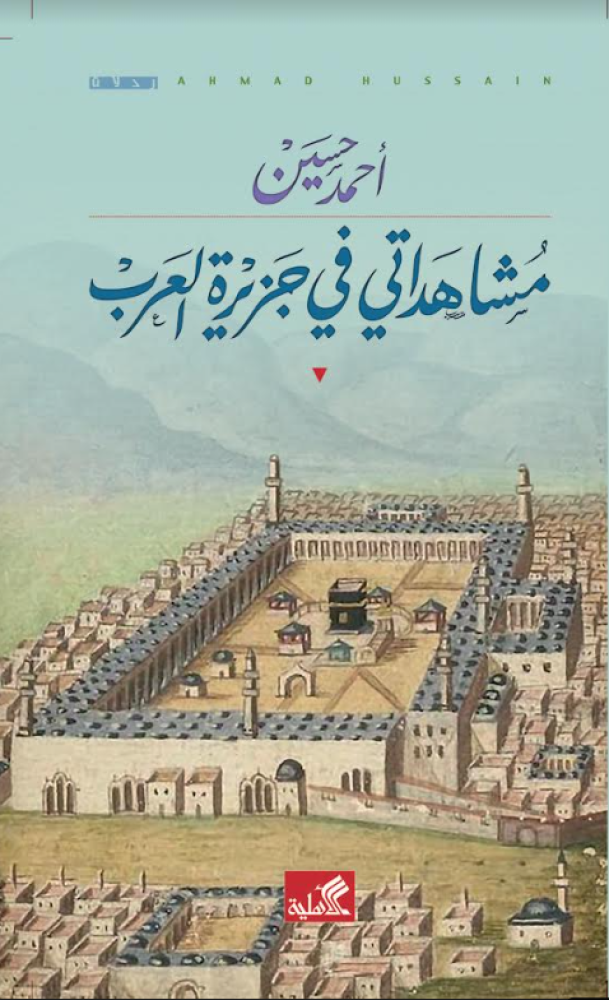
My observations in the Arabian Peninsula
77ر.س
Product description
Author's name: Ahmed Husseindar
Publisher: Al-Ahliyya for Publishing and Distribution
Year of publication: 2024
Literary classification: History and Politics
Brief about the book: The author Ahmed Husseindar clarified in the introduction of his book "My Observations in the Arabian Peninsula" that it is not a book of religion or philosophy or history or politics or propaganda, "but merely thoughts and reflections that surged within the soul as I prepared for the pilgrimage to the House of God for the fourth time," which took place in the year 1367 AH, when the Minister of Finance, Abdullah Al-Sulaiman, invited him to perform the pilgrimage as a guest of the government.
Instead of staying at the (governmental) guest house in Mecca, which was hosted by its director Abdul-Salam Gali, the author preferred Sheikh Muhammad Al-Radhi’s house because it overlooks the Haram directly to settle there, "so I barely arrived at the house and saw the hall designated for us, when I realized that this was the first sign of divine satisfaction."
It is not surprising that the first reflection of the author concerns the state of what was acceptable to exist and not expected to disappear.
"Poor condition of the Sa’i" was the title of this reflection, as the author explained, stating "and the truth is that there is nothing that shocks the pilgrim’s feelings more than the shock of Sa’i between Safa and Marwah. He reads in the Holy Qur'an that Sa’i between Safa and Marwah is one of the rituals of Allah, and he knows that they are among the completion of Hajj, so his imagination wanders before Hajj about this Sa’i, and how it will be performed with grandeur and dignity, until he reaches Mecca (the Makkah) and is suddenly surprised, which shocks him and destroys his reverence and piety, transferring him from a spiritual atmosphere to a worldly material one.
The Sa’i has turned into a street... this one sells fabrics, this one sells food, this one offers ice cream, this one exchanges money, and this one argues with that one. And there is no market in all of Mecca (the Makkah) more crowded with shops than this market."
As for the second selected reflection from the book, it concerns overcoming the obstacle of installing loudspeakers in the Grand Mosque. The author mentioned, ".... And all the credit for using the microphone in the Haram goes first and last to His Highness Prince Saud, the Crown Prince, who ordered its installation (starting with the Maghrib, Isha, and Fajr prayers, which are the loud prayers) when he substituted for his father during the 1366 AH pilgrimage season."
".... So the microphone became as good as it could be, and it will establish its footing just as the car, telephone, and wireless did before... and the Kingdom of Saudi Arabia will enjoy, and the pilgrims who suffered from chaos will also enjoy, the blessing of this scientific miracle, the miracle of transmitting a person's voice to millions, and the ability of one person (the Imam and preacher of the Grand Mosque) to direct nations and peoples separated by oceans, deserts, and mountains across the east and west of the earth."
".... And if I add to that that I arrived in Jeddah in a few hours by plane (from Cairo), and I traveled from Jeddah to Mecca (the Makkah) in an hour and a half on a paved road," I realized that I am with a people "who know that the world is rushing around them, and that stagnation has only one result and one effect: the destruction of groups and nations."

From Najran