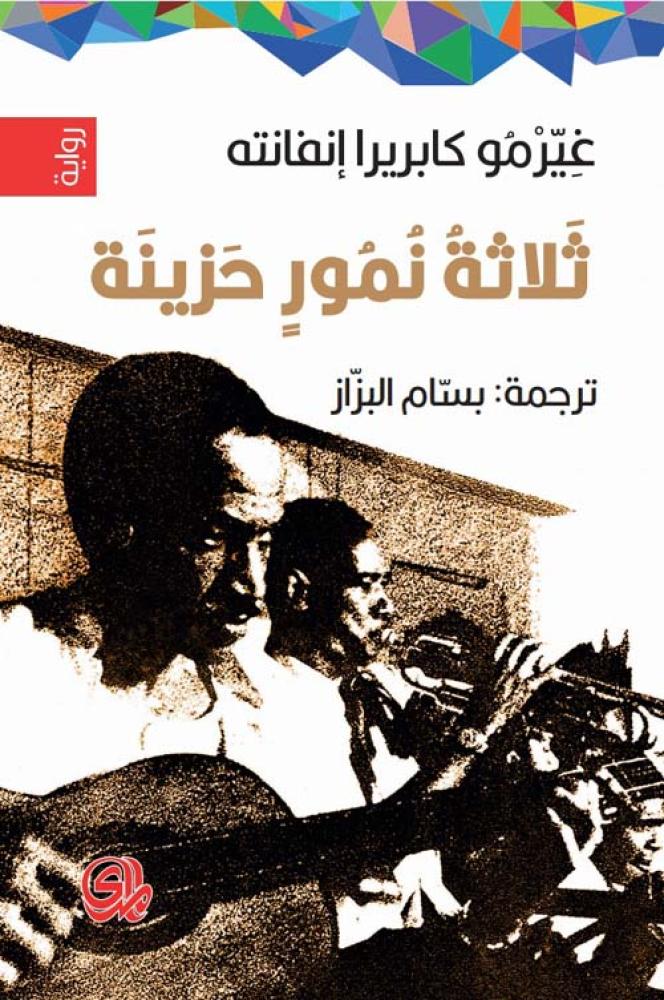
Three sad tigers
65.69ر.س
Product description
Author's name: Guillermo Cabrera Infante
Publisher: Dar Al-Mada for Publishing and Distribution
Year of publication: 2020
Literary classification: Novel
Brief about the book: Three Sad Tigers by Guillermo Cabrera Infante ...
Three Sad Tigers: An enjoyable word game that, with the emergence of abstract and surreal art, opened a new debate: Is the purpose of the artwork to entertain our eyes and help us understand it, or to strip our imagination and ourselves to dive into its depths and seek understanding and then pleasure?
Will we find our goal in this deep dive? Or will we return to the shore with a wet body and empty hands?
The topic took its course, and defenders of the new trend tried to promote it and convince the audience of the novelty of the product and its abundant returns and benefits. They convinced some, but many did not accept their claim that this abstraction and this departure from reality—above it, below it, or behind it—gives the viewer a space for contemplation and reflection to emerge with his own image, his own perception, and his own vision.
It is as if the creator is a player who kicks off to start, then the audience, each with their ball, heads toward a goal they imagine exists and envision their shot into it.
It is as if he throws the ball into the audience's court, while they repeat the saying of Al-Mutanabbi:
"My eyelids are closed over their disturbances, and mankind stays awake, dragging them, and they dispute."
Something similar happened in literature, especially in the novel.
In the sixties of the last century, a group of young Latin American novelists pioneered a style known as "Boom," which quickly expanded in scope, diversified in forms and colors, and sparked a revolution and upheaval.
Indeed. García Márquez, the Colombian, and Vargas Llosa, the Peruvian, along with Cortázar, the Argentine, and Carlos Fuentes, the Mexican, and others, caused a revolution in the world of the novel, directed at its language, content, and structure.
It was no longer a straightforward narrative with a beginning, a conflict, and a resolution; rather, it broke all sequences and disregarded structure altogether. It was no longer pure storytelling, but we began to hear about magical, historical, metaphysical, and fantasy elements.
It is said that the detonator that exploded the bomb and the stone that stirred the silence was the Cuban Revolution of 1959, with all its implications of a coup against the political, social, and intellectual reality in Cuba and Latin America.
That shift had its signs, and those revolutionaries had their guides, who were inspired by their literature and style—Europeans like Raymond Queneau, James Joyce, Lewis Carroll, Kafka—and Latin American Americans like Borges, Asturias, Carpentier, Juan Rulfo, and Ernesto Sabato, and before them, José Martí, Rubén Darío, and Arturo O'Leary Piety.

From Najran
Questions you might have