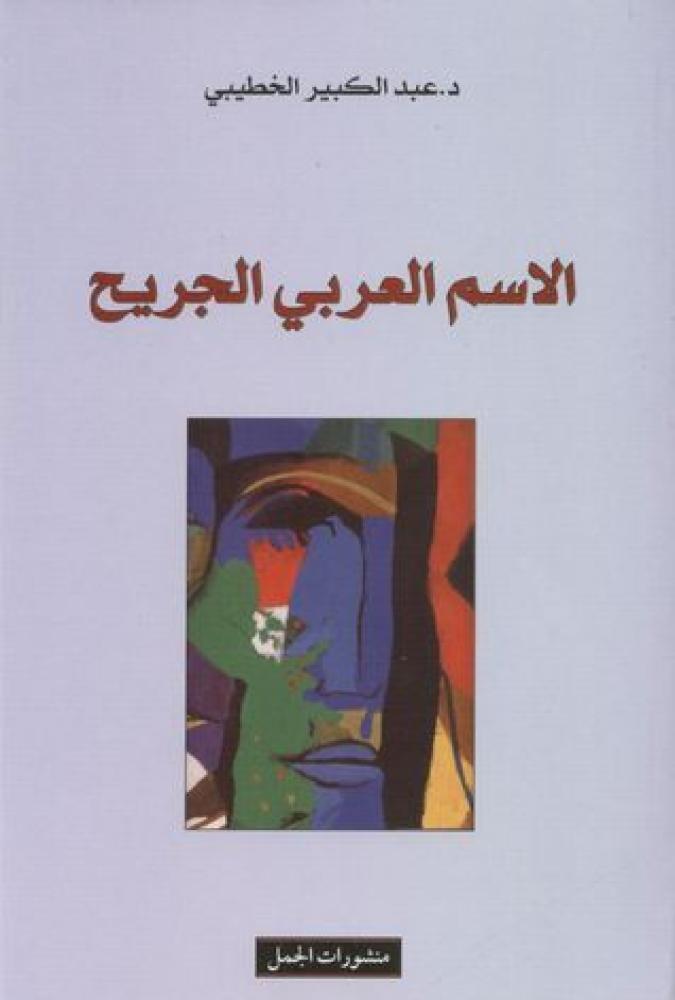
The wounded Arabic name
25ر.س
Product description
Author's name: Dr. Abdulkabeer Al-Khattabi
Publishing house: Al-Jamal Publications for Publishing and Distribution
Year of publication: 2009
Literary classification: History
Book overview: "The wounded Arabic name" has its uniqueness in modern Arab culture, and it is the most important book written by Al-Khattabi so far, in the field of research, and its importance is compared to "The Book of Blood" in the field of creativity.
A book that re-reads the Arab body from a heritage imbalance of Moroccan popular culture with a critical awareness, relying on two main aspects: criticizing the theological concept of the Arab body on one hand, and criticizing ethnological approaches that deal with popular culture externally and condescendingly on the other. It is the dual critique as Al-Khattabi calls it. Every reassurance finds itself here being judged, welcomed by a question that the tongue has spoken before.
This critical reading of the Arab body aims at a central goal, which is the separation between the conceptual body and the real body, the lived and tangible. Arab culture has dealt with the body based on transcendentalities that have hindered our reading of it according to theological laws, emptying the body of its historical and subjective load.
Thus, talking about the real body passes through talking about another body, strange to it. And what has this transcendental reading given us, in the final analysis, except for the miserable awareness that cannot see the body in its conscious and unconscious states?
Modern Arab culture appears as if it is a discourse written about books, whether it concerns re-reading the Arab heritage or confronting the historical phase that has recently woven a distinct structure different from previous social-cultural structures.
This intellectual field in which modern Arab culture has settled prevents transition to a different cognitive domain and another place for reading, and therefore the discussion of the real body has remained forbidden, with no difference between theologians and secularists.
This transition is prepared in Al-Khattabi's book on a second level, which is confronting Moroccan popular culture. It is not new to be interested in popular culture in the Arab world; both Romantics and their successors paid attention to it, but the boundary between their approach and Al-Khattabi’s approach is more than clear, based on methodology.
The difference between the two approaches lies in answering the following question: Why popular culture?
Al-Khattabi’s approach to popular culture is contrary to any phase slogan, its outward appearance is mercy, and its inner is torment. It is also far from any ethnological intervention in an Arabic tongue that claims to oppose the foreign tongue while it is actually a means to achieve its goals and dreams.
This approach, rather, is a violent ideological intervention that does not surrender to the scenes of strangeness where ethnologists feel their nerves stretching, making their approach to it an entry to exploit popular culture after stealing the word from the mouth of the people.
Al-Khattabi’s reading of popular culture is a methodological and theoretical halt in a historical phase that still sanctifies transcendentalities and remains silent at the boundaries that see touching them as a cause for destruction.
This historical phase is still centered around theological thought, and therefore any approach that fears class war within the text or outside it remains imprisoned within the concepts of the traditional cognitive field, despite all the verbal claims that suggest otherwise.
Al-Khattabi’s reading of the Arab body relies on difference, which is a fundamental law of this reading. Difference is an acknowledgment of multiplicity, and reaching the core of the wounded Arabic name cannot be achieved without considering the multiplicity of languages through which this wound was shaped.
The talk of books about books is, in one of its dimensions, a talk of the center about the margin, a talk of unity about multiplicity, a talk of absence about presence, and certainly this talk has a repressive character, seeing what is around it as dead, inarticulate, and unshaken, as long as we can eliminate this multiplicity that has been and still is an active and driving force of history.
Difference is the active force for Al-Khattabi; there is a class difference, linguistic difference, historical difference, geographical difference, endless differences that modern Arab culture, whether dominant or on its way to dominance, has tried to suppress.
The difference that Al-Khattabi seeks to read is this active force that we have always slept through, driven by the principle of tyranny and dominance.
In this book, the difference is clear: it is Moroccan popular culture — the talk of proverbs, tattoos, the book "Al-Rawd Al-‘Atir" by Sheikh Nefzaoui, the story of the speaking bird, in addition to calligraphy.
The first four fields are strange to written Arab culture or forbidden to practice in both the East and the West. They are the culture of the marginalized whom we seek help from to solve our contradictions, neglect, boycott, or deter when they ask about their fate, as a human block that is the foundation of all social existence and has a stake in every change.
The second law of this reading depends on dismantling the theological that moves within its domain despite us, as it is the heritage that criticism has not approached, as long as it is revered and sacred in our subconscious, if not in our consciousness as well.
Here, Nietzsche, Heidegger, Marx, Freud, Levi-Strauss, Lacan, and Dreyfus find legitimacy to speak in Al-Khattabi’s text.
The Arab world has deteriorated with the accumulation of transcendental concepts and values that separate man from his body, man from his future, his pleasure, lust, and change.
And without exaggeration, we say that Arab liberation also presupposes the liberation of the body.
The social relations we call for changing their structures, from feudal and backward states, are inseparable from the necessity of liberating the body subjected to various forms of oppression.

From Najran