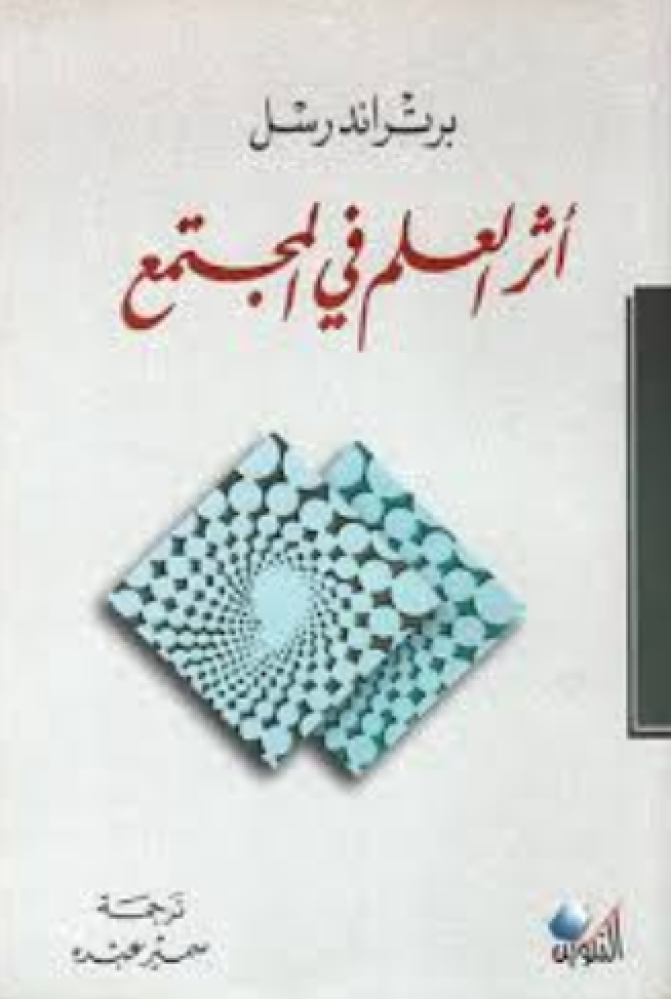
The impact of knowledge on society
11.99ر.س
Out of Stock
Product description
Author's name: Bertrand Russell
Publisher: Al-Takween for Publishing and Distribution
Year of publication: 2009
Literary classification: Philosophy and Thought
Brief about the book: This book is a collection of lectures delivered at Ruskin College in Oxford, as well as three of them were re-delivered at Columbia University in New York. The last chapter is a separate lecture given at the Royal Society of Medicine in London. These lectures were published in the form of a book for the first time in 1952. This book is not deeply philosophical or difficult to grasp, but it is a book for all intellectuals who wish to gain an insightful perspective on topics considered of utmost importance in human life. As Russell shows us, science enables humans to enjoy a level of well-being better than anything in previous ages, but this prosperity may be a temporary state that we might lose within a generation or two, because science — as the author presents — provides us with all this prosperity under certain conditions. If these conditions are not met, the negative impact of science will outweigh its positive impact many times over. Our behavior as humans in the coming decades will determine whether this prosperity continues and spreads to all parts of the world (which is a fundamental condition according to the author) or recedes, returning us to barbaric ages. Other conditions, besides the universality of prosperity, include: eliminating wars, stabilizing the population, distributing power within a just global government, and providing individuals with initiative in work and leisure... These are harsh conditions, but the author is optimistic about their achievement, believing that humans must resort to the option of reason rather than the option of death.
The reader will notice that many of the problems discussed by the author still exist, and some have even worsened, and most of his predictions have proven correct over time. Therefore, the book is a (classic) work whose value is not diminished by the passage of time, and reading it today is just as valid as when it was first published.
There is something unfortunate: Russell died before witnessing the electronic and computer revolution that elevated scientific technology to levels previously unseen at the time of his lectures and their publication. Undoubtedly, the changes brought about by this new technological revolution and how it might influence humanity’s future open vast new horizons beyond what the author addressed. Nanotechnology and genetic engineering will have a much greater impact than computers and electronics during the first half of this century, and those who live long enough will experience their effects. The author predicted such developments, stating that scientific technology and its impacts are still in their infancy. As for where it will end, that knowledge is with my Lord.
The third chapter of the book, about (scientific technology in oligarchic rule), is of particular importance to the Arab reader. Most governments in the Arab world are somewhat oligarchic. This term includes any type of rule where only a specific group within society holds power without others. Naturally, this type of rule is comprehensive. But what reassures is that Arab oligarchies are not (scientific) to the extent that they pose a lasting danger. Also, the author's conclusion that oligarchic rule cannot continue unless it spreads worldwide gives the Arab individual hope for the end of this wave of totalitarian rule.

From Najran