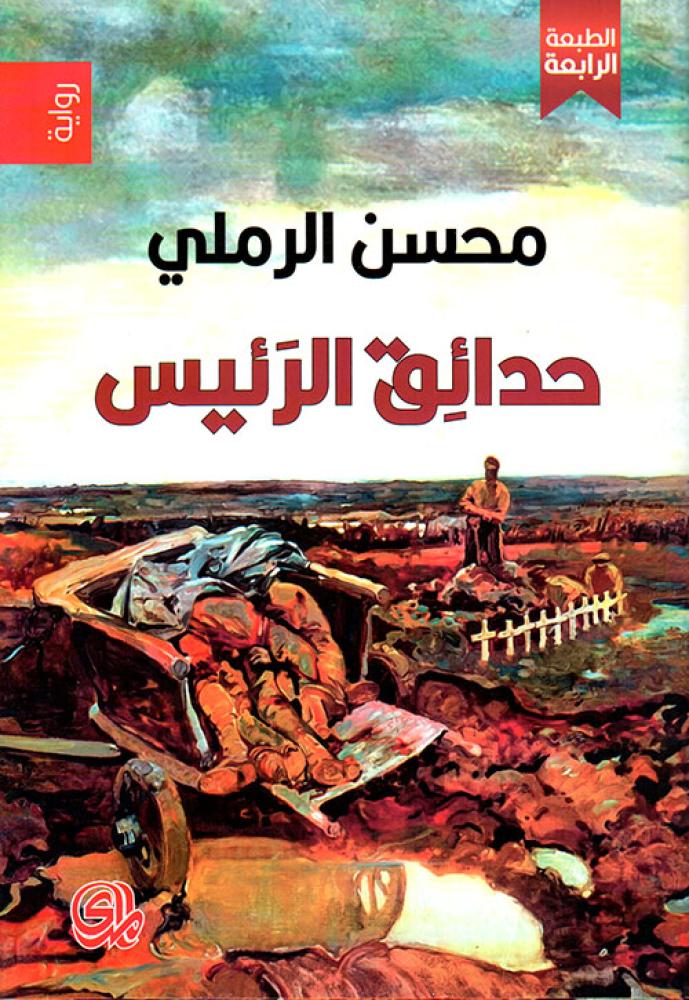
President Gardens
36.71ر.س
Out of Stock
Product description
Author's name: Mohsen Al-Ramli
Publisher: Dar Al-Mada for Publishing and Distribution
Year of publication: 2016
Literary classification: Novel
Brief about the book: On the dividing line between authority and people, or between the executioner and the victim, the novel "The President's Gardens" moves and tells through this movement stories of three of Iraq's sons, all of whom are "children of the cracked land," a description chosen by "Mohsen Al-Ramli" for three exceptional heroes: Tarek bin Zaher, the mosque imam; Abdullah bin Shaq Al-Ard, who became Salih's son; and Ibrahim bin Suhail Al-Dimashqi.
All three were born in 1959 in the most famous sequential years, and since their crawling and playing naked at the back, in the dirt near their mothers gathered beside the skirts, or in front of their house doors, in the evenings, exchanging gossip and news they call (علوم), they became friends who do not part except for sleeping at their parents' houses, and sometimes one stays at the other's house if upset with his family or late in staying up.
Together they contracted measles and recovered from it, learned to walk, swim, and shoot birds, raise pigeons, steal watermelons and pomegranates, and play shooting, hiding, and football.
Together they entered school, defending each other against attacks from other students, studying for exams in the fields or in one of their rooms at night.
This fictional space is driven by a discourse with its own characteristics, whether in narration, dialogue, or language.
In terms of narration, the novelist moves between facts and memories, and often memories serve as a refuge from harsh realities, where the narrative language tends toward description: "...They said: What do we do, Sheikh? Do we bury the heads alone or wait until we find their bodies and bury them together? They were killed in Baghdad, or on the way to it, and Baghdad now is chaos teeming with unidentified bodies, car bombs, foreigners, and lies, and perhaps it is impossible to find their bodies...".
Regarding dialogue, the novelist successfully blends narration and presentation to depict characters and their speeches, making his voice a tool to reveal their instincts, thoughts, behaviors, and their different social tones and even their positions, as in his talk about "The Palaces of the People": "...His Excellency says they are the people's palaces, he loves the people and the people love him. It also gives a proud image of us and shows visiting foreigners how much dignity the Iraqi people live in...".
This enhances the realistic dimension of the contradiction/ gap between authority and the people, and also reflects the spirit of the society it discusses.
As for the language, it is smooth and clear, leaning toward beautiful descriptive imagery that remains faithful to the content and facts, and more expressive of Iraqi specificity, both socially and individually, in the characters' speech and their vital intentions.
Thus, "Mohsen Al-Ramli" was able to express the most human feelings of frustration and the sense of the absurdity of fate in the face of an entire people's destiny, faces change, but injustice and the executioner remain. As the Lebanese say, it became "Furnji Bernji," meaning a chaotic, oppressive situation.
For half a century, the lives of ordinary people have not changed—wars, sieges, mass graves, and the chaos of occupation, where Ibrahim's blood, symbolizing Iraqi blood, gets lost in this novel among remnants of a previous regime and followers of a subsequent regime.
"The President's Gardens" is more than a novel; it is a story of a homeland, between yesterday's Iraq and today's Iraq, crafted by Mohsen Al-Ramli to expose the falsehood of the democracies of the advanced world, as he tests his weapons against the chests of our children.

From Najran
Questions you might have