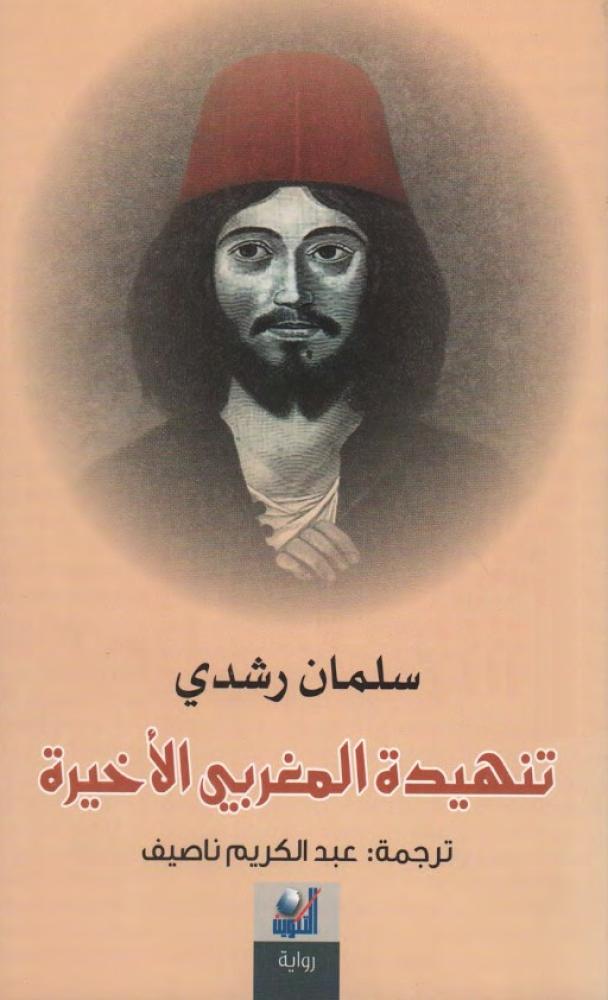
The Moroccan's last sigh
65.69ر.س
Out of Stock
Product description
Author's name: Salman Rashid
Publisher: Al-Takween for Publishing and Distribution
Year of publication: 2018
Literary classification: Novel
Brief about the book: In "The Last Moroccan Sigh," Rashid builds his plot on three dimensions; two spatial dimensions, which are India, the birthplace of the protagonist and narrator Maurice Al-Zughbi, and Spain, the land of the expelled ancestors from the Garden of Al-Andalus and the desired place for the last sigh and the origin of Maurice's family surname, as Zughbi in meaning indicates misfortune, and here it refers to Abu Abdullah Al-Saghir, the last king of Al-Andalus who was exiled by his Jewish maid to India while pregnant, and there his lineage continued. The third dimension is time, which borrows the movement of a pendulum rising and falling, merging beginnings with ends without the narration falling into the dull rhythm of the pendulum.
Returning to the events of the novel, Rashid moves back in time to the era of another rulers of the Arab Al-Andalus and the Jews' choice between Christianity and exile, and Columbus's launch to discover a new route to India. In India, the narrator recounts the history of his mother's ancestors from his great-grandfather, Francisco de Gama, a wealthy, patriotic, and progressive spice merchant, passing through his grandmother Epifania, who whispers to his mother Aurora a curse that will strike her son Maurice, who is not yet born, in an allusion to the Macondo curse in a hundred years of solitude.
Aurora remains the most present character in the novel, whether in terms of the events she participated in or the contradictory developments and transformations of her personality. Aurora marries the Jewish Abraham Al-Zughbi after a passionate love story that defied religious figures and the society of Cochin, and then Maurice is born, neither as a Catholic nor a Jew, but as an unknown "Yehuliki." The "Marquisian" paradox — if the term is correct — is that Maurice was born after his mother carried him for only four and a half months; this doubled time will accompany him throughout his life until he reaches seventy, while he is still thirty-five.
Later, Abraham moves the family to Bombay, leaving behind the Jewish community in Cochin on the verge of extinction, where he engages in more profitable activities, including smuggling girls to city brothels, heroin trafficking, and even nuclear weapons trade. If Rashid chose this villainous role for Abraham, it reveals a new complex dimension in Aurora, the talented artist and confused mother who suffers from a sense of emotional neglect toward her son Maurice, but she resolves her inner conflict by choosing painting as her space of motherhood.
Here, Maurice enters his mother's drawings, and Spain appears in paintings about India, where the series of drawings ends with a painting bearing the title of the novel, depicting Maurice as a spirit trapped in hell.
The events' chapters follow rapidly afterward, shedding light on Maurice's life in India and on India's own history, from the British occupation, the division of society between supporters and opponents, passing through its political parties and figures like Nehru and Gandhi, and the country's descent into sectarian and ethnic conflicts and wars. Amid these events, Aurora reappears as an activist and defender of minority rights against the majority Hindu population.
After her mother is killed, her father's trade is destroyed, and conflicts devastate half of Bombay, Maurice decides to withdraw from India to Andalusia, overwhelmed by the scale of destruction and barbarism, believing in Aurora's prophecy depicted in his drawing inside hell.
Rashid returns in the final chapter to close the circle with the first chapter, paralleling Maurice and Abu Abdullah Al-Saghir in their fates condemned to exile, and he soon adds to Maurice's suffering, seeing him lost among tourists in Spain as if he were in one of Dante's terrifying labyrinths, searching for his stolen drawings of his mother. His search leads him to a prison where he begins writing the family story, ending with Maurice seeking sleep near a gravestone, hoping to wake up in a better time.
Finally, it seems Rashid deliberately implied in the novel's content a message that the fate of children of exile is one of alienation and searching for the lost and missing. As for the form and narrative structure, Rashid's style, which seeks chaos in writing, leads to an issue in meaning, thus engaging in intentional ambiguity, and at the same time, it destroys the classical structure of the novel.
Moreover, numerous characters appear and disappear even in the last pages, along with the inclusion of names, symbols, and myths scattered throughout the novel. All this makes the text difficult to access in terms of literary enjoyment and amazement, despite containing many keys within it.

From Najran
Questions you might have