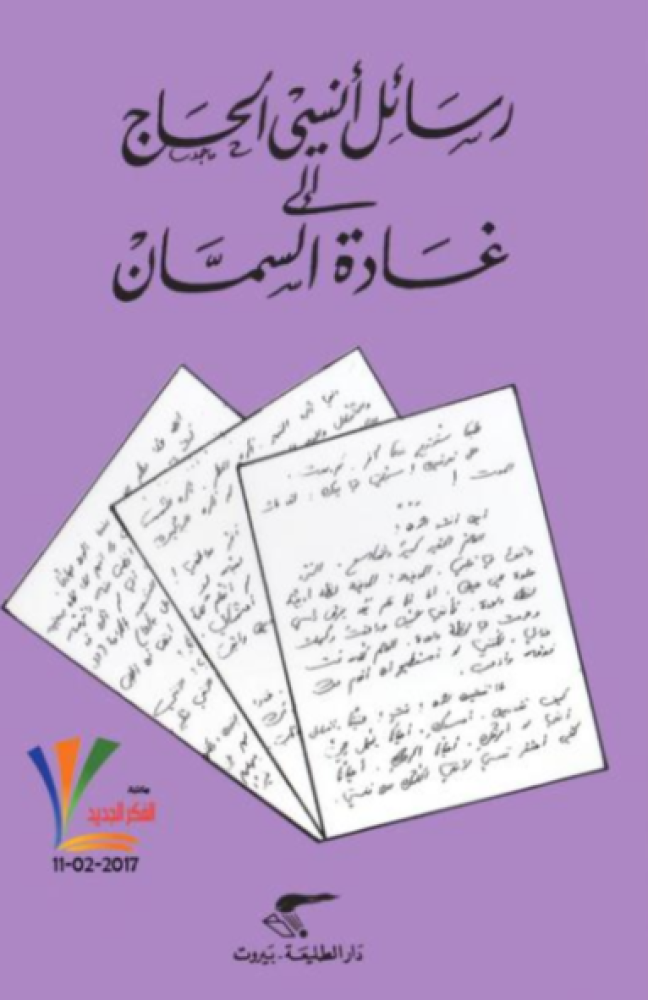
Ansi Al-Haj's messages to Ghada Al-Samman
26ر.س
Out of Stock
Product description
Author's name: Ansi Al-Haj publisher: Al-Tali'a for Publishing and Distribution year of publication: 2019 literary classification: letters brief about the book: If the reader thinks that "Ansi Al-Haj's letters to Ghada Al-Samman," recently published in a book by "Dar Al-Tali'a" in Beirut, are letters of literary importance or that they can be indiscriminately included with the immortal love letters, then his assumption will be disappointed. Because these letters can help the reader or researcher understand the psyche of the disturbed and unstable poet Ansi Al-Haj while he was in his mid-twenties. And perhaps they benefit psychologists more than they benefit lovers, if these scholars intend to study the biography of the late poet. They are, therefore, the product of a specific period of his life during which he was rebellious against everything familiar and consecrated, and they reflect a set of personal or social values—nothing more, nothing less. Without introductions or prior warning, as they say, Ansi Al-Haj sends seven consecutive letters to Ghada Al-Samman in which he declares his love for her, and he does not imagine (as is clear from the letters) that the "beloved" might respond to his request or apologize for reciprocating the love he offers. He "decided" to love her, and she has nothing to do but submit to his decision. He says to her: "Half of love is will, and I have decided that I want to love you until the end, either you or the end." "I don't think I'm the only one in need of you. You also need me. Be brave enough to admit that." In another letter, he replies: "I love to love you... I was confident that I should know you and that a close relationship should develop between us, extraordinary. And I kept saying to myself: why should all these people know her except me? Am I not more deserving than everyone else? I felt they were wronging me and stealing you from me, and that my right to you is the only legitimate right!" And this is among the strangest and most bizarre things that can be found in love letters, if such phrases or ideas are meant for a love letter or a love dictionary. Because in love, as in its dictionary, one does not "decide" to love or adore, but "finds" himself having loved or adored. Umm Kulthum in one of her songs says about the beloved's eyes: "They told me to love, I found myself in love," and this is true, for the lover loves and does not decide beforehand or after deep thought to love. Ansi decided to love Ghada Al-Samman, informed her of his decision, and within the details of this decision, Ghada "needs" him as much as he "needs" her. So all she has to do is submit to his will and give herself to him. And all this, if it indicates anything, shows that the "modernity" that Ansi Al-Haj raised throughout his life was just a slogan that did not touch the soul, spirit, or behavior. He remained internally backward. Just a mention of a woman he desired. The depths remained linked to ancient centuries, not to the era of modernity, civilization, culture, or different behavior. He wants an "extraordinary intimate relationship" between him and her. What is this extraordinary intimate relationship? There is no need to answer the question. The answer is known. As for addressing her with a pure, poetic emotional speech, that has not been clarified, although he writes to a writer and rebellious intellectual like him, and rebellious against the old, decayed social values embodied by the phrase "patriarchal society" or "old society." "And how does all these people know her except me?" Isn't he more deserving than everyone else to include her in his adventure archive? Others steal her from him, while his right to her is the only legitimate right... Then others have nothing to do but hide and disappear from existence! The confidence of this male to himself reaches the point of saying in one of his letters: "I think I felt that you are destined for me, and whenever I read news about you, I feel jealousy, annoyance, and fear. I envy you from the world." This means he is addressing a woman who is his possession, and he feels she is destined for him from eternity. All this without any indication from her that she reciprocated or exchanged any feelings with him, and that she is in fact just a writer or novelist or colleague sitting with him and others in public cafes in Beirut! Ansi Al-Haj's letters to Ghada Al-Samman differ from Ghassan Kanafani's letters to her, published a quarter of a century ago, in that Ghassan Kanafani appeared in his letters to Ghada Al-Samman as a true "lover" who had a mutual love relationship with his beloved, while Ansi Al-Haj in these letters appeared merely as a "teenager," no more, no less. A teenager who projected his personal tragedy onto Ghada more than anything else. Anyone reading these letters finds their author drowning in the darkness of his madness and hallucinations more than drowning in the hell of his love. There is no love, but a process of lust, no more, or emotional and intellectual adolescence together. And we must not forget the arrogance and vanity that appear. Countless evidence can be cited of such dual adolescence, mixed with arrogance and vanity, as we mentioned earlier—the "decision" he made by declaring his love for her, and also that he is not the only one in need of her, but she also needs him. His need for her can be called, and it is the male's need for the female, but what is her need for him? Is it purely biological need, or is it the need of an educated girl, unfamiliar with Beirut, originally from Damascus, at the beginning of her novelist journey, to a journalist like him who can provide her with media services? Surely, he hints to her with such assistance. But is such a hint enough to seduce a girl in her situation and her position, who was not an unknown educated woman at that point in her life, as she was working in journalism, and her father, Ahmad Al-Samman, was the president of the University of Damascus? It is unreasonable for a writer in her position to respond to him just because he works for a Lebanese daily newspaper, "An-Nahar," even if it was the most widely circulated Lebanese newspaper at the time. Ghada Al-Samman says in the few lines she prepared to introduce these letters that she did not write any letter to Ansi. And this is indeed clear when reading his letters, which do not contain any indication that the letters between them were exchanged. The letters are his alone, and he showered her with a barrage of words indicating self-disturbance and plunging into absurdity, reaching madness. He says to her: "It is the first time that I feel that I am on the verge of madness... I have lost myself. Do you realize what this means? My old rebellion against the world has been revived in me, the rebellion through which I used to respond to the reaction and erupt from the heart of my loneliness like fire." And in another letter, he says: "Does my crime shock me? Am I innocent? Am I a criminal? Am I interested? What did I do? When I first contacted you, you were still just a vague possibility, but strong... You are still closed off to me, refusing to come out to me with the nakedness I desire and want to bear its burden." His "crisis" reaches a terrifying level in other parts of his letters, including these excerpts: "If you knew to what extent you are responsible for my fate now, you would tremble with fear. I chose you. And you are responsible for me, whether you like it or not. I have placed my cursed freedom upon you... In the end, you will not know anything more beautiful than my love. I may not be confident in anything, but I am confident in this thing. And you, do I keep talking to you without a conversation? Let love end on earth and let people go to hell. I will remain alone, stamping my love on stones. I will love only death and ghosts, and I will love the day too, and I will love the extinction of my passionate self in this miserable world. And I will love you, and I will say nothing else... Words closer to delirium sometimes, and to emptiness at other times, and always in need of psychology words indicating a crisis in the self, not a great love he has for a woman, an intellectual and emotional teenager, mixed with gloom and a "revolution" familiar to many writers and poets at the beginning of their careers or in the phase before the age of twenty, while the poet was then twenty-six. But neither the twenties nor the thirties nor even the seventies and eighties are sometimes able to curb adolescence and reach mental maturity. For some poet, writer, or artist, adolescence persisted throughout his life, and he thought that when he wrote and lost balance, equilibrium, and the right words, he was in the fullness of modernity, creating, soaring, achieving, and able to do what the pioneers could not!

From Najran