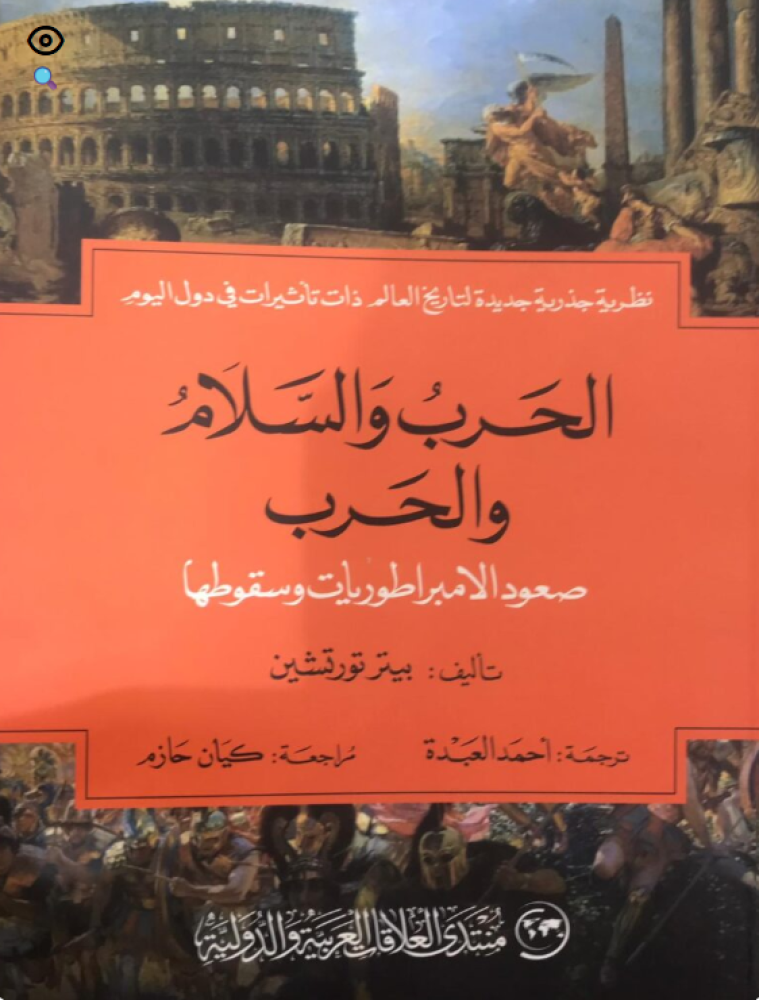
War and peace and war
56.01ر.س
Out of Stock
Product description
Author's name: Petertorchindar
Publisher: Arab and International Relations Forum
Year of publication: 2025
Literary classification: History
Book overview: The phenomenon of forming empires, their rise and fall, occupied a number of philosophers, thinkers, and historians, where philosophers such as Ibn Khaldun reflected on the succession of states and the upheavals of eras, while others like Marx, Engels, and Weber analyzed the material phenomena of complex societies that formed over ages. With the renaissance and modernity, the study of history gained a scientific methodology, but lacked sufficient data and evidence for thinkers and theorists to formulate their perceptions about the succession of human societies' formations, given the scarcity of statistical information on which conclusions could be based, which kept all predictions about societal trends lacking definitive scientific legitimacy.
However, the American researcher of Russian origin, Petertorchindar, believes that the dominance of science in our era provides large databases and statistics, enabling us to reconsider the way of writing the history of history itself, by transitioning it to the rigor of basic sciences like physics and mathematics, or at least approaching them. Thus, it is possible to discover recurring patterns, and predict states of instability and severe societal crises without ideological biases, and perhaps we can build consensus among the relevant factions of political, economic, and cultural elites to take precautionary measures that may help prevent major disasters and crises.
Accordingly, laws can be established for the rise and fall of empires, for population explosions, and the accompanying systemic imbalances, which he attempts to explain in his book "War, Peace, and War: The Rise and Fall of Empires" (translated by Ahmed Al-Abda, Arab and International Relations Forum, Doha, 2023). In it, he presents a law for reading the rise and fall of empires, summarized as "peace brings war, and war brings peace," based on Ibn Khaldun’s theories of the rise and fall of states. He sees that societies on the borders of different cultures are forced, due to this proximity, to find a unifying bond for cooperation and support, and this bond is "asabiyyah" (social cohesion), a concept introduced by Ibn Khaldun. This bond may become solidified and strengthened, allowing the group to transform into a political force, expanding its influence according to its strength, cohesion, and cooperation, thus creating empires through wars with neighbors.
If the empire stabilizes, internal peace and security follow, bringing prosperity, and with them come factors that weaken this unified asabiyyah, as wealth grows, welfare spreads, luxury and the affluent increase, and tendencies of monopolization and exclusivity develop. An elite emerges, bound by a narrower asabiyyah than that of the community, monopolizing resources and exploiting the weak for the strong, the poor for the rich. Conflicts over wealth and power arise, weakening the unifying social bond, and the weak, driven by greed, lead to war. These wars lead to the empire’s collapse and decay.
With the collapse of the unifying empires, war erupts, epidemics and death spread, and civil wars occur, resulting in population decline and a reduction in elites.

From Najran