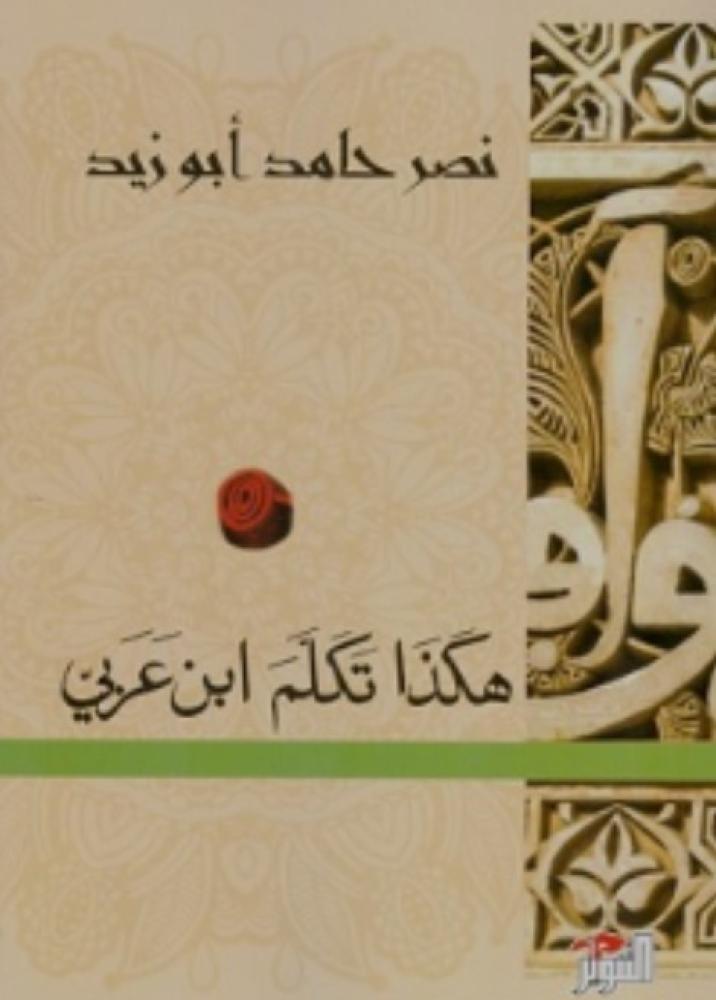
This is how Ibn Arabi spoke
42.50ر.س
Out of Stock
Product description
Author's name: Nasr Hamid Abu Zayd
Publisher: Dar Al-Tanweer for Publishing and Distribution
Year of publication: 2001
Literary classification: Studies and Researches
Brief about the book: The importance of Ibn Arabi's thought is due to it representing a state of maturity in Islamic thought in its various fields, from jurisprudence, theology, philosophy, and Sufism, in addition to the sciences of "Qur'an interpretation" and "Prophetic Hadith sciences" and sciences of language and rhetoric... etc.
From this perspective, his study in the Islamic context reveals a panorama of Islamic thought in the sixth and seventh Hijri centuries (the eleventh and twelfth Gregorian centuries).
From another angle; Sheikh al-Akbar Muhyiddin Ibn Arabi is the link between the global heritage and the Islamic heritage, and from this perspective, Ibn Arabi's heritage can be viewed as a living, creative continuity with the global heritage, which was known and circulated in his era, whether it was religious heritage, Christian or Jewish, or philosophical and intellectual heritage.
This is evident from his insistence on using diverse terms to denote a single concept.
However, Ibn Arabi's importance as a link does not stop at his comprehension of human heritage and his utilization of it to establish his lofty philosophical and intellectual structure; it goes beyond that to his contribution to reshaping human heritage through a creative influence on it equally.
Evidence of this can be found in the studies of the Japanese orientalist Toshiko Izutsu on "Ibn Arabi and Taoism," as well as the studies of the Spanish Arabist Aisin Blausios on the influence of Ibn Arabi's writings on Raymond Lull and his impact on Dante Alighieri, the author of "The Divine Comedy."
His comprehension of the Islamic heritage preceding him and his influence on the subsequent heritage is more than enough to warrant no further proof.
What is clear is that Ibn Arabi's reading of the previous heritage contributed to shaping many of the implicit concepts and perceptions in the writings of his predecessors.
From here, Dr. Nasr Hamid Abu Zayd sees that invoking Ibn Arabi, along with other spiritual figures across cultures, is a necessity, as his experience, and their experiences, can serve as a source of inspiration in our world, which suffers from the problems of life.
He adds that the spiritual experience is the source of artistic experience, music, literature, and all auditory, visual, and kinetic arts; it is the comprehensive framework of religion and art.
This is the importance of recalling Ibn Arabi for Abu Zayd in the general context.
However, for him also, recalling Ibn Arabi in the Islamic context, and restoring him from the margin to the core of the discourse again, is equally important, due to the dominance of some trends, ideas, and Salafi visions over the entire Islamic discourse in the last thirty years of the twentieth century.
Additionally, in the field of contributing to affirming the values of dialogue, understanding, and mutual courage between East and West, Ibn Arabi's thought represents a rich legacy worthy of contemplation and purpose, to liberate the contemporary Muslim mind from the effects of political, social, and cultural problems that caused tension and frustration in Islamic thought.
On one hand, and on the other, Ibn Arabi's thought offers the non-Muslim reader a different image of the spirituality of Islam, and of the concept of "Jihad," which has been heavily distorted.
From this standpoint and within this framework, Dr. Nasr Hamid Abu Zayd proceeds with Ibn Arabi's texts and, earlier, with his biography, to introduce the reader to Ibn Arabi's thought.

From Najran
Questions you might have