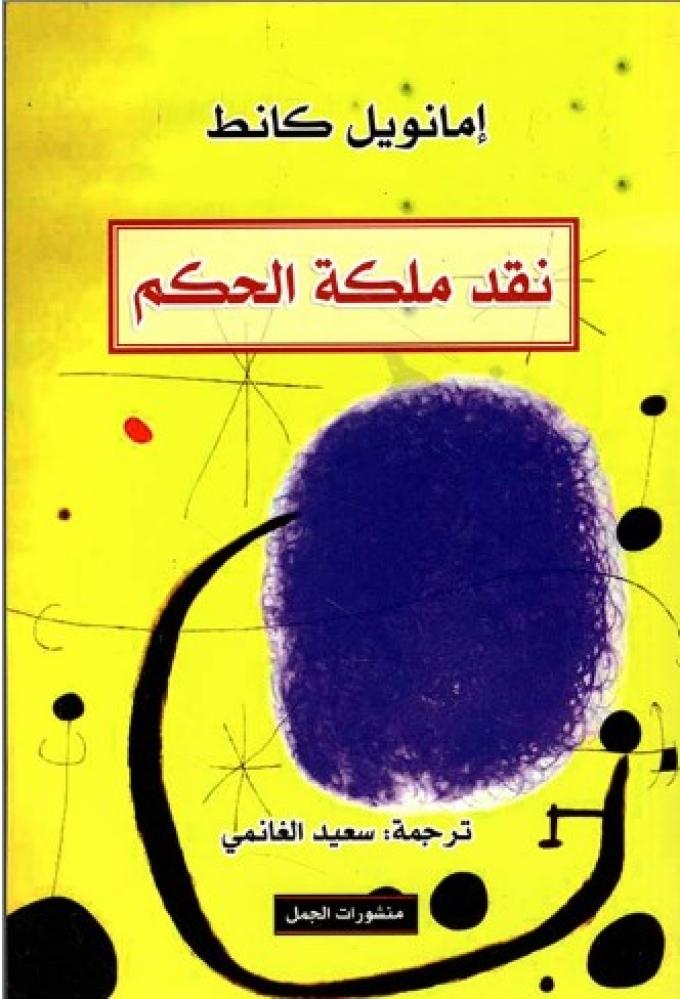
Criticism of the queen of governance
64ر.س
Out of Stock
Product description
Author's name: Immanuel Kant
Publisher: Al-Jamal Publications for Publishing and Distribution
Year of publication: 2019
Literary classification: Philosophy and Thought
Brief about the book: We must point out a characteristic that distinguishes Kant's philosophical method, which is that his philosophical doctrine is so closely attached to his language that they cannot be separated at all. To present Kant's critical system, one must adopt his language along with it at the same time. Kant's doctrine is so intertwined with his language that it is inseparable. This makes every attempt to explain his thought an explanation in his own words. And as soon as the explainer uses a linguistic device from outside this system, he shifts from being a critic of this thought to a critic of it. But to do the second task, the first task must be accomplished.
It seems to me that the reason for this strong interconnection between Kant's language and his thought is due to two things: First, that Kant's doctrine itself thinks in the language of transcendental concepts, meaning the priori concepts that precede all experience, including linguistic experience, as a purely intellectual apparatus existing in itself. Second, that this doctrine did not give language itself any importance at all in thinking. Instead, it is the preconceptual schemata and categories that occupy its position, which Kant perceives as existing entirely within the cognitive apparatus of humans regardless of language.
This fusion between Kant's philosophical language and his doctrine creates difficulty in this language, making it a language that maneuvers with progress and delay, elevation and decline, and saying one thing and its opposite in a single phrase. It seeks to grasp what is transcendent to sensation on one hand, and what it internalizes and nourishes on the other.
Therefore, Kant's sentences are characterized by excessive length and fragmentation into subordinate sentences burdened with both abstract and sensory meanings. Readers have always found them burdensome, so much so that it was said that Goethe felt as if he was walking in a "dark room" whenever he read something by Kant.
This complaint is often repeated among most of his scholars. Although Roger Scruton, in his book on "Kant," considers "Critique of Judgment" to be "the most important work in aesthetics written in modern times," and states that "since Plato, no philosopher has given aesthetic experience a central role in philosophy like Kant did," he criticizes Kant for the difficulty of his language.
In his book "From Descartes to Wittgenstein: A Brief History of Modern Philosophy," he notes that "while the third critique remains undeniably the most important work in aesthetics produced since Aristotle's era, it was the product of an exhausted mind burdened with ideas that had not yet fully formed, unable to give them the comprehensive treatment they deserve."
Undoubtedly, Kant in "Critique of Judgment" is the most important philosopher in history to elevate the science of beauty to a pillar of epistemology, second only to Paul Ricoeur in his book "Time and Narrative." However, the source of difficulty in his writing is that the language itself was neglected as much as it was neglected by no other philosopher.

From Najran