Islamic jurisprudence between freedom of Ijtihad and the restrictions of the official madhhab
25.30ر.س
Out of Stock
Product description
The price includes tax 25.30
Cover
Namaa Center
Author: Dr. Osama Shafi' Al-Sayed
About the edition:
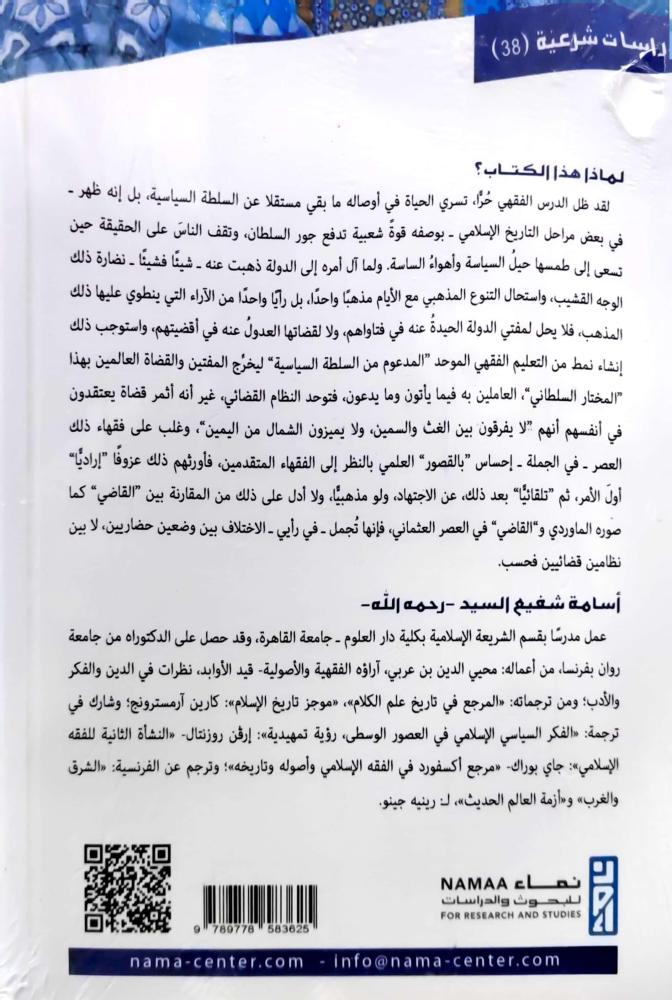
Legal scholarship has remained free, life flows through its veins as long as it remains independent of political authority, but it appeared — in some phases of Islamic history — as a popular force pushing against the tyranny of the sultan, and standing with the people for truth when political tricks and the whims of politicians attempt to obscure it.
And when its matter became part of the state, the freshness of that pale face gradually faded away, and the sectarian diversity over the days turned into a single sect, but a single opinion among the opinions contained within that sect.
It is no longer permissible for the state's mufti to deviate from it in their fatwas, nor for the just judges to deviate from it in their judgments.
This necessitated the creation of a unified jurisprudential education system "supported by political authority" to produce muftis and judges knowledgeable of this "royal choice," working according to it in what they issue and what they call for.
Thus, the judicial system was unified, but it resulted in judges who believe — in themselves — that they "cannot distinguish between the good and the bad, nor tell the north from the south."
In general, the jurists of that era were overwhelmed by a sense of "scientific deficiency" compared to the earlier jurists, which initially led to a voluntary reluctance, then automatically, to independent reasoning, even sectarian.
There is no better evidence of this than the comparison between "the judge" as depicted by Al-Mawardi and "the judge" in the Ottoman era, which, in my opinion, summarizes the difference between two civilizational states, not just two judicial systems.

From Riyadh