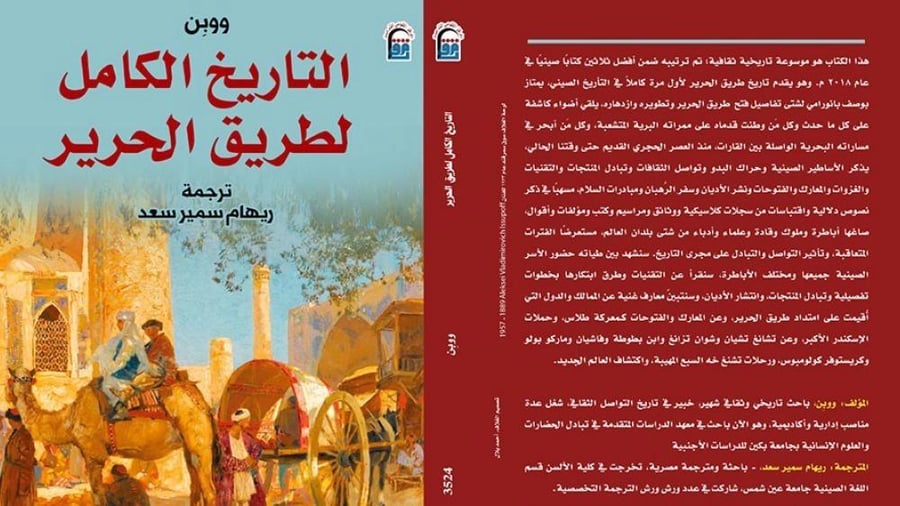
The full history of the Silk Road
57.50ر.س
Out of Stock
Product description
The National Center for Translation issued, in Cairo, the book "The Complete History of the Silk Road" by the Chinese historian "Woben", translated by Riham Samir Saad, and the book presents, traces, and monitors for the first time the routes of the Silk Road from various angles. The book talks about Chinese myths, cultural communication, exchange of products and technologies, invasions, battles, conquests, spreading religions, monks' travels, peace initiatives, and mentions texts and quotes from classical records, documents, decrees, books, and writings, authored by emperors, kings, leaders, scholars, and writers from different countries around the world, reviewing successive periods, and the impact of communication and exchange in the course of history. The name (Silk Road) was introduced early on by the German geographer and geologist Rischehofen, who inherited the traditions of the European Age of Exploration, emerging in the 17th and 18th centuries. From 1868 to 1872, he undertook seven exploratory trips to China, during which he traveled across most of its lands. After returning to his homeland, he published five volumes titled "Results of My Exploratory Journey to China and the Ongoing Research." The famous explorer Sven Anders Hedin— a student of Rischehofen— mentioned in his book (The Silk Road), published in the 1930s, that the term (Silk Road) was not previously mentioned in Chinese documents, but most likely the first to use this descriptive term was Rischehofen. He mentioned the term (Silk Road) in a famous book about China, clarified its coordinates on the map, and additionally explained the maritime Silk Road. Sven Anders Hedin said: "The name Silk Road explains the whole matter," confirming the significant academic development of this concept over thousands of difficult and mysterious years; its influence was not limited to opening horizons for Chinese and foreign cultural exchanges, but also contributed to exchanges that continued for thousands of years in Chinese cultural history and global cultural history. It has always been a main transit route, and some Western scholars say that the history of the Silk Road is "half of world history," as it narrates the history of global cultural exchanges that passed through the Asian continent. Based on reality and modern academia, the "Silk Road" has become a well-known term, encompassing more than just geography (the route). UNESCO defined it as "a route of dialogue," creating dialogue between the East and the West, between different ethnic cultures in Eurasia, and among peoples themselves. Because the Silk Road was a path of convergence, exchange, and dialogue of Eastern and Western cultures, it gained a special place and importance in the history of world culture. It is the cradle of major global cultures, as many ancient civilizations arose around the end of the route in particular, such as Mesopotamian civilization, Egyptian civilization, Khwarezmian civilization, the Indus River civilization, and Chinese civilization. The East and West met thanks to the Silk Road; cultures of different countries gathered on it, like a golden strip extending across ancient Eurasia, linking the East to the West. It became a transit route for the connection and communication of Eurasian peoples, serving as a hub of advanced civilization in the ancient world. Therefore, it is considered a traffic route that connected many great civilizations, a place of their meeting and continuous contact, and a means of ongoing exchange of material products, lifestyles, and spiritual customs among peoples. It witnessed thousands of years of victories and defeats, and gathered the greatness of ancient culture and history. The book explains that along this route, over many years reaching thousands of years, traders, official envoys, monks, explorers, travelers, migrants, and armies continuously met. It was a major corridor for international trade; along its length, rich Chinese products like silk, porcelain, and tea were exported to various countries. Through it, Chinese production skills and scientific knowledge spread to the Western world, and stories and oral histories were circulated via this route, alongside the flourishing of Chinese travel literature. An overview of the history of global cultural development shows that exchanges between the East and West were the most important cultural exchanges the world has witnessed, and the greatest influential force in global cultural development. Through the Silk Road, China discovered the world and became part of it, and the West discovered China. The East and West met on the Silk Road, dialogued, communicated, and merged, forming some of the most revered images in world cultural history.

From Riyadh