
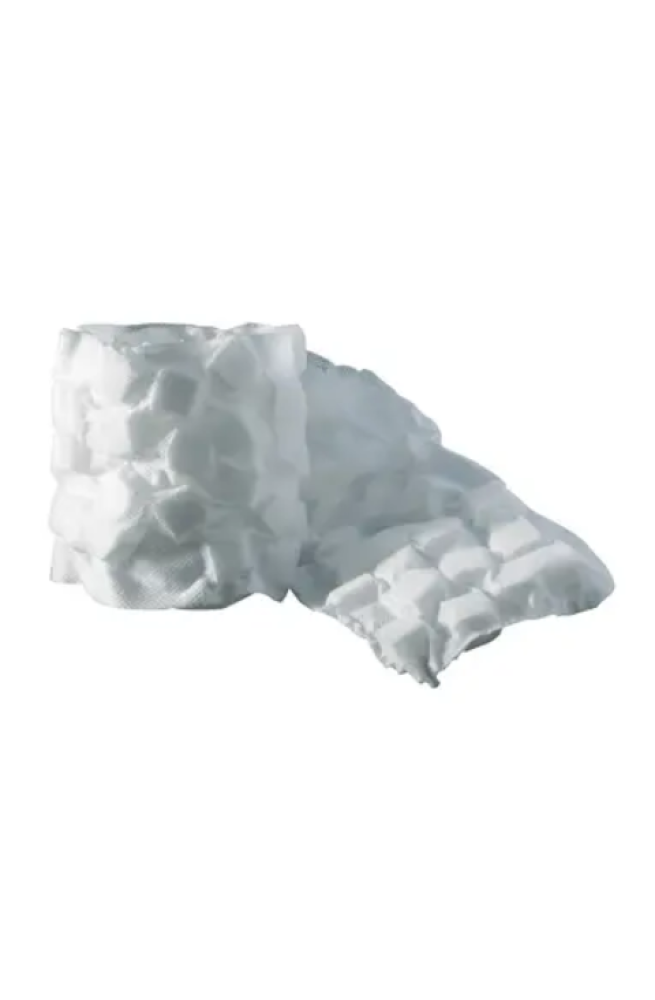


Mobiderm Bandages bandage for moving lymphatic edema
364ر.س
Product description
Mobiderm® Mobilising Bandages
Mobiderm® Bandages for mobilizing edema
Detailed description
Mobiderm® Mobilising Bandages are used under a reduction dressing (such as a compression dressing), as they help to mobilize the tissues of the skin beneath the swollen or hardened subcutaneous tissue, thereby improving the treatment of acute or chronic edema, such as lymphedema thuasne.com+1.
Technical mechanism (Mobiderm® Technology)
This technology relies on foam blocks covered between two layers of non-woven fabric. When the bandage is applied, these blocks create pressure differences between the areas that directly press on the skin and the surrounding areas, creating multi-directional channels for lymphatic fluid flow under the skin and enhancing effective drainage thuasne.com+1 Thuasne USA.
Available versions
The bandage is available in two different versions depending on the size of the blocks:
Large blocks
Small blocks
This variety allows meeting the needs of different body areas and varying edema sizes thuasne.com Thuasne USA.
Medical indications (uses)
Suitable for treating various types of edema:
Acute or chronic edema (such as lymphedema) thuasne.com+1 Thuasne USA.
Hematoma drainage
Fibrosis relaxation
Rehabilitation to improve movement in affected areas Thuasne USA thuasne.com.
Materials and composition
Non-woven fabric forms the outer layer.
Foam blocks are made of:
Polyurethane in the large block version,
Polyethylene in the small block version thuasne.com+1.
Precautions and contraindications
Not used in cases of severe skin diseases in the affected limb.
Prohibited in cases of allergy to any component of the bandage.
Not suitable for those with severe peripheral neuropathy or septic thrombosis.
Also contraindicated in cases such as phlegmasia cerulea dolens (painful blue thrombophlebitis with arterial pressure), or severe peripheral circulation weakness (ankle-brachial index less than 0.6), or unbalanced heart failure, or severe and high-grade ischemia (more than 30 mm Hg), or external vascular shunt.

From Jeddah