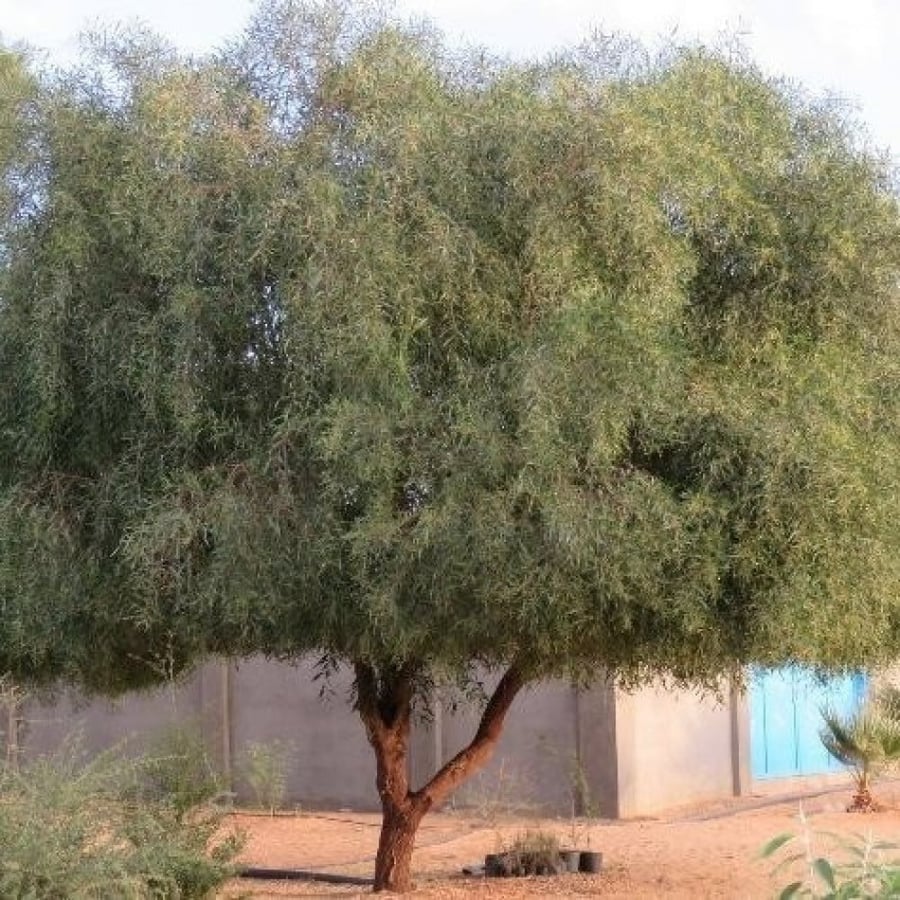


Salty Acacia tree seeds
7ر.س
Product description
Common name: Salty Acacia
Scientific name: Acacia ampliceps
Other names: Salty Talh
A fast-growing tree belonging to the Acacia genus, considered a perennial evergreen tree that grows and reproduces quickly. It is a smooth, dense tree with drooping branches, reaching a height of up to 10 meters, and extending horizontally with a diameter of up to 7 meters. It is also a tree that does not require much care.
• Salty Acacia flower: The flowers appear in vertical clusters, white to creamy in color, spherical in shape, 10 cm in size, blooming from February to December.
• Salty Acacia fruit and seeds: The fruit is a pod, 12 cm in size, containing seeds inside.
• Salty Acacia propagation season: It is planted in spring, but can be cultivated year-round in agricultural reserves, enclosed or plastic-covered areas where temperature can be controlled, and where the plant receives sufficient sunlight.
• Suitable climate and soil for Salty Acacia: It tolerates drought periods that may last up to 9 months and grows in salty and alkaline soils, tolerating severe salinity. It also withstands high temperatures and extreme cold.
• How to plant Salty Acacia: It reproduces from seeds, which are soaked in water for a full day before planting. Seeds are planted at a depth of 1 cm to 3 cm, and fertilized with organic fertilizer at least once.
• Benefits and uses: It has multiple medicinal uses and is considered one of the best shade trees due to its horizontal spread, providing a large shaded area. This plant is used as a windbreak or barrier in sandy areas because of its dense foliage and horizontal growth pattern. Salty Acacia has been listed in some statistics as one of the best tree species for this purpose. The Salty Talh tree plays a significant role in soil reclamation. Some plant specialists also mention that branches, twigs, leaves, and flowers of the Salty Talh can be used as livestock feed in the form of fodder.
• Native habitat of Salty Acacia: Its original habitat is Australia, and it is widely cultivated in Saudi Arabia and Gulf countries.

From Buraydah