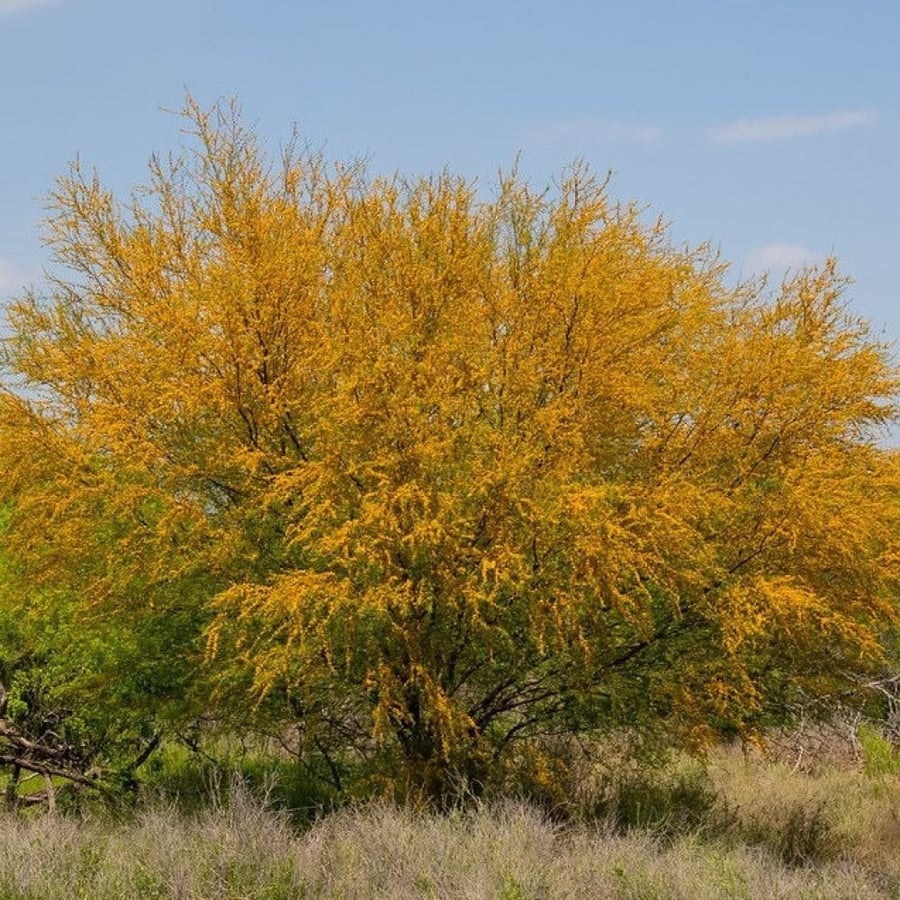


Seeds of the Vengeance Tree (Acacia farnesiana)
6ر.س
Product description
Common name: Talh Al-Fitnah
Scientific name: Acacia farnesiana
Also known as: Al-Talh Al-Anbari - Al-Talh Al-Hulool
The flowers of Al-Talh Al-Anbari have a pleasant scent, and they are small thorny trees with several branches and a rounded crown. They are evergreen in winter or semi-evergreen in winter with frost.
Flower of the Talh Al-Fitnah tree:
The inflorescence bearing the flowers appears in spring, with light yellow flowers, about 1 cm in size, with a good fragrance.
Fruit and seeds of the Talh Al-Fitnah tree:
Its fruits are pod-shaped, 4 cm to 10 cm in size, containing small brown seeds inside.
Season for germinating the Talh Al-Fitnah tree:
Seeds are planted in February and March, and they can also be cultivated year-round in agricultural reserves and enclosed or plastic places where temperature can be controlled and sunlight or adequate lighting is available.
Suitable climate and soil for cultivating the Talh Al-Fitnah tree:
The tree is affected by frost and needs humidity in summer. It thrives in dry, salty soils rich in sodium and grows well with abundant water.
Method of cultivating the Talh Al-Fitnah tree:
It is cultivated from mature seeds after treatment, fertilized with organic fertilizer at least once. Since they are tree seeds, the planting depth is between 2 cm and 3 cm.
Its benefits and uses:
It has various medicinal uses and is considered one of the best shade trees. This plant is used as a break or windbreak fence in sandy areas.
Original habitat of the Talh Al-Fitnah tree:
Its native countries are the Caribbean and Mexico, extending to Australia. It is also cultivated in Saudi Arabia and Gulf countries.

From Buraydah