
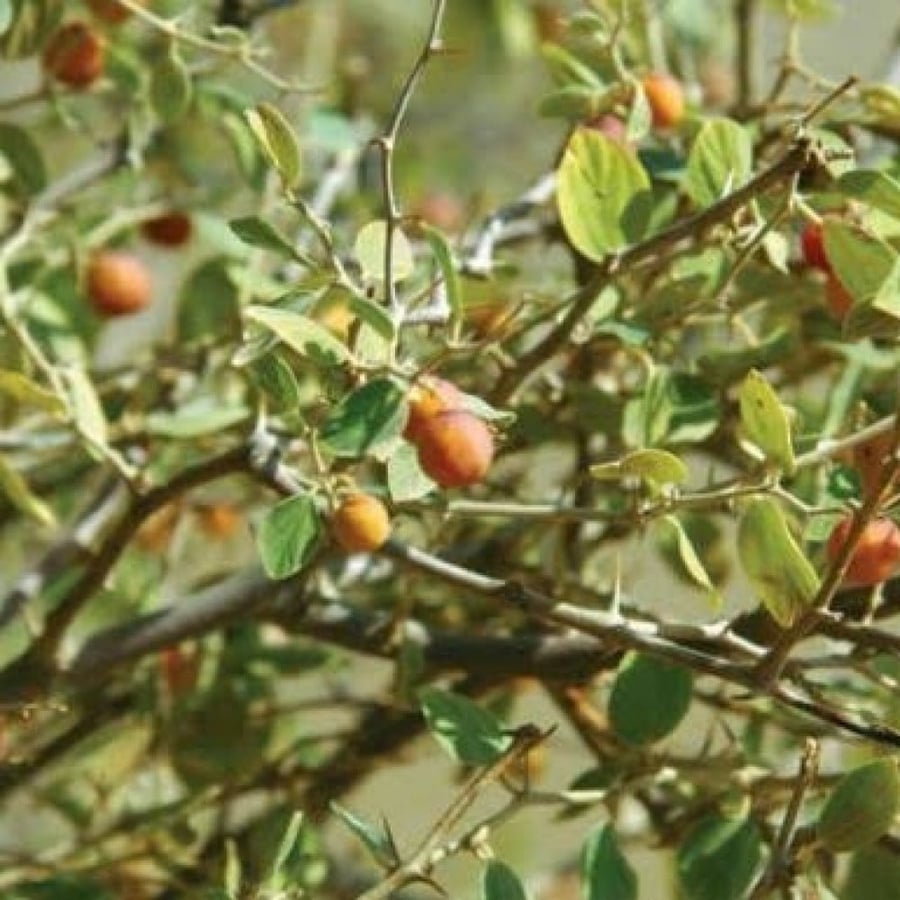


Wild Sidr tree seeds
6ر.س
Product description
Common name: Wild Sidr
Scientific name: RHAMNUS
Other names: Swid - Nabq - Habari - Kanar
The Sidr tree is a desert tree belonging to the Rhamnaceae family, characterized by its dense leaves and branched trunks. Its small, oval-shaped leaves are found in mountainous areas.
Wild Sidr tree flower: The flowers are located in the leaf axils, ranging from 10 to 15 small greenish-white flowers. Its flowers bloom in summer.
Wild Sidr tree fruit and seeds: Spherical in shape, with a diameter ranging from 1.5 to 3.5 cm, orange or red in color, with a sweet taste.
Season for germinating the wild Sidr tree: It is preferred to plant local Sidr in March and April, but it can be cultivated year-round.
Suitable climate and soil for the wild Sidr tree: It grows in dry and hot areas, can tolerate salinity and all types of soil, and is considered one of the best plants for enduring these harsh conditions.
Method of cultivating the wild Sidr tree: It is propagated by cuttings and seeds. Due to the hardness of the seeds, they are soaked in water or broken to speed up germination. It takes a long time to germinate, so it must be watered regularly. Flowering begins from September to October. It is better not to water it too much to avoid falling flowers at this stage.
Its benefits and uses: Local Sidr has many benefits. It is edible because it is sweet and rich in fibers and minerals. It is also used in soap-making and other cosmetic products.
Original habitat of the wild Sidr tree: Its native region is Saudi Arabia, the Gulf countries, and Syria. It also spreads in tropical and subtropical areas.

From Buraydah