


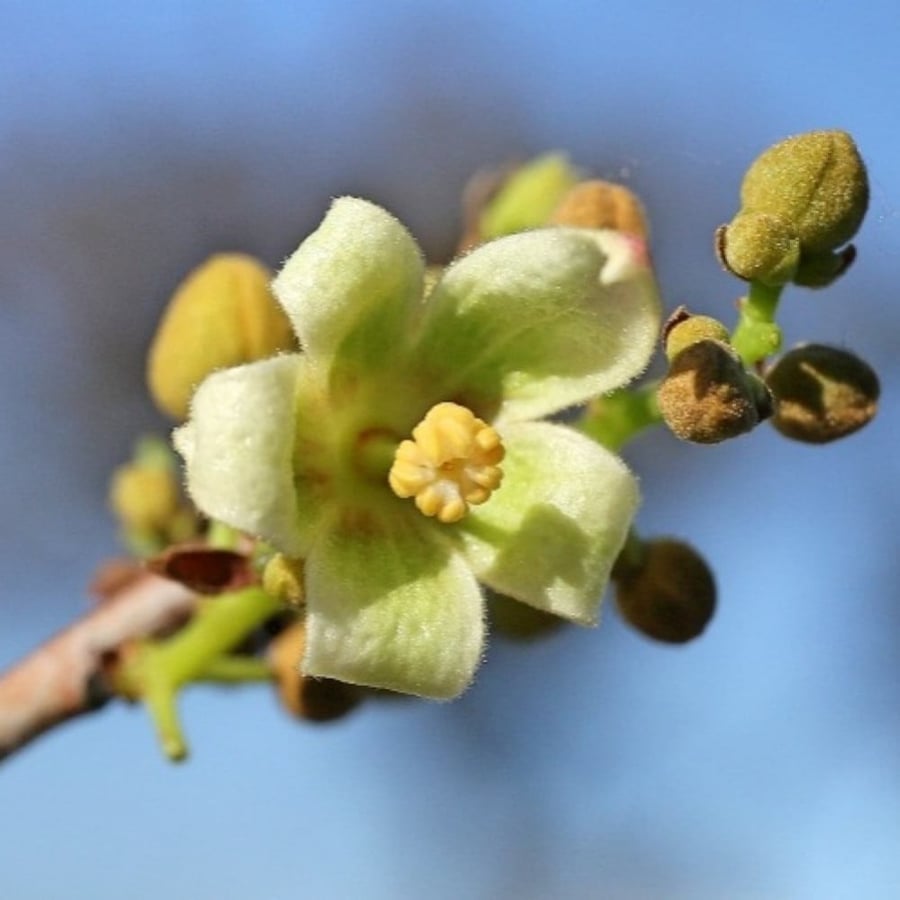
Brachychiton gregorii seed of the duck man's tree
7ر.س
Out of Stock
Product description
Common name: Sterculia man of the duck
Scientific name: Brachychiton gregorii
Among its names: Sterculia, Sterculia man of the duck
A perennial evergreen tree that spreads in arid areas where rocky hills, slopes, and sand dunes are found. Its height ranges from 3 to 12 meters, and the canopy width is about 2 to 5 meters. Its leaves are evergreen, with three or five lobes on a long stalk. The leaves fall during the dry months.
• Flower of Sterculia man of the duck tree: Pale yellow bell-shaped flowers, blooming between October and December.
• Fruit and seeds of Sterculia man of the duck tree: Its fruits are black woody pods about 5 cm (2 inches) long, containing many pale yellow oval seeds.
• Propagation season of Sterculia man of the duck tree: It is planted in spring, and can also be cultivated year-round in agricultural reserves, enclosed spaces, or plastic greenhouses where temperature can be controlled, sunlight reaches the plant, or adequate lighting is available.
• Suitable climate and soil for Sterculia man of the duck tree: Grows in sunny locations and hot desert climates. This tree is more drought-tolerant. It grows in rocky, gravelly, and deep soils. The plant is moderately frost-resistant and can grow under full sun or partial shade in well-drained soil, with regular watering.
• Method of cultivating Sterculia man of the duck tree: Propagated from seeds. Seeds are soaked in warm water for 12 hours before planting, then planted at a depth of 1 cm from the soil surface. It can be fertilized with organic fertilizer at least once to accelerate growth and development.
• Its benefits and uses: Used for decoration in homes and gardens.
• Native habitat of Sterculia man of the duck tree: Northern and western Australia, and it is also spread in Gulf countries.

From Buraydah