


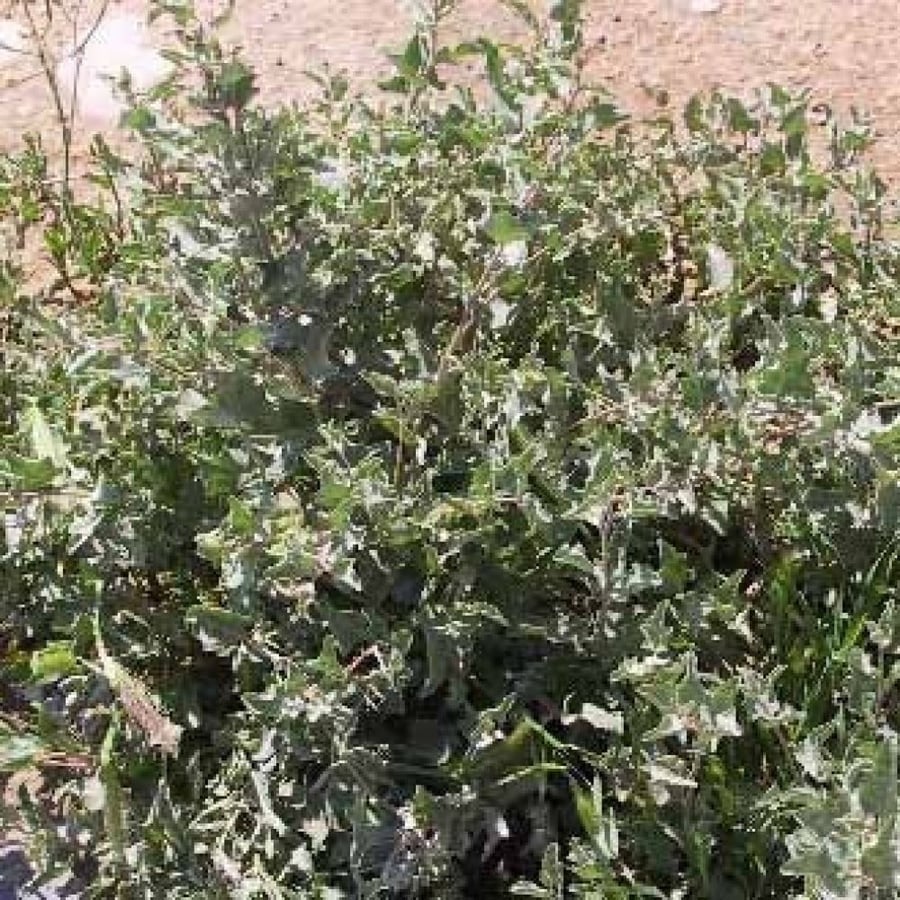
Harvest seeds - white saltbush (Atriplex Leucoclada Boiss)
7ر.س
Out of Stock
Product description
Common name: Qataf - White Rugh
Scientific name: Atriplex Leucoclada Boiss
Other names: White Rugh - Syrian Rugh - Shiny Rugh - Turkmen Rugh
A small shrub from the Rugh genus belonging to the Chenopodiaceae family from the Caryophyllales order, with a grayish stem and dense branches, evergreen, exceeding one meter in height. Its leaves are semi-oval, up to 3 cm long, and it is considered a rare plant with medicinal uses and environmental benefits.
• Qataf flower - White Rugh: Its flowers are dense, clustered in spikes, blooming during the spring season.
• Fruit and seeds of Qataf - White Rugh: Its fruits are capsule-shaped, about 0.5 cm in size, containing brown seeds inside.
• Qataf - White Rugh germination season: Cultivated in January and February.
• Suitable climate and soil for Qataf - White Rugh: Qataf is a salt-tolerant plant that withstands harsh climates, adapting to high temperatures and strong winds. It is cultivated in loamy and clay soils.
• How to cultivate Qataf - White Rugh: It reproduces through seeds. A scientific study titled "A Study of the Possibility to Raise Seeds Germination of Atriplex Leucoclada Boiss" was conducted, experimenting on 2000 propagation units divided into five equal groups: control (no treatment), soaking for half an hour in boiling water, soaking for a full hour in boiling water, soaking in concentrated sulfuric acid for 8 minutes, and mechanical treatment by crushing in a mortar and extracting the seeds.
The results showed that all studied treatments increased the germination rate of the white branch Rugh propagation units, but to varying degrees. The mechanical treatment by crushing in a mortar was the most effective in accelerating germination and increasing its rate, raising the germination percentage from 7% in the control to 69%.
• Its benefits and uses: It has many health benefits, helps remove soil salinity, and contributes to stabilizing it. It can be used as a fence or plant barriers but requires care and pruning to maintain a suitable aesthetic shape.
• Original habitat of Qataf - White Rugh: Its native regions are the coastal areas of the Mediterranean basin and temperate Europe, and it is also found in some areas within the Kingdom of Saudi Arabia.

From Buraydah