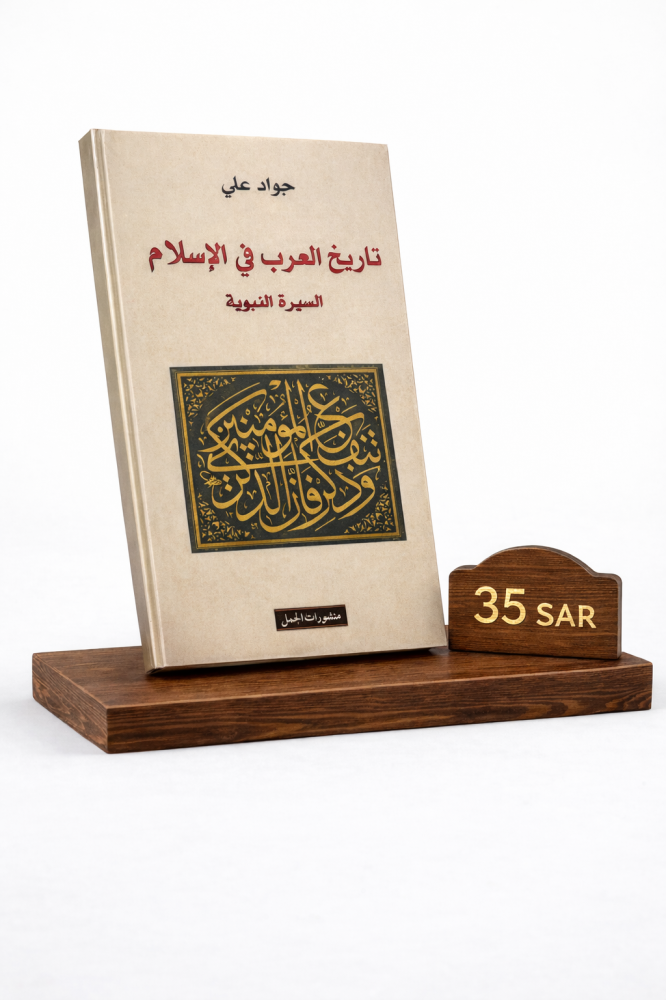
History of the Arabs in Islam - The Prophetic Biography - Jawad Ali
35ر.س
Product description
A historic work of heavy caliber. We are in front of "The History of the Arabs in Islam – The Prophetic Biography" by Dr. Jawad Ali, one of the most prominent Arab historians of the twentieth century, and the author of the detailed massive project on the history of the Arabs before Islam.✍🏻 About the author Jawad Ali (1907–1987) an Iraqi historian and academic specializing in ancient Arab history. Known for his methodological accuracy and reliance on original sources and comparing them, and his tendency to read history analytically rather than just narratively. He was not just a transmitter of news, but an investigator of it, inclined to scrutiny and re-examination of common narratives.📚 Reader impressions and evaluations According to what is circulated among readers on academic platforms and reading accounts: The book is viewed as a solid scientific reference more than a simplified narrative book. Readers praise his precise analytical methodology and reliance on multiple sources. Some readers point out that his language tends toward an academic tone, making it less accessible to the general reader. The book is especially valued by students of historical studies and researchers, while non-specialist readers may find it relatively dense. In brief: it is a book to be read with a vigilant mind, not with flowing emotion.🔎 Critical literary reading 1️⃣ Between narration and investigation Jawad Ali does not merely narrate the events of the prophetic biography, but treats them as historical material that needs scrutiny. He does not settle for "said" and "reported," but asks: who said? Why? And what is the political and social context of the narrative? This critical spirit gives the book a special value, as it transforms from just presenting the biography to an analytical study of its historical and social structure. 2️⃣ The biography as a history of society The most prominent feature is that the author does not isolate the biography from its environment. He sheds light on the Arab environment before Islam, tribal transformations, economic structure, and political relations, to place the Islamic call in its full historical context. In this sense, the book does not present a biography of an individual only, but a biography of a society at a moment of civilizational transformation. 3️⃣ Style The language is clear but academic in tone, leaning more toward documentation and analysis than literary eloquence. Some may see this as dryness, but in reality, it is a methodological choice that aligns with the nature of the work. 🎯 Who is this book suitable for? Students of history and Islamic studies. Those interested in critical reading of the biography. Readers seeking analytical depth rather than emotional narration. Those looking for a didactic or simplified narrative biography may need a more fluid and less dense book. 📌 Critical summary "The History of the Arabs in Islam – The Prophetic Biography" is not a book to be read in haste. It is a work that asks its reader to participate in thinking. Its value does not lie in retelling what we know, but in questioning what we are used to hearing. It is a book that restores the biography to its broad historical space and gives it an analytical depth that makes it more solid… not less sacred.

From Al Mubarraz