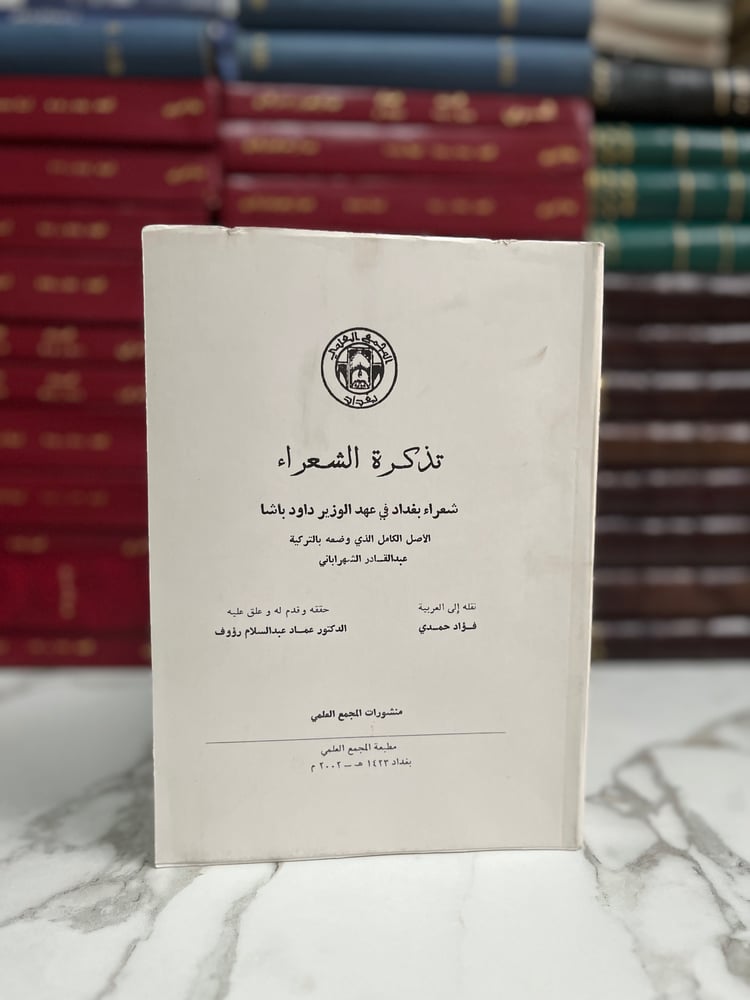
Poets' ticket
50ر.س
Out of Stock
Product description
In the year 1897, Father Anastas Al-Karmali, the well-known linguist (1866-1947), came across a small message with his friend the scholar Sayyid Mahmoud Shukri Al-Alusi (1857-1924) that investigates the biographies of a number of Baghdad poets under the title "Poets of Baghdad in the days of the ministry of the late Dāwūd Pasha and until Baghdad in the year 1200 to the year 1246," and it was written on it that it was authored by the virtuous, the intelligent, Abdul Qadir Afnadi Al-Khattibi Al-Shahrambani, so he only asked Al-Alusi for permission to copy a copy for himself, and he permitted him, and Al-Karmali deposited this copy in his famous library at the monastery of the Carmelites to remain there for about twenty years. When he issued the newspaper (Al-Arab) in 1917, Al-Alusi consulted him about publishing it, and he agreed, advising him to improve its phrasing, as it was written in awkward language with obvious grammatical and spelling mistakes, and Al-Karmali took the advice, as he began to reformulate the message and publish it in sequence in his newspaper, but it did not last long before he stopped publishing for unknown reasons, and the number of biographies published had reached 34 biographies. It happened that these biographies caught the attention of the well-known researcher Yaqub Sarkis (1876-1959), so he requested from Al-Karmali at the end of 1935 to lend him the message to see what had not been published of it, and during his study and scrutiny of the message, he had observations which he sent to Al-Karmali, and the summary of his findings was that this manuscript was not authored by Abdul Qadir Al-Shahrambani. After that, Father Al-Karmali published the book as a scholarly, meticulous edition, and perhaps the best thing he did in this work was that he prepared comprehensive and inclusive indexes for what was in the book, and attached to it a small dictionary "containing explanations of obscure words from colloquial, borrowed, terminological, Turkish, Persian, and foreign words, most of which are not found in Arabic dictionaries." This dictionary became a guide to understanding dozens of words that time entrusted to this book and others, and thus the book was published to the public on one of the days in 1936, with doubts about its actual title and the identity of its author and translator, but the inability to find another copy of the manuscript prevented reaching a definitive conclusion. Therefore, researchers in Iraqi history during that era accepted it as it was, despite its flaws, because a historian or a literary scholar cannot do without referring to what it contains of biographies to learn many details of an era in which historians were few, and many of its aspects remain shrouded in mystery. However, finding the original settled all doubts, as the author of the book is Sheikh Al-Adib Abdul Qadir Al-Shahrambani, and he described it in old Turkish, which grew out of his mastery of Turkish literature and his extensive knowledge of both Arabic and Persian literatures, as he included many examples of their poetry in the three languages. Abdul Qadir Al-Shahrambani was born in the town of Shahrban (which was called Al-Maqdisiya) in the eastern outskirts of Baghdad, and he is attributed to it. He left his homeland heading to Mosul, where he met many of Mosul’s literati and scholars. When Minister Dāwūd Pasha took control of Baghdad, he preferred to work as a clerk in the bank of Baghdad, which was a financial institution that included the best clerks and literati of the era, especially those proficient in poetry and prose in all three languages. There, the bonds of friendship between him and Baghdad’s writers and poets were strengthened, and he got to know those he did not know among them, examined their poetry collections and other literary works, and selected many models from them in his notebooks. It is logical that these interests would attract Dāwūd Pasha’s attention and impress him, so he encouraged him to write a book of the known type called "Tadhkira of Poets," which gathers the news of poets of his era and their writers, records their biographies, and includes expanded models of their literary efforts in the different languages they wrote in. He wrote this book, which is in the hands of the reader. It is worth noting that this book contains a large number of administrative and cultural terms that were used in the Ottoman era. Additionally, the book includes many names of literary and poetic figures, holders of administrative positions such as governors and officials, names of geographical locations, and cultural institutions that existed at that time, as well as historical incidents mentioned in the biographies of its figures, which the researcher has explained and commented on in special footnotes inserted in their places. Furthermore, the researcher had to compare this book with the brief book that Al-Karmali published more than a decade earlier titled "Tadhkira of Baghdad Poets" to highlight the differences between them.

From Riyadh