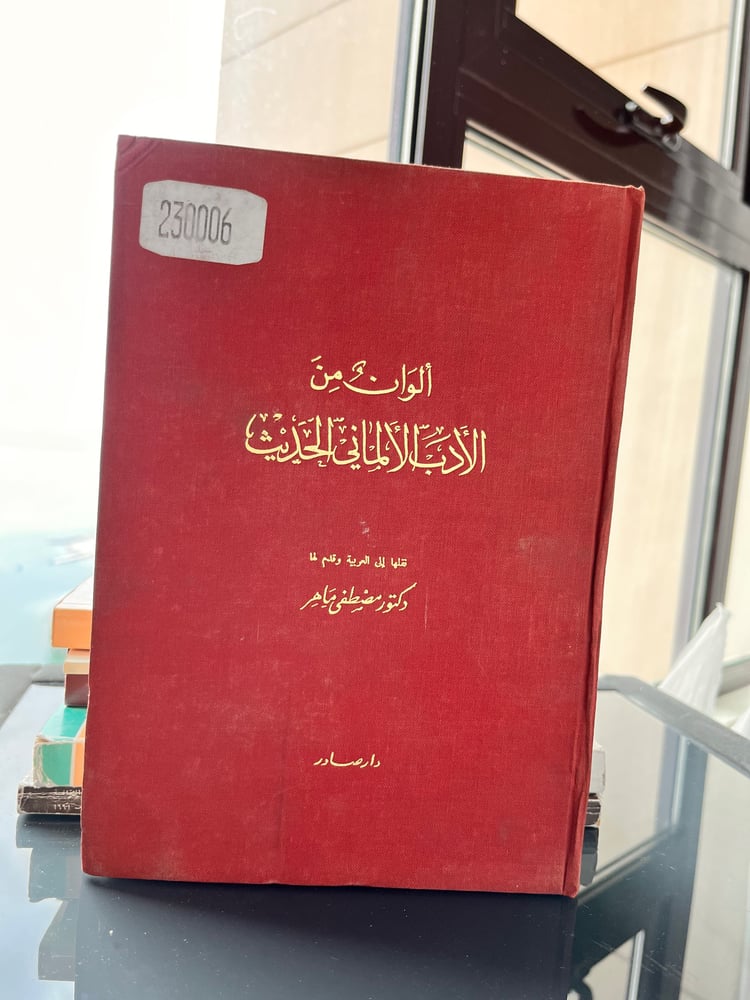
Colors of modern German literature
60ر.س
Out of Stock
Product description
The Egyptian academic and translator Mustafa Maher, who passed away the day before yesterday, belongs to the founding generation. He is the one who established the first Department of German Studies in the Arab world and headed this department at the Faculty of Languages for more than twenty years. He is also the sheikh of German translators, the first to translate the eyes of German literature directly into Arabic, and the most prolific translator from Goethe's language, and one of the most present translators in the Arab cultural scene since the sixties. Dr. Maher's efforts were not limited to founding, teaching, and translating from German to Arabic (about sixty works), but he also translated about forty works of Arab literature and thought into German. The late was a man of encyclopedic knowledge, enormous scientific contribution, and a huge achievement unmatched by anyone, as if he was a team of translators and researchers, writing, translating, and publishing articles about German literature, as well as theoretical studies in translation science and cultural communication, and supervising hundreds of master's and doctoral theses. One truly wonders: where did he find the time to accomplish all this?
Mustafa Maher was born in Shubra, Cairo, in 1936. He studied English and French at school, then joined the Faculty of Education. After graduating, he worked as a French language teacher at a high school in Cairo. At the age of nineteen, he began learning German, and in 1958, he traveled to Munich and joined a training course at the Goethe Institute and the city’s university. After obtaining a diploma in German language teaching, he continued his studies in Cologne and earned his doctorate in 1962. In the same year, he returned with his wife, Mrs. Elsa, to Cairo, becoming the first Egyptian student to hold a doctorate in German language and literature. Immediately, he began establishing the German Department at the School of Languages (which later became a faculty), and headed this department from 1965 until 1987.
He turned to translation from German starting in 1961, offering several translations of the eyes of old German literature, including works by Goethe, Lessing, and Kleist. He then moved to modern and contemporary literature, providing the Arab reader with translations such as, for example, Franz Kafka’s novel "The Trial," the massive novel "The Glass Bead Game" by Hermann Hesse (Nobel 1946), the play "The Visit" by Friedrich Durrenmatt, the play "Biedermann and the Arsonists" by Max Frisch, the novel "The Lovers" by Elfriede Jelinek (Nobel 2004), and the play "Kaspar" by Peter Handke (Nobel 2019). He usually supplemented his translations with introductory prefaces and several footnotes explaining the historical and cultural context of the translated text.

From Riyadh