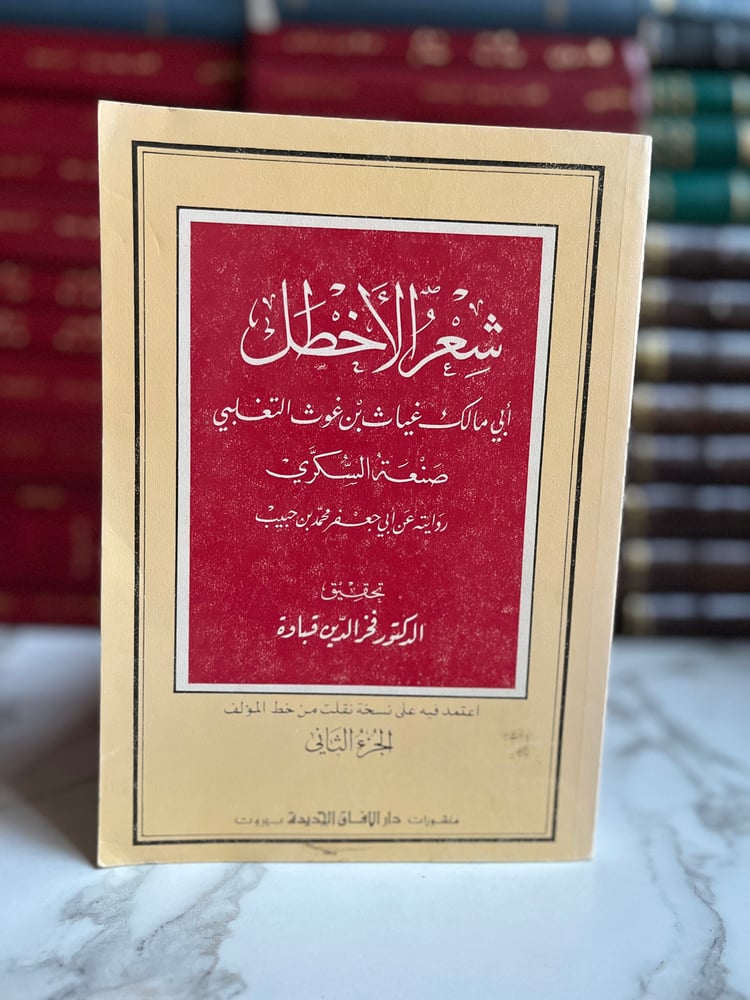
The poetry of Al-Akhtal
18ر.س
Out of Stock
Product description
No one can deny the artistic value of Al-Akhṭal the Great in the history of Arabic literature and especially in Umayyad poetry, as he provided a picture of poetry during the Umayyad era. Father Antoine Salehani the Jesuit realized this more than eighty years ago and made a commendable effort, sincere work, and spread knowledge when he revived the آثار of Al-Akhṭal in the world of literature, making them accessible to anyone who loved Arabic or cared about its literature. Accordingly, he issued the poetry of Al-Akhṭal (copies by Petrusirh, Baghdad, Yemen), an appendix to the Diwan of Al-Akhṭal, the oppositions of Jarir and Al-Akhṭal, the footnotes of the Diwan of Al-Akhṭal, the golden dust in the poetry of Al-Akhṭal, the continuation of Al-Akhṭal's poetry, and throughout all this, articles and studies published in Al-Mashriq magazine, where he elaborated on what concerns Al-Akhṭal, his poetry, and his life. However, efforts in caring for Al-Akhṭal with scientific precision stopped with Father Salehani, and his printed works have become rare and hard to find, while the manuscripts are far from research and study fields, except for some contemporary studies in their general research.
Hence, the importance of this book, which the researcher dedicated to Al-Akhṭal as a poet, studying, explaining, and commenting on him, relying on the version that included the explanation of Al-Sukri. This valuable version was made the basis for the Diwan – the Diwan of Al-Akhṭal – and its explanation, assisting in verifying and clarifying the text with what Father Salehani issued from his publications of Al-Akhṭal's poetry, adding what Al-Sukri omitted in interpretation or in verses related to the poems he narrated.
Thus, this book combines the following features that distinguished it from all printed works of Al-Akhṭal's poetry: comprehensive interpretation, meaning accurate explanation that encompasses the words, detailed clarification of expressions and verses to facilitate the reader, and the rest of the assumptions of conjecture and interpretation, making it unnecessary to consult dictionaries and literary or historical sources.
As for the specification of the text's subject: Al-Sukri often neglected to specify the circumstances in which the poems and sections were composed, which could lead the reader away from accuracy in understanding, analysis, and inference. Therefore, the researcher resorted to footnotes in which he included the beginnings of texts to clarify their attribution or the nature of their topics, so that the comments serve as aids in understanding the meanings, knowing the personalities, events, facts, and artistic, social, and historical references.
Regarding the footnotes of the Diwan: since Al-Shukri had limited Al-Akhṭal's poetry to narrations by Ibn Habib from Abu Amr Al-Shibani and Ibn Al-Arebbi, explaining that poetry based on what he reached without including other sources of Al-Akhṭal's poetry from various narrations, the research aimed to fill this gap by collecting these poems from various sources and supplementing Al-Sukri's work with them. In his comments on the footnotes of the Diwan, he aimed to narrate what Al-Akhṭal's poetry proved to belong to others.
As for precise transcription: referring to all texts, poetic and prose, in the main text, explanation, and comments, and providing adequate punctuation and markers.

From Riyadh
Questions you might have