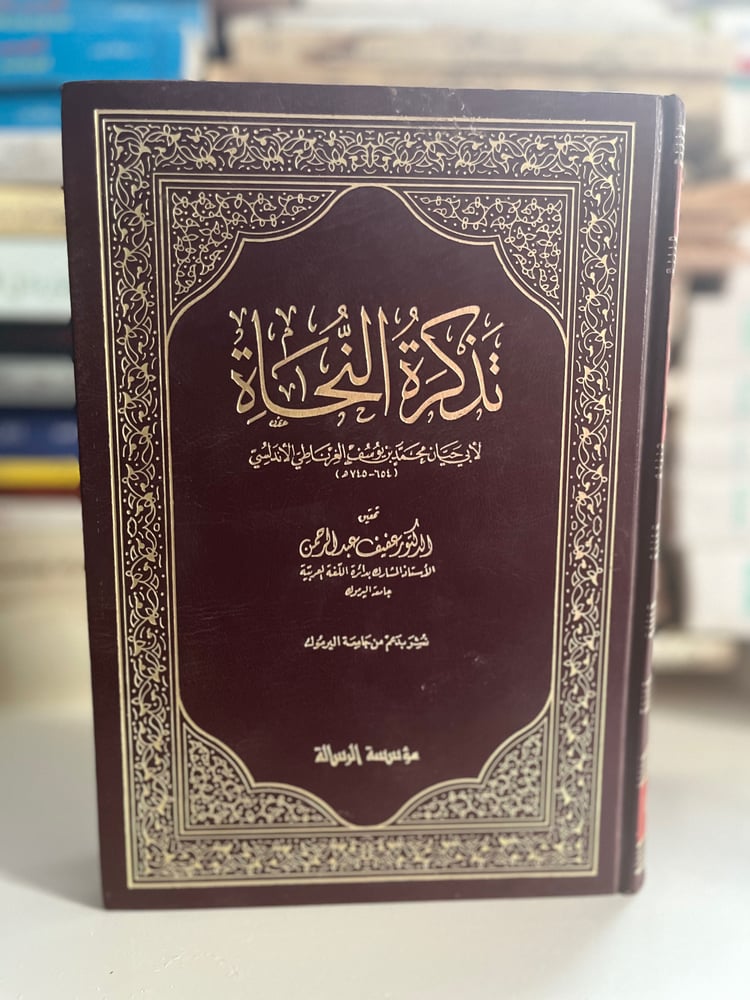

The grammarians' ticket
50ر.س
Out of Stock
Product description
The owner of this book is Atheer al-Din Abu Hayyan Muhammad bin Yusuf bin Ali bin Yusuf bin Hayyan al-Andalusi al-Gharnati, نسب إلى قبيلة نفزة، القبيلة البربرية، born in the city of Granada in the year 654 AH. Abu Hayyan is a scholar well known, his mind opened to seek knowledge and culture, so he was widely read and abundant in knowledge due to the many sources of his knowledge and their diversity. Abu Hayyan was not only prominent in Arabic and its literature, but he was also familiar with other languages, which helped him expand his knowledge; he was fluent in Persian and Turkish, and also mastered Amharic. Abu Hayyan contributed as a scholar to the scientific movement, especially in relation to language, grammar, morphology, exegesis, and literature, with a generous share. His work was not limited to writing and authorship in his language, but he also wrote in other languages, and he did not leave any art from the arts known in his era except that he contributed to it. It is mentioned that his writings exceed fifty, between long and short. Some of these works he worked on verifying, and some are still preserved or lost. This book is considered one of his manuscripts that were lost. In Dr. Khadija Al-Hadithi's book about Abu Hayyan, in her discussion of the lost books of Abu Hayyan, she states: "The Tadhkira (Reminder) of Abu Hayyan was written in grammar, and some called it the Tadhkira in Arabic." She added: "Nothing is known about this book because it is among the lost books of Abu Hayyan." However, Dr. Afeef Abdul Rahman found the manuscript of the second part of Tadhkira in the General Library in Rabat. The manuscript is considered one of the rare manuscripts with no duplicate, and it is part of a book. Regarding its value, it was taken into account considering Abu Hayyan's status in the world of language, literature, and exegesis, his active scholarly work, his extensive scientific output, his clear grammatical methodology, and that his effort did not stop at mere transmission from previous scholars, but he discussed what he reached and took a specific stance towards it, not accepting it blindly. We sensed the value of this manuscript because it contained extracts from many books that had lost their way to us, as well as from books that reached us. He did not limit himself to copying from books and documents, but he also listened to scholars, took from them, and authorized them. Abu Hayyan, in all that he transmitted, did not make it a mere material to be presented in his book, so it appears coherent and in its place. As for the process of verification, it was carried out as follows: 1- The researcher tried hard to compress the size of the book due to the large size of the manuscript first, and because much of what appears in the footnotes repeats in most of the verified books on language and grammar. 2- A table was prepared following the verification methodology to indicate the linguists whom the author referred to in his manuscript. 3- Multiple indexes were prepared to facilitate benefiting from the book. 4- A list of sources relied upon by the researcher was prepared to document the material of the book.

From Riyadh
Questions you might have