Product description
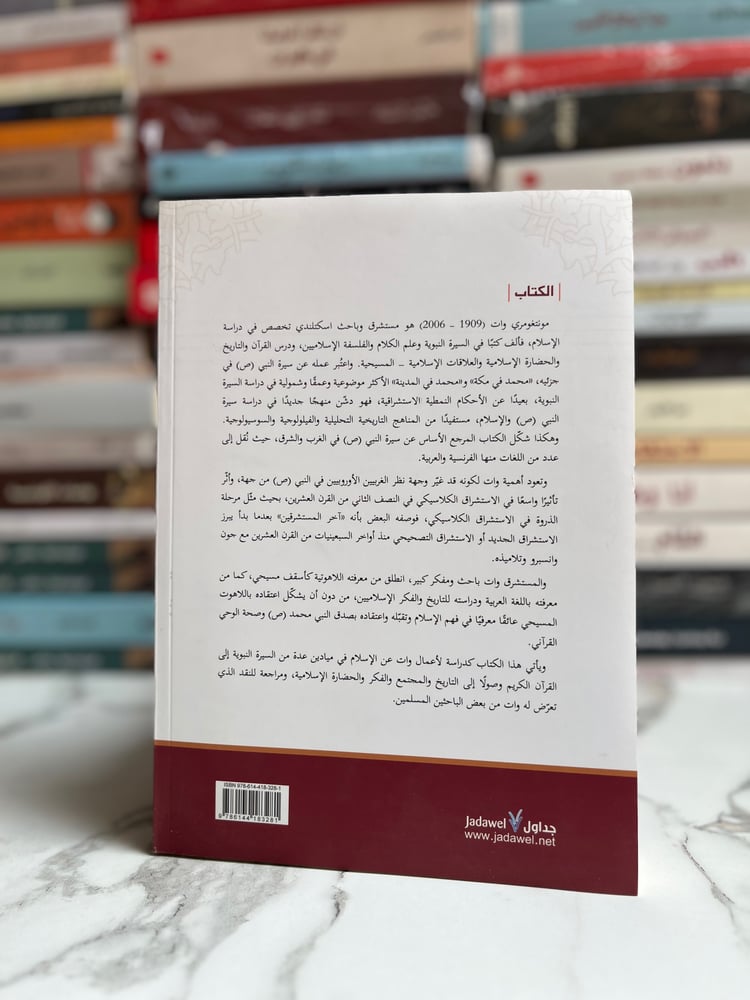
He tried and attempted to avoid the bias inherited from Orientalism from the Middle Ages, and at the same time avoid the sanctification that turns into an obstacle to scientific historical interpretation. Haytham Muzahim presents, in his book "Montgomery Watt and Islamic Studies," the main ideas of the orientalist Watt and discusses them with presentation, analysis, and critique. Montgomery Watt (1909 - 2006) was a Scottish orientalist and researcher specializing in the study of Islam, and he authored books on the prophetic biography, Kalam (Islamic theology), and Islamic philosophy. He studied the Quran, history, Islamic civilization, and Muslim-Christian relations. His work on the biography of the Prophet (peace be upon him), in its two parts, "Muhammad in Mecca" and "Muhammad in Medina," was considered the most objective, profound, and comprehensive study of the prophetic biography, far from stereotypical orientalist judgments. He pioneered a new approach to studying the Prophet's (peace be upon him) biography and Islam, utilizing analytical historical, philological, and sociological methodologies. Thus, his book became the foundational reference on the Prophet's (peace be upon him) biography in the West and the East, and it was translated into several languages, including French and Arabic. Watt's importance lies in having changed Western European perspectives on the Prophet (peace be upon him), and he had a wide influence on classical Orientalism in the second half of the 20th century, representing a peak in classical Orientalism. Some described him as "the last orientalist," especially after the emergence of new or reformist Orientalism since the late 1970s with John Wansbrough and his students. Watt, as an orientalist, was a great researcher and thinker, drawing from his theological knowledge as a Christian bishop, as well as from his knowledge of the Arabic language and his study of Islamic history and thought. His Christian theological beliefs did not pose an obstacle to understanding, accepting, or believing in the truth of Prophet Muhammad (peace be upon him) and the authenticity of the Quranic revelation. This book comes as a study of Watt's works on Islam across various fields, from the prophetic biography to the Quran, and extending to history, society, thought, and Islamic civilization, along with a review of the criticism Watt faced from some Muslim researchers.

From Riyadh