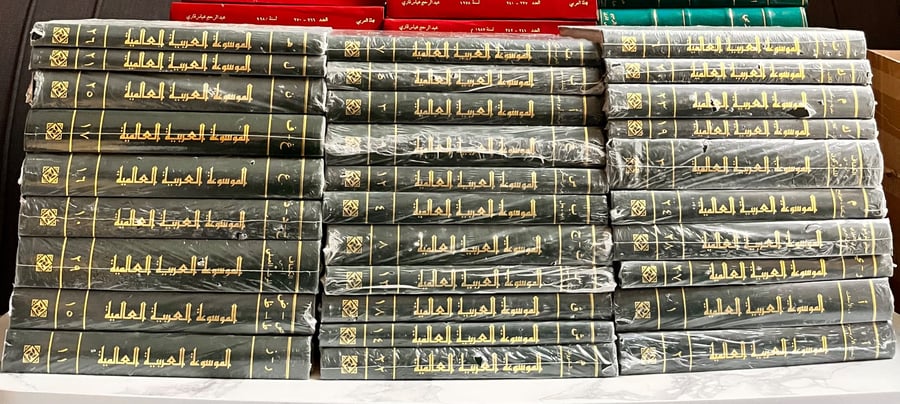
The Arab Encyclopedia Global 1/30
1000ر.س
1500ر.س-33%Out of Stock
Product description
This encyclopedia was not the result of pure authorship, but was based on a foreign model that was translated many parts of and presented in an adapted form, then another section of its knowledge was authored. This encyclopedia drew its materials from two main sources: the first is the World Book Encyclopedia, where many materials from that source were translated, with those materials being edited and adapted to Arab and Islamic contexts; and the second: the additions made by Arab researchers in various fields of knowledge, which in this second edition reached a high percentage that deepened the Islamic identity of the encyclopedia.
This second edition of the encyclopedia comes as a natural development of the first edition, representing an advanced station on the path of gradually achieved identity, the identity of modern encyclopedic knowledge with more clear and comprehensive Arab features. The encyclopedia added many materials in various branches of knowledge after their adaptation, aiming to maintain two main standards: that knowledge be scientific and accurate on one hand, and in harmony with the civilizational character of the Arab Islamic nation on the other.
This authorship required new articles in fields not covered in the first edition, as well as translation of other articles; the total of new articles reached about four hundred and fifty-five (455), including scientific and literary articles (262), political articles (8), sports articles (17), in addition to articles about prominent figures (168). Examples of authored articles include introductions to the main Arab Islamic heritage, extended articles about Islamic civilization in Andalusia, geographical, historical, and archaeological sites in the Arabian Peninsula, wild plants and animals in Arab countries, Persian literature, Arab and Islamic unions, and articles about some emerging concepts like globalization and cultural pluralism. As for articles about Arab and foreign prominent figures, they included introductions to global personalities who won well-known awards such as the King Faisal International Prize or the Nobel Prize in 1996 and 1997.
The translated articles among these new articles totaled 248, covering various fields of knowledge, including biodiversity, dynamics science, the International Fund for Agricultural Development, electronic data processing, and the European Union.
In terms of editing and modification, the second edition included changes in a large number of images, maps, and illustrations, in addition to numerous articles—no less than 2,228 articles—containing corrections, abbreviations, and additions. These included articles on science, Orientalism, Arabs, literary criticism, Arabic proverbs, and Arabic music. The goal of editing these articles was to reach, like others, a greater degree of comprehensiveness and knowledge balance within the context of the specificity of Arab Islamic culture and its needs. For example, the article on "Science" was expanded to include the concept of Islamic Shariah science, and the article on "Criticism" was revised to include Arab literary criticism and to be more globally comprehensive.
It is worth noting that in the context of editing, some articles touching on foreign cultures from the first edition were shortened (such as the article on South Africa), and many others were modified (such as articles about prominent American and English cultural figures) to match the size of similar or parallel articles, so that the balance between articles on Arab Islamic culture and other world cultures was maintained.
Additionally, in the context of informational modernization, more than 1,200 articles were affected, including articles on prominent figures, political, scientific, literary, and sports topics. In the political and personality development field, what needed to be added was included, such as new positions held since the first edition, or those no longer alive. Political changes affecting some countries (government changes, name changes, etc.) were also updated, along with information related to populations, economic output, and more. Although the updates covered various countries worldwide, greater attention was given to Arab and Islamic countries.
The Arab World Encyclopedia is an effective means of learning. It is a general knowledge encyclopedia that informs about people, places, things, events, and ideas, providing the reader with accurate information that is easy to find and understand. It contains information on study topics, scientific and practical projects, and introductions to prominent figures in all fields.
The first part of the index (volume 29) contains guidance information under the title "The Scientific Guide to Improving Writing, Speaking, and Research Skills." This guidance was prepared to assist students, researchers, intellectuals, and businessmen in preparing articles or research, or helping them speak to audiences effectively and impactfully.
The encyclopedia is compiled in thirty volumes, prepared in Arabic-English and English-Arabic formats (volume 28), aiming to establish main entries, arranged once alphabetically in Arabic with their English equivalents, and once alphabetically in English with their Arabic equivalents. This provides two mini-dictionaries to help consult the encyclopedia's materials and to familiarize the reader with the encyclopedia's approach to standardizing names and terms.
The alphabetical arrangement of all entries and references allows the reader to find desired information easily. If not found, they can refer to the index (volumes 29 and 30), which is a comprehensive index with about 130,000 entries and subject headings, helping to access a wealth of information.
It truly is a comprehensive Arab world encyclopedia covering all topics that enrich your libraries and ideas alike.

From Riyadh
Questions you might have