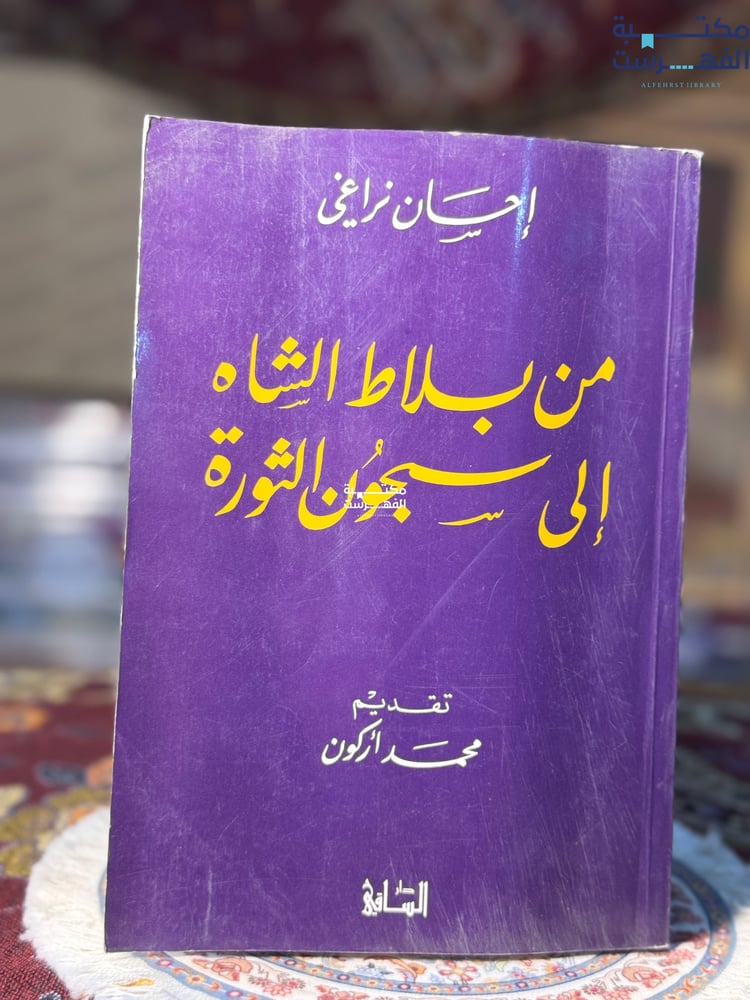
From the Shah's palace to the revolution's prisons
40ر.س
Product description
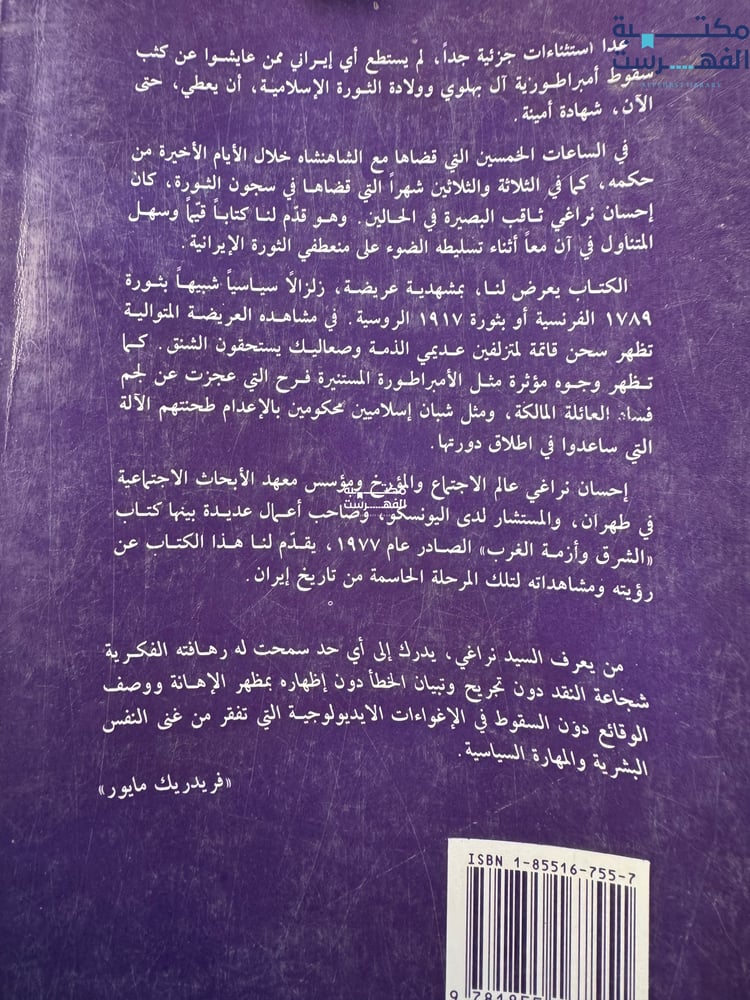
Ehsan Naraghi's memoirs, the prominent Iranian sociologist with reformist tendencies, provided a special insight into the details of the last days of Shah Mohammad Reza Pahlavi, showcasing the heated events in the streets of Tehran at that time. The memoir book tells the story of the revolution that erupted in Tehran at the beginning of 1978 after the publication of an article in the Tehran-based "Ettelaat" newspaper accusing Khomeini of treason, narrates the events and details of that revolution, analyzes its deep-rooted causes, and reveals the behind-the-scenes of the Shah's final months in power. That testimony remained hidden for years until its author decided to release it in 1991, years after those events, to tell us about his journey from the Shah's court to the revolution's prisons. Naraghi said: "It seemed a duty to me towards my country to reveal the psychological specifics of a man who was considered for decades one of the most influential leaders in the world before witnessing the collapse of his rule himself, so I quickly began writing my memoirs, to be an honest testimony as much as possible."
Political Role
Academic Mehran Kamrava, a professor at Georgetown University in Qatar, believes that Naraghi, like many other intellectuals of his time, studied Iranian society and was disturbed by what he considered a number of social deviations that swept through Iranian society. Kamrava added that the Shah was unaware of the social conditions of Iranian society, so he turned to intellectuals to understand what was happening, and Naraghi was one of them. Academic Fatima Al-Samadi, a senior researcher at Al Jazeera Center for Studies, confirms that Naraghi was a multifaceted personality, in addition to being a prominent sociologist in Iran, where he laid the foundation for the academic field related to social sciences, as well as having a role in Iranian politics during the period leading up to the Islamic Revolution.
After months of escalating events in Iran and the death of thousands at the hands of the army and SAVAK (the intelligence and national security organization), Naraghi arrived at the Saadabad Palace complex for his first advisory meeting with the Shah. Meetings between Iranians and the Shah followed special protocols, through which the king sought to reinforce his majesty and tyranny before his people.
Shah Mohammad Reza Pahlavi and US President Jimmy Carter on November 15, 1977 - Getty
After multiple postponements, Naraghi met with the Shah, and he immediately sensed a change in the king when he showed more feelings and appreciation. Naraghi said about that session: "I saw before me a man shaken to his core by recent events and losing the confidence he previously showed in the work meetings I sometimes attended. He politely apologized and said: 'My many worries did not allow me to meet you until now.'"
Al-Samadi pointed out that Naraghi held an opposition stance to the revolution and believed in the possibility of reform. Therefore, he had a sharp stance against Ali Shariati, considering him one of those who laid the foundations of the revolution and had an influence in sparking protests against the Shah. Naraghi criticized Shariati intellectually and politically, viewing him not as a sociologist but as a populist figure.

From Riyadh