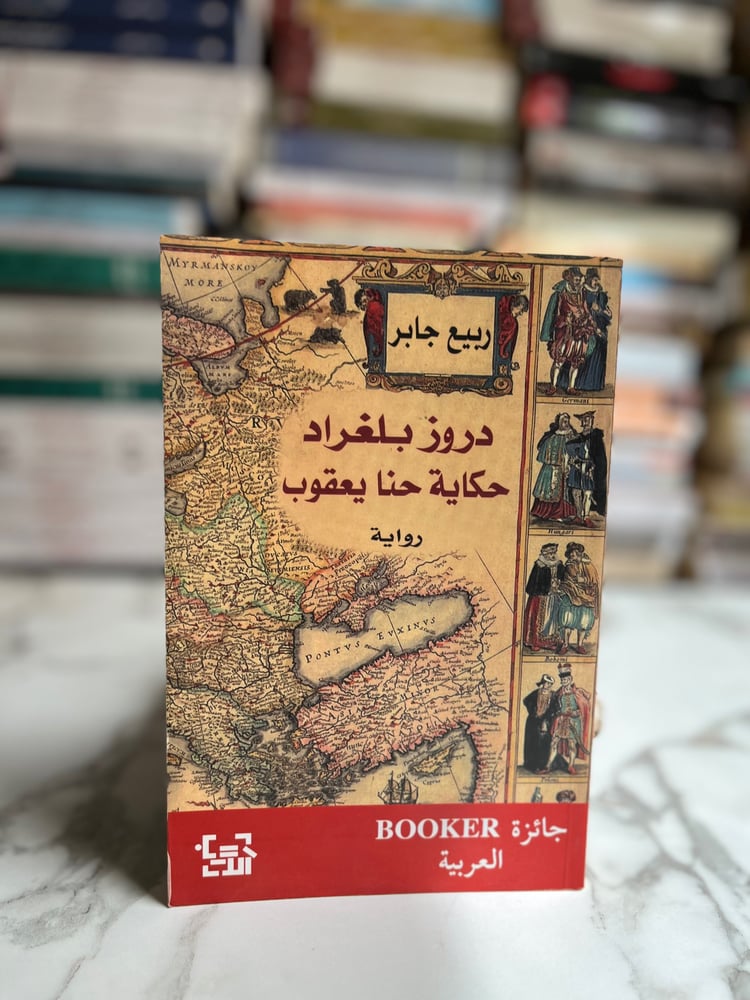

Druze Belgrade
24ر.س
Out of Stock
Product description
In his novel "Druze Belgrade," Rabi' Jaber draws from history material reality, and re-shapes it according to the mechanisms of the novelistic art, to add to our memory events that took place in the distant past whose effects still trouble the Lebanese despite more than a century passing since their occurrence.. It is the story of "Hanna Yaqub," the Christian egg seller, his wife Helena Constantine Yaqub, and their daughter Barbara, and it includes what happened to the small Beirut family of calamities because of the unfortunate fate and the presence of this man - the egg seller - in the wrong place at the wrong time. In this work, the novelist starts from a specific historical incident that occurred in the second half of the nineteenth century, following the events of 1860, which is the incident of the exile of a few hundred Druze from Mount Lebanon to Tripoli and Belgrade as punishment for their participation in the events, and "Jaber" narrates this incident adding the story of Hanna Yaqub, so that the two stories form one story that tells the destiny of the group and the destiny of the individual in their synchronization and harmony to the point of identification, so on one hand there is the group / Druze of Belgrade who must pay the price of war and peace, and on the other hand there is the individual / Hanna Yaqub who is toyed with and mocked by fate. In both cases, there is a tremor interrupted by the group and the individual between Beirut and Belgrade back and forth. One morning, Hanna Yaqub leads his feet to the port door, and perhaps this step is the only one he chooses, where he is surprised in the loading yard by hundreds of Druze about to be exiled, and he is included among them to fill a deficiency, after Ismail Pasha released Suleiman Az Din in exchange for two barrels of gold lira while keeping his four brothers in detention and exile. Thus, under threat, Hanna Yaqub, the Christian, must turn into a lost substitute for Suleiman Az Din the Druze, and start with his four brothers and others the path of torment for twelve years, after which he returns to his wife and only daughter while the fate of the forty and forty Druze of Belgrade was tragic, and perhaps they died under different circumstances, this path that the exiled ones traveled knew hunger, thirst, darkness, cold, and death by killing, suicide, exhaustion, or dehydration, and this is the fate of the weak... Critics considered that the novel "Druze Belgrade" was "the most distinguished, shining, and diligent work, deserving the Booker Arab Prize for Fiction in 2012" for its powerful depiction of the fragility of the human condition through recreating a past historical reading in a highly sensitive language. This was expressed by the "Judging Committee of the 2012 Booker Arab Prize."

From Riyadh