
The future of political Islam
18ر.س
15ر.سProduct description
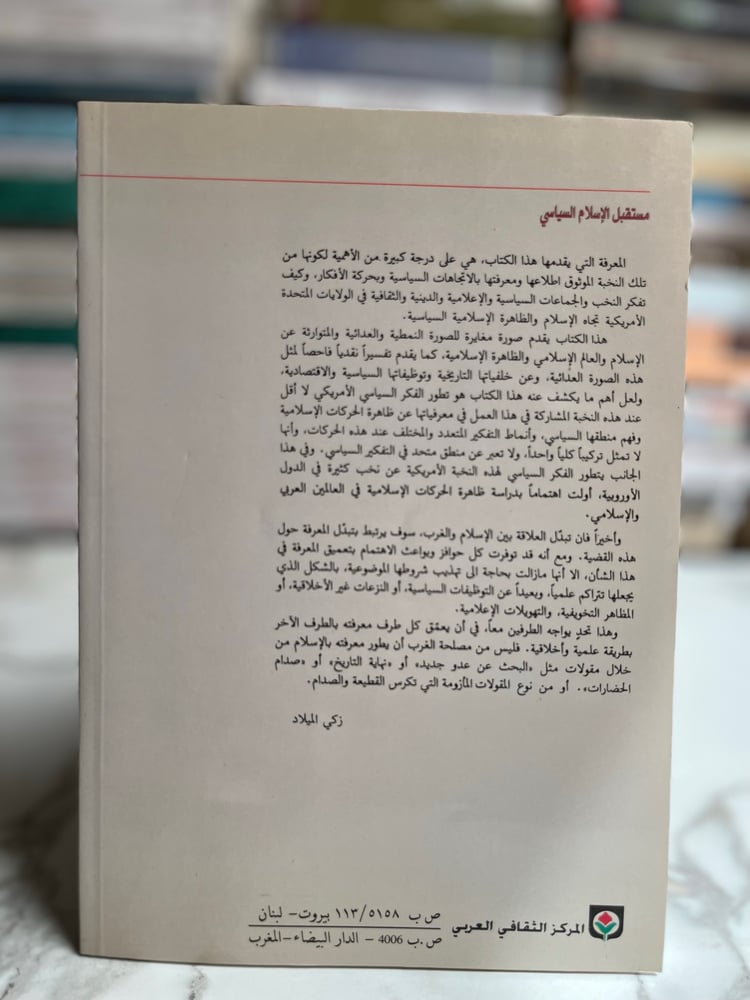
With the advent of the twenty-first century, most Arab, Islamic, and even Western countries still witness the growth and emergence of the Islamic revival phenomenon. Despite all the manifestations of prejudice and distortion of the Islamic phenomenon, which many Western official and unofficial circles have worked to associate with extremism and terrorism, this phenomenon has maintained its momentum and expanded its popular base. It has formed, in its social, political, and economic discourse, an alternative that threatens the stasis of the current situation and offers a perspective for the demands of the desired change in the rhetoric of both elites and masses. Influential Zionist entities within Western media, political, and academic institutions have made several attempts to convince the Western public that Islam is the upcoming threat to Western interests and values, and that Islamic fundamentalism is the alternative enemy to communism..! Amid this frenzy of propaganda to distort the image of Islam and the political orientations of Islamists, these dialogues with influential leaders at the intellectual and political levels came to confirm that the Western arena — especially America — despite the fierce incitement, does not lack an objective perspective that attempts to understand the phenomenon by studying its roots and analyzing its origins. It also understands the atmosphere of grievances from which some manifestations of blind violence emerged. They have reached sufficient convictions to refute the false accusations and prejudice driven by Zionist entities with a clear Israeli agenda and motives. Perhaps these dialogue forums are one of the efforts that aimed to carry the embryo of truth and strongly counter the thesis of the "Islamic threat" and the exaggeration in accusing Islamists of extremism and terrorism, while recognizing their right to practice political and union work and benefit from the gains of the democratic transition that many countries are witnessing. These participations aimed to present the "other perspective" within the Western camp, characterized by independence, objectivity, and relative distance from the stereotypical images that the Zionist agenda has tried to embed in Western consciousness, fostering hostility towards everything Islamic, considering Islam a threat to its existence and a serious challenge to its culture. Perhaps these serious dialogues in the American arena, participated in by a elite of American academics, contribute to restoring justice and achieving some balance in studying this Islamic phenomenon, which the magazine "Al-Wasat" has called "The Storm of the Nineties." All the dialogues included in this book reflect manifestations of understanding and positive awareness of the Islamic discourse, along with an awareness of the magnitude of grievances borne by the Islamic movement. The signs of this awareness are evident through calls for openness, expanding the base of political participation with the Islamic other, and avoiding methods of repression and political tyranny that deprive the Islamic other of its right to peaceful power transfer.

From Riyadh