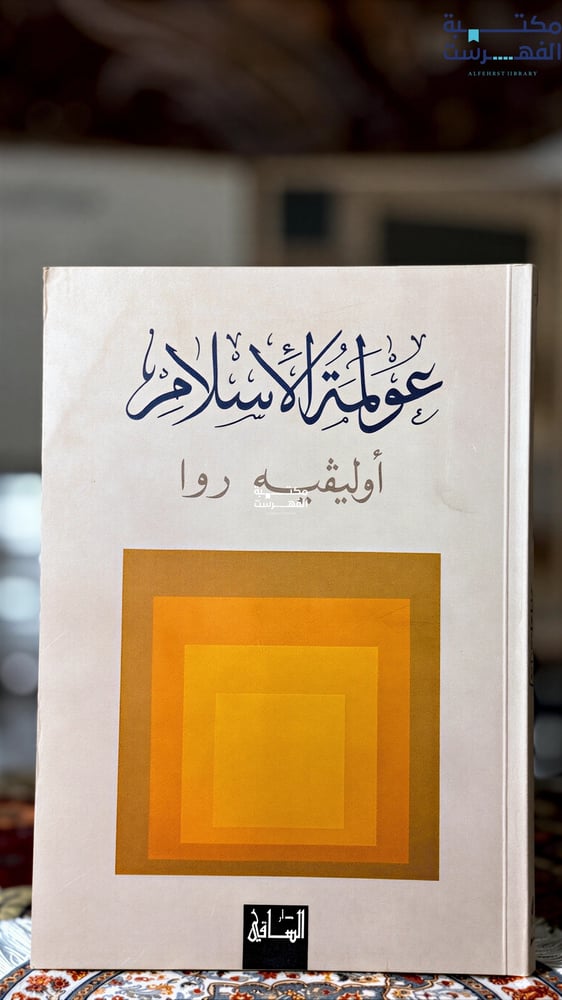


Globalization of Islam
30ر.س
Product description
Olivier Roy says in the introduction of his book "Islam Globalization," which we turn its pages; that his previous book "The Failure of Political Islam" sparked a long controversy in cultural circles with various tendencies, orientations, and affiliations; how can Roy speak about the failure of political Islam after the Osama bin Laden phenomenon, while weapons reach their peak. Roy answers by saying that these two phenomena resulted from the failure of the project to establish an Islamic state (which justifies the topic of his first book), and they are related to what Roy called modern fundamentalism. In his view, Muslim fundamentalists (the Iranian revolution, the Turkish Welfare Party, the Islamic Salvation Front in Algeria, the Islamic group in Pakistan, the Muslim Brotherhood, Hassan al-Turabi in Sudan...) see Islam as a political ideology that allows building an Islamic society starting from the state. Therefore, Roy sees that the idea of the Islamic state for politics is a form of temporal worldly secularism. However, in a parallel line, despite that, Islam still receives wide acceptance, and what the world is witnessing today is a convergence around the issue of the state through the movements of Islam and building Islamic identity starting from the individual up to re-establishing a society that cannot be embodied in a specific geographical elevation except in an imaginary and illusory way. The movement of individualism and abandoning these dual roots is evidence of Islam globalization in varying ways on the political and religious levels: spiritual and human Islam or new fundamentalism and socialism or radical internationalist struggle. Based on the logic of "historical trick," these diverse movements contribute to Islam's globalization and spread, and thus give it a Western trait, knowing that Western societies are experiencing some changes as a result of this interaction, which some mistakenly call cultural diversity. The change in the composition of society parallels, in its importance, the shift of Islam to the West. But the Islam that Roy particularly sees (and the West in general) is one: the religion of Muslim migrants to the West and the religion of the Islamic world, and the West witnesses the same phenomena; however, they are exacerbated and out of control due to the lack of state intervention in religious affairs. Based on Roy's perspective, his book "Islam in the West" does not present the idea of Islam in the West as a religion in itself, which leads to the Islamization of individuals and making them Islamists, but rather that Islam in the West is a guiding line that helps study the uprooting of Islam from its roots in general. Roy says, from this standpoint, whatever the matter, and returning to the controversy about his opinion on the failure of political Islam, the politics of Islam today faces more failure than ever before for reasons summarized as follows: politics separates from religion, but in parallel, political secularism, today, religion returns with full force into society. However, this development undoubtedly requires some explanations that Roy will attempt to present to the reader through this book. To understand the reasons behind this phenomenon sweeping the world, which manifests in the spread of Islam across the globe, and which can be called "Islam globalization."
Publisher's note: Westerners often see Islam as a religion of resilience, identity, and dynamism, and extremist Muslims may share this view, proud of re-Islamizing societies and individuals. However, Olivier Roy fundamentally questions this theory, considering that whether the discussion is about violent or moderate forms, the West, globalization, and individualism are inevitably at the core of the process of re-Islamization. The promotion via the internet, as well as political work, are two Western models of struggle; the new religious elements in the West dominate the field of re-Islamization, even if this is unaware to Islamist activists: opening individuals, sectarian attitudes, fabricating doctrines and behaviors, all against a backdrop of ignorance. Far from being an expression of "clash of civilizations," the tensions related to Islam today are symptoms of its alienation, as well as crises resulting from it, which are difficult for Islam to coexist with.

From Riyadh
Questions you might have