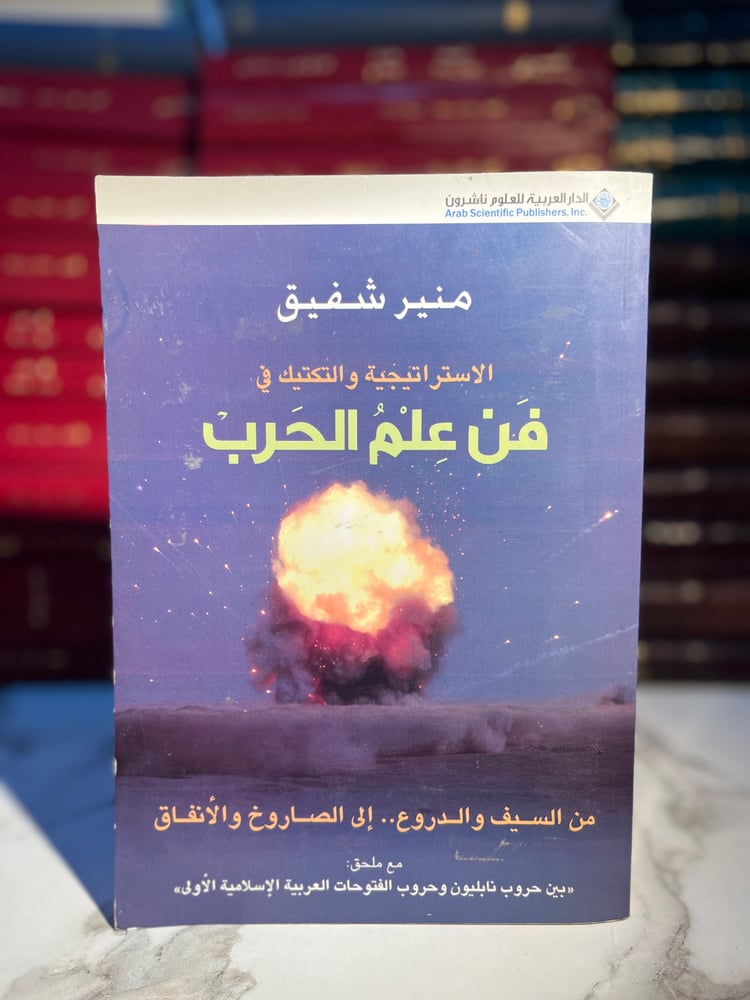

The art of warfare
25ر.س
Out of Stock
Product description
War is a savage clash process in which humans fight each other, physically breaking one another. It is a mass killing process aimed at achieving specific goals. But war is a phenomenon with its causes, and human societies have agreed since the dawn of human civilization until today, and will remain so for a long time to come until the causes that generate wars are eliminated, with no indication of that. Moreover, if war is fought to achieve specific goals, no one fights for fighting itself, so it must be seen within the scope of its goals and within the nature of the forces that wage it. Viewing war within this framework divides wars into two main categories: just wars and unjust wars. The criterion of justice or injustice in war stems from the perspective of the justice or injustice of the goals that wars are fought to achieve. It is based on the nature of the forces waging war, why they wage it, and the historical role played by each of the warring parties. Is it a moral role that advances human development? Or is it an immoral role that hampers human life? Here, we find ourselves facing a type of wars waged by international forces for the purpose of plunder, oppression, and colonization, meaning to subjugate the masses, peoples, and nations to various forms of independence. This type of war is initiated and continues based on an aggressive, exploitative nature directed against the broad masses of humans. Therefore, this type of war is characterized by injustice, and examples can be seen in the wars that took place between emperors, kings, and invaders in the past, or between imperialist countries in modern times, such as World War I along with old and new colonial wars against Asian, African, and Latin American peoples. Conversely, there have been just wars throughout history, and there are still ongoing and will continue in the future, fought against unjust wars, with the aim of achieving goals that serve the broad masses of humans and move toward justice among people, such as national liberation wars against colonial occupation, or civil wars to overthrow oppressive, corrupt, or agentive exploitative classes, and to build a just future among nations free from exploitation and oppression, safe from the brutality and barbarity of wars. This is what gives this type of war the attribute of justice and defense.
Within this framework, this book addresses strategy and tactics in the art of warfare, emphasizing the importance of studying the science of war for strategic political thinking, understanding international politics, and for political analysis and assessment of the situation. Anyone interested in politics and international strategies must have a basic or preliminary knowledge of strategy and tactics in the science of war. The author, in the fifth chapter of this book, compares the early Islamic Arab conquests with Napoleon’s wars, aiming to correct the Western military science's neglect of the developments introduced by Islamic wars in the science of war. On the other hand, this chapter also aims to be a proof that highlights the indications mentioned throughout this book regarding Arab achievements in this field.
Publisher’s note: Studying war and understanding it is a vital matter not only for specialists but also for intellectuals, journalists, politicians, technicians, scientists, activists, and the masses. The phenomenon of transforming military culture into a general culture for the people has become a global phenomenon in all countries because war and its issues today rely more than ever on the collective effort of the entire nation, whether in rear operations or in the field. The leadership of war and its strategy is no longer solely the responsibility of generals; strategy— even in Western capitalist countries— is now formulated on round tables around which political leaders, generals, and specialists gather. In the People's Republic of China, studying war and its rules is an essential part of educational programs in schools and universities and part of the general culture of the entire people. When we talk about military culture or studying the rules of the art of war, we do not mean military drills or exercises involving weapons and shooting or marching in formation—that is a basic skill. Instead, we mean studying the subject at the highest levels of strategy, operations, and tactics. Our Arab countries face a threat that endangers future generations, a threat armed with weapons, resorting to war to achieve its expansionist and colonial goals. It is the threat of the Zionist entity and imperialist armies. We have no choice but to defend our countries, our masses, and our future. War will be an important part of this defense, and we must understand it, know how to adjust it, confront it, and fight it successfully.
Although war is a savage clash process carrying disasters, destruction, and calamities, it is imposed on us and lives among us. We must face this bitter truth and turn its bitterness into human liberation sweetness. Those who understand the rules of the science of war, know how to address its issues, and know how to lead it are the only ones who can lessen its calamities and eliminate its dangers. Continuing ignorance in this field or trying to bury heads in the sand will not keep war away from us, nor will they reduce its brutality and disasters. They will always produce defeats similar to our military defeats in 1948/1949 and 1967.

From Riyadh